
The Tool Desk
Outbyte Driver Updater FREEScan for outdated or missing drivers - takes under a minuteDriver Scan →Outbyte PC Repair FREEClear out junk files and repair common Windows errorsFree Scan →Magnets do not split water or make oxygen. A 2022 study demonstrated a different, narrower idea: using magnetic effects to gather and coalesce gas bubbles at chosen locations in a vessel under microgravity. The approach could inform future space-based electrolysis systems, but it is a proof of concept—not a working oxygen generator.
What the 2022 magnetic-separation study demonstrated
In “Magnetic phase separation in microgravity,” published in npj Microgravity on 8 August 2022, Álvaro Romero-Calvo, Ömer Akay, Hanspeter Schaub and Katharina Brinkert examined whether substances’ inherent magnetic properties could help manage gas bubbles when gravity is very weak. The authors report that those properties were sufficient to collect and coalesce bubbles at distinct locations in an experiment vessel. They describe the result as a proof of concept for developing magnetic phase separators that might enable reliable, lightweight space systems.

The distinction matters: the experiment concerns where bubbles move and gather, not how water molecules are split. The study does not demonstrate an operational oxygen generator, a complete life-support system, or flight-ready equipment. Read the study in npj Microgravity.
Why separating bubbles is a problem in microgravity
Electrolysis uses electrical energy to drive a reaction that produces oxygen and hydrogen from water. Gas bubbles form at electrodes and need to detach and be separated from the liquid electrolyte. On Earth, buoyancy helps bubbles move away from surfaces and rise through liquid. In microgravity, that buoyant assistance is greatly reduced, making bubble detachment and gas-liquid separation more difficult and potentially increasing system complexity.
#1 Best Overall

- Core Functionality: This scientific apparatus experiment kit is designed specifically for water electrolysis demonstration, enabling clear visualization of the electrolysis process to enhance students' understanding of chemical principles and electrochemical reactions
- User-Friendly Design: the electrolysis kit features simple operation suitable for both students and teachers, streamlining laboratory experiments and making it an effective educational tool for chemistry lab equipment and electrolysis teaching aids
- Safe and Reliable Construction: Manufactured with advanced technology and materials, this lab electrolysis apparatus ensures safe usage during experiments, providing a secure learning environment for educators and students alike
- Versatile Laboratory Use: Suitable for electrolysis experiment teaching, scientific research, and demonstration purposes, this electrolysis scientific apparatus meets diverse needs in educational and industrial scientific settings
- Compact and Portable Size: with dimensions of approximately 6.49 by 4.52 by 2.75 inches and weighing about 7.51 ounces, this compact electrolysis kit is easy to handle and store, ideal for classroom and laboratory use
Reviews of electrolysis in reduced-gravity environments identify bubble formation, detachment and separation as important engineering concerns for space systems. The review in npj Microgravity discusses magnetic effects alongside other forces and engineered strategies; it does not establish one universally best method.
What magnets contribute—and what they do not
- They may help manage bubbles: The reported result is collection and coalescence at selected locations in the vessel under microgravity conditions.
- They do not provide the electrolysis energy: The magnetic-separation result is not a demonstration that magnets power the chemical reaction.
- They do not break water into its elements: Electrolysis is the oxygen-producing process; magnetic effects address handling the resulting gas bubbles.
- They are not a complete system: The study does not show an operational oxygen supply or deployed spacecraft hardware.
How this approach fits into space-electrolysis research
Magnetic effects are one candidate for managing bubbles when buoyancy is weak. Other forces and system-design strategies are also being studied. A meaningful comparison would need to assess the mechanism used, system mass and complexity, power and fluid-circuit requirements, ability to detach bubbles from electrode surfaces, and testing in a relevant gravity environment. The available review does not provide a basis for ranking these approaches against one another.
Rank #2
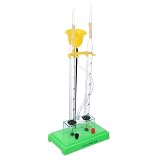
- Core Demonstration: This water electrolysis experiment device is designed to demonstrate water electrolysis and oxygen production in a clear, hands-on way, making it a practical teaching instrument for home school, classroom, and laboratory use
- Clear Observation: the water electrolysis experimental equipment lets users observe the electrolysis process directly, helping students and instructors better understand electrolysis, chemical reactions, and related science concepts during experiment and teach activities
- Reliable Build: Made with sturdy materials, this electrolyzer unit is built for stable use during repeated demonstration sessions, supporting consistent operation for science class, lab instruction, and educational experiment setups
- Versatile Use: This water electrolysis kit works well in home learning spaces, school classrooms, and physics laboratories, giving teachers and learners a flexible apparatus for demonstration, test, and practical study
- Compact size: Measuring 12.20 x 5.90 x 3.54 in, this electrolysis machine includes 1 x electrolysis unit in the package, making it easy to store, handle, and use as a teaching demonstration instrument for chemistry learning
The study’s significance is therefore a possible new tool for phase separation in future low-gravity electrolysis, not proof that the broader engineering challenges have been solved.
Quick Recap
Rank #4

- Economical and compact design allows students to observe the electrolysis of water and even collect small volumes of hydrogen and oxygen gases
- Consists of a stand assembly, electrodes, 2 attached wires with alligator clips, 2 test tubes, trough, electrolyte solution, acid/base indicator solution, and instructions
- Requires a 6- or 9-V battery (not included).
Rank #3
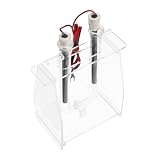
- Safety features: designed with user safety in mind, incorporating features that protect users during the electrolysis process,water electrolysis equipment,student teaching instrument
- Versatile use: suitable for electrolysis experiment teaching, scientific research, and other scenarios, meeting diverse needs and enhancing learning experiences,water electrolysis demonstration,school lab chemical experiment
- Safety assured: incorporates safety features to ensure the protection of users, providing a secure environment for conducting experiments,chemical physical teaching aid,student teaching aid
- Effective learning tool: clearly illustrates the electrolysis process, aiding students in comprehending complex scientific principles and enhancing their educational experience,physical demonstration instrument,water electrolysis lab
- Ease of use: userfriendly design operation, making it suitable for students and teachers, and enhancing the efficiency of educational experiments,educational for lab,chemical teaching instrument
Product prices and availability are accurate as of the date/time indicated and are subject to change. Any price and availability information displayed on Amazon at the time of purchase will apply.

