
The Tool Desk
Outbyte PC Repair FREERepair Windows errors before they cause bigger problemsFix Now →Outbyte Driver Updater FREEScan for outdated or missing drivers - takes under a minuteDriver Scan →Yes—utility-scale solar power has become dramatically cheaper: IRENA’s global weighted-average levelized cost of electricity (LCOE) fell 90% from USD 0.417/kWh in 2010 to USD 0.043/kWh in 2024. But the latest data show a pause, not another steep drop: the global average was USD 44/MWh in 2025, unchanged from 2024. Those figures describe the cost of generating electricity at large solar farms, not rooftop installation prices or household electricity bills.
How much cheaper has utility-scale solar become?
IRENA’s global weighted-average LCOE for newly commissioned utility-scale solar photovoltaic (PV) projects fell from USD 0.417/kWh in 2010 to USD 0.043/kWh in 2024—a 90% reduction. Put another way, the 2024 average was 4.3 cents per kilowatt-hour of generated electricity. The figure is a global average across projects, not a price available to every buyer or a forecast for any specific location. IRENA’s 2024 cost report details the figures.
The project-cost decline was similarly large. The global weighted-average total installed cost for utility-scale solar PV commissioned in 2024 was USD 691/kW, 87% below 2010 and 11% below 2023. This is the cost to build generating capacity, measured per kilowatt of capacity; it is not the same measure as LCOE, which spreads project costs across expected electricity generation.
Why did solar costs fall so far?
Modules became much cheaper
IRENA reports that global crystalline-silicon solar module costs fell 97% between January 2010 and December 2024. Manufacturing scale, technological innovation, and competitive supply chains helped drive the decline in renewable generation costs. More affordable modules made it possible to build solar projects for less, while expanded deployment supported learning and scale across the industry. IRENA identifies technological innovation, competitive supply chains, and economies of scale among the forces behind renewable cost reductions.
Quick wins for a faster PC:
Fix the driver behind crashes, sound loss and screen glitchesFind Drivers →Repair Windows errors before they cause bigger problemsFix Now →Scan for outdated or missing drivers - takes under a minuteDriver Scan →#1 Best Overall

- [Ideally Output of 9.36KWH] The power of 9.36KWh per day under 4 hours full sunshine by the 2340W solar panel system, very suitable for home, shed, cabin, farm or other energy backup, and it will provide enough power for portable ac, air condition, TV, refrigerator, coffee maker, microwave and other AC 240V (split-phase)devices.
- [Inverter Parallel Supportable] 10KW max continuous output.Parallel up to 6 unitsfor 60kw output power,120V/240V AC output to meet the power needs of your home's high-power appliances,and come with wifi module.The off-grid inverter has passed UL 1741 certification, and the product meets high industry standards in terms of safety, performance, and market access.
- [Real-time Battery Monitoring] ECO-WORTHY 48V(51.2V) Server Rack Battery supports CAN/RS485 for seamless communication,you can also easily monitor your battery’s status through the mobile app, which supports both Bluetooth and WiFi connections. .UL1973 | UL9540A | CEC- Completed comprehensive testing by Intertek and has officially earned two key North American safety certifications.And has met the standards set by the California Energy Commission,The outstanding performance of ECO-WORTHY products in design, electrical safety, and thermal runaway management, effectively ensuring the safety of your energy storage projects.
- [N-Type 18BB High-Efficiency Solar Cells]The newly upgraded 195W N-Type solar panel measures 58.86×26.18×1.18 inches and achieves a high conversion efficiency of 25%. Its 18 busbar design enhances conductivity, while double-sided generation delivers up to 100Wh of additional energy daily. With IP68 waterproof rating, tempered glass, and corrosion-resistant materials, it ensures a 30-year lifespan.
- [Segmented Charing/Discharging]3 output modes: mains priority and, battery priority, PV priority; uninterrupted power supply. Available in 4 charging modes: Only Solar, Mains Priority, Solar Priority and Mains & Solar hybrid charging. Set a flexible time period for mains charging/discharging according to the local mains condition, and help you save the mains.
Panels are only part of a solar farm’s cost
Cheaper modules do not make the rest of a project free. In 2024, balance-of-system costs—everything in the installed-cost measure other than modules and inverters—accounted for around 65% of utility-scale PV total installed costs. Site preparation, construction, financing, grid connection, and local market conditions also influence what a project costs and what electricity it can produce.
Output matters as well as construction cost. IRENA’s global average capacity factor for utility-scale solar PV was 17.4% in 2024, up from 15% in 2010. Capacity factor describes actual generation over time relative to a plant’s maximum possible output; it is not a promise that a solar farm can produce at full capacity whenever the grid needs it.
Rank #2

- System Components:Delivers up to 10kW power output with 120V/240V single-phase split-phase support, making it suitable for smoothly running common household appliances. The system includes 5 × 590W solar panels with a total PV capacity of 2950W, capable of generating up to 11.8 kWh per day under optimal conditions, along with one 48V 314Ah portable LiFePO₄ battery offering 16.1 kWh of energy storage. Complete with necessary cables, this all-in-one solar solution is designed for convenient setup and reliable home power support.
- Upgraded Integrated Battery:ECO-WORTHY 48V 314Ah lithium battery combines advanced safety, high capacity, and smart system compatibility. It features a PACE 200A Battery Management System with multi-layer protection and dual breakers for reliable circuit safety. With a 16.076 kWh energy capacity and support for up to 15 units in parallel (up to 241 kWh), it delivers scalable and dependable power. A 7-inch full-color display, along with Bluetooth, Wi-Fi, and PC connectivity, enables convenient real-time monitoring. Designed to work seamlessly with mainstream inverters via RS485 and CAN communication, the battery also includes built-in wheels and handles for easy installation and mobility
- Keep Home Running 10kW:ECO-WORTHY 10kW AIO solar charge inverter features 48V DC pure sine wave output with 120V or 120V/240V split-phase support, delivering 10,000W continuous power and up to 20,000W peak output. Equipped with dual MPPT controllers, up to 200A battery charging, built-in WiFi monitoring, multiple charging and output modes, time-slot energy management, and comprehensive protection functions, it is compatible with AGM, Gel, Flooded, and lithium batteries, supports battery-free operation, and allows parallel connection of up to six units
- High Power Solar Panel:590W Mono-crystalline Solar Panel (Black). Low power loss in cell connection compared to conventional modules. Improved shading tolerance. Lower internal current, lower hot spot temperature. Heat-strengthened glass minimizes micro-crack impact.
- Shipping Notice: Due to its large size and weight, the 5pcs 590W solar panel/1pc 48V 314Ah battery is securely packed and shipped on a pallet using a truck to ensure safe transportation. Please ensure your delivery address can accommodate truck deliveries.
What does LCOE tell you—and what does it leave out?
LCOE, or levelized cost of electricity, is a project-generation cost metric. It estimates the average cost per unit of electricity over a project’s life, making it useful for comparing generation technologies when the comparison uses compatible assumptions. It is not a retail tariff, a household solar quote, or a measure of whether electricity is available at every hour.
- It can show: how the modeled cost of generating electricity from a new project compares with that of other new projects.
- It does not by itself show: a homeowner’s installed price, local bill savings, the value of incentives, or the cost of supplying power when solar output is low.
- Comparisons need context: technology, location, project scale, commissioning year, financing assumptions, and whether storage or other enabling infrastructure is included can all affect the result.
IRENA notes that utility-scale solar PV is increasingly paired with batteries to improve grid reliability and flexibility. A solar-only LCOE figure should therefore not be read as the cost of a fully firm, round-the-clock electricity supply when storage and other system costs are outside the comparison.
Rank #3

- System Components:Delivers up to 10kW power output with 120V/240V single-phase split-phase support, making it suitable for smoothly running common household appliances. The system includes 18 × 590W solar panels with a total PV capacity of 10620W, capable of generating up to 39.36 kWh per day under optimal conditions, along with two 48V 314Ah portable LiFePO₄ battery offering 32.2 kWh of energy storage. Complete with necessary cables, this all-in-one solar solution is designed for convenient setup and reliable home power support.
- Upgraded Integrated Battery:ECO-WORTHY 48V 314Ah lithium battery combines advanced safety, high capacity, and smart system compatibility. It features a PACE 200A Battery Management System with multi-layer protection and dual breakers for reliable circuit safety. With a 16.076 kWh energy capacity and support for up to 15 units in parallel (up to 241 kWh), it delivers scalable and dependable power. A 7-inch full-color display, along with Bluetooth, Wi-Fi, and PC connectivity, enables convenient real-time monitoring. Designed to work seamlessly with mainstream inverters via RS485 and CAN communication, the battery also includes built-in wheels and handles for easy installation and mobility.
- Keep Home Running 10kW:ECO-WORTHY 10kW AIO solar charge inverter features 48V DC pure sine wave output with 120V or 120V/240V split-phase support, delivering 10,000W continuous power and up to 20,000W peak output. Equipped with dual MPPT controllers, up to 200A battery charging, built-in WiFi monitoring, multiple charging and output modes, time-slot energy management, and comprehensive protection functions, it is compatible with AGM, Gel, Flooded, and lithium batteries, supports battery-free operation, and allows parallel connection of up to six units.
- High Power Solar Panel:590W Mono-crystalline Solar Panel (Black). Low power loss in cell connection compared to conventional modules. Improved shading tolerance. Lower internal current, lower hot spot temperature. Heat-strengthened glass minimizes micro-crack impact. [Professional Installation Required]To ensure safety and optimal performance, it is recommended to hire a professional installer. We provide online technical guidance (inquiries are welcome), but installation by non-professional electricians or novices is not recommended, as it may cause safety hazards and a loss of system performance.
- Shipping Notice: Due to its large size and weight, the 18pcs 590W solar panel/2pcs 48V 314Ah battery is securely packed and shipped on a pallet using a truck to ensure safe transportation. Please ensure your delivery address can accommodate truck deliveries.
Is solar the cheapest way to make electricity?
Not on every measure or in every place. In IRENA’s global weighted-average LCOE comparison for new utility-scale projects, onshore wind was cheaper than solar PV in both latest reported years, while solar was cheaper than offshore wind in 2025.
| Technology | Global weighted-average LCOE, 2024 | Global weighted-average LCOE, 2025 |
|---|---|---|
| Solar PV | USD 0.043/kWh (USD 43/MWh) | USD 44/MWh |
| Onshore wind | USD 0.034/kWh (USD 34/MWh) | USD 33/MWh |
| Offshore wind | not stated in IRENA’s 2024 report | USD 78/MWh |
| Hydropower | USD 0.057/kWh (USD 57/MWh) | not stated in IRENA’s 2025 comparison |
The values are global weighted averages for the stated years, not local bids or guaranteed costs. IRENA’s 2024 report and 2025 report provide the respective comparisons. IRENA also reported that 91% of all newly commissioned utility-scale renewable projects in 2024 delivered electricity at a lower cost than the cheapest new fossil-fuel-fired alternative. That finding covers renewable projects collectively, not solar alone. IRENA’s announcement states the comparison.
Rank #4
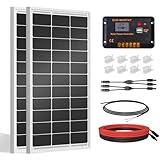
- [Wide Application]: Daily Output 800wh/day under 4 hours full sunshine condition. Perfect for RV, Caravan, Marine, Camper, Electric scooter, Golf Carts, Power wheels, Trolling motor, Tool trailer, Backup power supply for cabin shed home etc.
- [Excellent Performance]: ECO-WORTHY solar panels use high-performance monocrystalline solar cells, which can provide up to 21.5% higher efficiency sufficient light conditions.size:35.2*23.1.37in
- [Durable]: Corrosion-resistant aluminum alloy frame, so that the panel can be used for decades, and can withstand strong wind (2400Pa) and snow load (5400Pa), with a long service life. Ip65 rated junction box provides complete protection.:
- [Complete and Easy]: The back of the pre-drilled and plug-and-play cables allow quick installation, the kit can be connected in series (24V) or parallel (12V) if you need. What you will get: 2 pcs 100W mono solar panel + 2 set of Z mounting brackets + 30A solar controller + 1 pair of 16.4ft 10 awg solar cables + 1 pair of 2-in-1 connectors + 1 pair of 4.92ft tray cable.
- [Support]: 1 year with 24/7 tech support, if any problems or questions about the product,please do not hesitate to let us know through Amazon or call ECO-WORHTY hotline for solution.
Why the newest solar cost figure has stopped falling
The long-term decline does not mean costs must drop sharply every year. IRENA reports that global weighted-average solar PV LCOE was USD 44/MWh in 2025, unchanged from 2024. Its 2025 report describes renewable costs as stabilising after more than a decade of steep declines. In the 2024 data, IRENA associated a small year-on-year rise in solar LCOE with changing financial conditions, illustrating that project economics depend on more than panel prices. IRENA’s 2025 cost report gives the latest global average.
Solar deployment is still expected to grow. The International Energy Agency’s Renewables 2025 analysis forecasts 4,600 GW of global renewable capacity additions between 2025 and 2030—equal to the combined installed power capacity of China, the European Union, and Japan—and identifies low module costs among the drivers of solar PV adoption. That is a forecast for future additions, not a tally of capacity already built.
Best Value

- COMPLETE OFF GRID SOLAR SYSTEM KIT – 2340W of Clean Power ECO-WORTHY 5KW off grid solar system complete kit includes 12pcs 195W mono solar panels (2340W total), 1pc 48V 5KW off-grid inverter, and 1pc 48V 100AH Cubix lithium battery.Equipped with necessary cables and brackets.
- 12PCS 195W MONO N-Type SOLAR PANELS – High Efficiency & Durable Each 195W monocrystalline solar panel delivers reliable output and is built for roof, ground, or shed mounting. The 2340W solar panel roof kit is ideal for off grid cabins, RVs, homes, and backup power systems.
- 5KW 48V OFF-GRID INVERTER – Stable Power for Off-Grid The 48V 5KW off-grid inverter converts DC power from your solar panels and battery into usable AC electricity. Perfect for powering lights, appliances, TVs, fridges, and other essentials during outages or off-grid living.
- 48V 100AH Cubix LiFePO4 LITHIUM BATTERY – Long-Lasting Storage The 51.2V 100AH server rack LiFePO4 lithium battery offers deep-cycle storage, high safety, and a long lifespan. It stores solar energy for night use and works seamlessly with the included 5KW inverter for whole house storage.
- ECO-WORTHY SOLAR PANEL KIT – Easy Setup & Reliable Support This eco worthy solar panel kit is designed for DIY installation with clear wiring and mounting. Whether you search for solar system, solar kits off grid with battery and inverter, or ecoworthy 5k kit, this complete set is a solid off-grid energy solution.
What the global numbers mean for a homeowner
They show why solar is now a highly competitive source of new electricity in many utility-scale comparisons. They cannot tell you what a rooftop system will cost or save at your address. Household economics depend on local installed prices, incentives, retail electricity rates, system output, and how your utility compensates you for electricity sent back to the grid. Without those local inputs, a global LCOE figure is not a reliable estimate of a home system’s payback.
Quick Recap
Product prices and availability are accurate as of the date/time indicated and are subject to change. Any price and availability information displayed on Amazon at the time of purchase will apply.

