
The Tool Desk
Outbyte Driver Updater FREEScan for outdated or missing drivers - takes under a minuteDriver Scan →Outbyte PC Repair FREEClear out junk files and repair common Windows errorsFree Scan →The Seeed SenseCAP T1000 is a compact LoRaWAN tracker that can report GNSS location and send Wi-Fi or Bluetooth scan data for external location resolution. It is not a cellular GPS tracker: getting its data to an application requires LoRaWAN coverage and a network or server path that can receive and use its messages. The best fit is an asset or personal-tracking deployment where that infrastructure, the regional radio plan, and the desired update interval are already understood.
What the SenseCAP T1000 is—and is not
Seeed positions the T1000 as a small tracker for assets and people. It combines GNSS with Wi-Fi and Bluetooth scanning, can store records while offline, and includes an SOS button. Some versions also have temperature, light, and motion sensors. These capabilities make it a potential component in a tracking system, not a self-contained consumer tracker with a cellular subscription and a ready-to-use map in every app. Seeed’s product introduction was last updated 2025-10-11.
The key dependency is LoRaWAN. The tracker needs coverage from a LoRaWAN network to send data to the cloud, plus an application or server integration that receives the messages and presents or processes them. Seeed names Helium and The Things Network (TTN) as examples; it also describes use with a SenseCAP gateway and SenseCraft app. Network availability and the application path are therefore part of the purchase decision, not optional details to sort out after expecting a phone-style tracking experience. Seeed’s setup documentation explains the companion-app and network setup.
How its location modes work
GNSS: coordinates from satellites
GNSS is the most direct way for the T1000 to provide a location: it attempts to obtain a satellite fix and report it. Seeed lists 2.5 m CEP 50% accuracy for the current A/B guide specification. This is a manufacturer specification, not an independently measured result, and real availability and accuracy depend on receiving satellite signals. The guide lists GPS, GLONASS, Galileo, BeiDou, and QZSS support for A/B models. Seeed notes different constellation support for older C/D variants, so confirm the exact model if evaluating an older unit.
#1 Best Overall

- Multi-protocol support: Featuring nRF52840 and LR1110, it supports LoRa (global ISM bands in the 863-928 MHz range). After purchasing the T1000-E, you can freely choose your region in the Meshtastic app. It also supports Bluetooth 5.0, Thread, and Zigbee, ensuring compatibility with a wide range of devices and networks.
- Powerful Positioning Capabilities: Integrated with the Mediatek‘s AG3335 GPS chip, it provides high-precision positioning services.
- Expandable Interfaces: Designed with four pogo pins, it supports USB interface for DFU (Device Firmware Upgrade), serial logging, and API interface, simplifying device management and debugging.
- Open Source Support: Compatible with the Meshtastic open-source mesh networking protocol, suitable for long-range and low-power communication needs.
Wi-Fi and Bluetooth: scan data that needs resolving
Wi-Fi and Bluetooth modes should not be mistaken for coordinates generated and shown automatically by the tracker. In Wi-Fi passive scanning, the device uploads up to four nearby MAC addresses; for Bluetooth positioning, it uploads the three beacon MAC addresses with the best signal. A separate location-resolution service or infrastructure must translate those identifiers into a position. Bluetooth positioning also depends on known beacon locations.
Seeed’s FAQ says the Mate app currently displays GNSS positioning only; it does not automatically turn the Wi-Fi or Bluetooth scan data into map coordinates. The FAQ says Wi-Fi positioning requires a third-party map-parsing service. If indoor positioning is the goal, first verify that the intended service can resolve the scan data and that the relevant Wi-Fi or Bluetooth infrastructure is mapped. Seeed explains this limitation in its T1000 FAQ.
Rank #2

- 【Efficient Fast Charging】Advanced fast charging technology, optimized circuit design ensures stable output of current and voltage.
- 【Strong Magnetic Design】 Built-in pure copper probe with solid magnetic power supply, stronger adsorption watch charging than other chargers.
- 【Short-Circuit Protection】Multiple protection mechanisms, such as short-circuit protection, over-voltage and over-current protection, effectively prevent the battery from overheating and damage.
- 【Stable and Durable】Made of ABS material and flexible PVC. The charger cable has been tested for bending over 5000+ times.
- 【Portable and ECO-FRIENDLY】The charging cable is designed to be lightweight and portable, so it can be put into your travel bag and carried around.Adopting high efficiency conversion circuit and low power standby mode reduces energy consumption, minimizing energy waste and carbon emission.
Which T1000 version should you check?
The product name covers variants with meaningful differences. Seeed describes T1000-A and T1000-B as LoRaWAN versions; A lists temperature, light, and motion sensors that are absent from B. The T1000-E is a separate family described as open-source and offered in LoRaWAN and Meshtastic editions. Do not assume that every T1000 suffix uses the same network or sensor set. Check both the listing and the device label for the exact model and edition. Seeed’s variant overview summarizes the family.
| Model or family | Network/configuration note | Sensor distinction stated by Seeed |
|---|---|---|
| T1000-A | LoRaWAN | Temperature, light, and motion sensors listed |
| T1000-B | LoRaWAN | Temperature, light, and motion sensors absent |
| T1000-E | Separate LoRaWAN and Meshtastic editions | Not stated in the cited variant description |
Specifications to match to a deployment
| Specification | What Seeed lists | Qualification |
|---|---|---|
| LoRaWAN | Version 1.0.4, Class A | Confirm the exact model and regional support |
| Bluetooth | Bluetooth 5.1 configuration | Listed in Seeed’s guide |
| Regional channel plans | IN865, EU868, US915, AU915, AS923, KR920, RU864 | Confirm the model and plan match the deployment region |
| GNSS accuracy | 2.5 m CEP 50% | Manufacturer specification, not an independent field test |
| Offline storage | Up to 1,000 records | Seeed says cached records upload after connectivity returns |
| Battery | 700 mAh rechargeable | Capacity listed by Seeed |
| Dimensions and weight | 85 × 55 × 6.5 mm; 32 g | Manufacturer-listed specifications |
| Ingress protection | IP65 | Manufacturer-listed rating |
| Operating temperature | −20°C to +60°C | Manufacturer-listed range |
| Charging | One-meter USB magnetic charging cable | Power adapter not included |
These specifications are from Seeed’s user guide. The listed dimensions and IP rating may help assess whether the tracker suits a particular object or environment, but they do not establish suitability for every mounting method or exposure pattern.
Free tools Windows power users keep installed
One-click scans. No signup required.
Rank #3

- 【Seamless indoor and outdoor positioning/SOS panic button】T1000 effectively employs BLE and Wi-Fi for pinpoint indoor positioning and utilizes GNSS technologies, including GPS, Beidou, Galileo, and GLONASS for precise outdoor tracking.The panic button switches the tracker to SOS mode, which sends data frequently to your platform and triggers the built-in buzzer to alert people nearby that an emergency has occurred.
- 【High Precision Positioning】T1000 is equipped with essential features, including a temperature sensor, light sensor, motion sensor, panic button, and buzzer.The temperature sensor is ideal for monitoring temperature-sensitive goods like food, and the light sensor detects unpacking activities. The motion sensor is useful in identifying if goods are in transit and monitoring potential physical damages. It can report statuses including shock, the start of the movement, the end of the movement, and motionless timeout. Such data can serve as a reference for insurance claims and logistics optimization.
- 【More application scenarios/Low cost of data transmission】LoRaWAN can provide wider transmission range than BLE connections. The communication costs are significantly lower compared to cellular networks like 4G, LTE Cat-M, and LTE Cat-1. SenseCAP T1000 as a LoRaWAN tracker is a locator that keeps you connected to the people and things most important to you. Whether they're in a building, spread across a campus, dotted around a city, or placed in the wild. Store 1000+ Records data offline when out of connection.
- 【Credit card size/Adaptation to extreme environments】At a mere 6.5mm thick, this small and slim tracker can easily slip into envelope-like spaces. T1000 is with industrial-grade design, equipped with IP65 waterproof protection. It's built to endure harsh environments, with a working temperature ranging from -20℃ to 60℃ (-4 ℉ to 140℉).
- 【Months of battery after a single magnetic charge】With magnetic charge design to enhance water resistance. (PS: Battery life depends on upload interval, work mode, etc., please refer to datasheet)
Battery life depends on the reporting scenario
Seeed’s user guide estimates “4 months on a single charge (uplink every 1 hour, only GNSS data).” That is a manufacturer scenario estimate, not a guaranteed or independently tested runtime. Its FAQ separately presents a modeled EU868 example of 106.78 days at a 60-minute upload interval, based on a typical 25°C environment. The FAQ does not state a publication year for that figure. These estimates are not interchangeable promises: configuration, conditions, and documentation versions may differ.
Seeed says battery life varies with uplink interval, sensor use, LoRa transmission distance, and operating temperature. More frequent reporting and longer GNSS scans can increase power use. Treat the figures as planning references, then size the schedule around how often the deployment genuinely needs a fresh location. Seeed’s user guide and FAQ provide the respective scenarios.
Rank #4
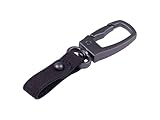
- Hands-Free Convenience: Attaching the tracker to a leather keychain allows you to keep your hands free while still carrying the tracker.
- Compact and portable: Convenient for attaching to keys, bags, and other items.
- Versatile Accessory: Can be attached to wallets, bags, and even clothing. This versatility ensures you can carry it with you wherever you go.
- Fashionable and Functional: Leather keychains balance style with practicality, allowing you to accessorize while keeping your keys organized.
- A Snap Hook for SenseCAP T1000 Tracker, providing both functionality and style, enhancing the usability and convenience of the tracker.
Setup checks before relying on it
- Confirm the radio plan. Identify the LoRaWAN channel plan used at the deployment location, then verify that the exact T1000 model supports it.
- Confirm the message route. Check for LoRaWAN network coverage and decide whether messages will go through an existing network such as Helium or TTN, or a SenseCAP gateway. Identify the server, dashboard, or app that will consume the data.
- Choose a location mode based on the available infrastructure. Use GNSS where satellite reception is plausible. For Wi-Fi or Bluetooth positioning, establish in advance how scan identifiers will be resolved and, for Bluetooth, whether known beacon locations exist.
- Set a practical reporting interval. A shorter interval provides more frequent updates but consumes more power; do not plan around the one-hour GNSS-only estimate if the intended schedule or sensor use differs.
- Verify the model’s sensors and hardware details. Confirm A versus B sensor needs, or the exact E edition. Check that the included magnetic cable suits the charging arrangement; no power adapter is included.
- Test GNSS reception at the intended placement. If a fix is missing, Seeed’s FAQ recommends increasing GNSS scan time, up to a maximum of 120 seconds. A longer scan can use more power, so validate the trade-off at the actual placement.
Seeed recommends configuring the tracker through its companion app. Its getting-started guide covers setup, while the FAQ addresses absent GNSS data and scan-based positioning.
Who should consider the T1000?
- It may fit an asset or personal-tracking project with LoRaWAN coverage, an application path for the messages, and a need for GNSS or resolvable scan-based location.
- It may suit sensor-aware deployments if the selected version includes the temperature, light, and motion sensing required; verify the A/B distinction rather than relying on the family name alone.
- It is a poor fit for an out-of-the-box cellular tracker expectation if you need location to appear directly in a consumer map without LoRaWAN infrastructure or application integration.
- It is not enough by itself for indoor map positioning when no third-party resolver or mapped Bluetooth beacon infrastructure is available.
There are no independently verified head-to-head test results or field measurements here, so a claim that the T1000 outperforms a competing tracker would not be justified. Compare candidates by network type and coverage, location-resolution requirements, regional radio support, reporting schedule, sensors and alerts, physical protection and attachment, charging, and integration with the application you intend to use.
What’s actually slowing this PC down?
Pick the symptom - the matching free tool is one click away.
Quick Recap
Product prices and availability are accurate as of the date/time indicated and are subject to change. Any price and availability information displayed on Amazon at the time of purchase will apply.

