
Free tools Windows power users keep installed
One-click scans. No signup required.
Nick Lewis reports building a Home Assistant-oriented voice assistant that processes AI tasks on a server he controls and responds quickly to some commands. His account is a personal build report, not a controlled speed test against Alexa or an independent audit proving that no data leaves the home network. The useful takeaway is the design: a tiered, mostly local pipeline that routes simple commands around larger language models.
How the assistant is put together
Lewis describes a pipeline that wakes on a spoken trigger, transcribes speech, decides what kind of request it is, and speaks a response. Its parts include openWakeWord for wake-word detection, NVIDIA Parakeet for speech-to-text, direct phrase matching for explicit commands, Llama 3.2 3B to map natural phrasing to predefined commands, Qwen 3.x for broader conversation, and Kokoro for text-to-speech. The stages can be orchestrated through Home Assistant’s Assist pipeline using Wyoming or through a custom script. Source: Nick Lewis’s How-To Geek article, syndicated by Yahoo Tech.
Simple commands take a shorter route
A request such as “Play X” can match a known command directly. A less explicit request—“I’m in the mood to listen to some AC/DC”—can be interpreted by Llama and mapped to “Play AC/DC.” Requests beyond the predefined command set can go to Qwen for conversation. This tiered routing is the design Lewis uses to avoid sending every utterance through a general-purpose model; it explains the intended responsiveness, but is not a measured causal comparison.
What “faster than Alexa” means in this account
Lewis reports that wake-word detection takes a small fraction of a second and that Parakeet transcribes faster than he speaks on his NVIDIA 5060 Ti. In his setup, simple commands run after he finishes speaking, while more complex commands that need the interpreter return in less than a second. He says Qwen is the main source of delay: its first load takes more than 10 seconds, after which responses feel roughly conversational when the model is loaded into VRAM.
#1 Best Overall
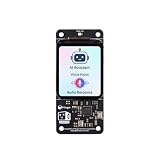
- [All-in-One Audio & Display Expansion] Elevate your Raspberry Pi projects with the Whisplay HAT. It seamlessly integrates a high-performance audio codec, an onboard speaker, dual microphones, and a vibrant 1.69-inch color LCD (240x280 resolution) into a single, compact board. Perfect for building smart speakers, voice assistants, and creative media terminals.
- [Perfect Match for Pi Zero & More] Designed with the exact same form factor (65mm x 30mm) as the Raspberry Pi Zero and Zero 2 W, this expansion board fits flawlessly into handheld and ultra-portable setups. It is also fully compatible with Raspberry Pi 5 via the standard 40-pin GPIO header.
- [High-Fidelity Audio System ] Powered by an integrated high-quality audio codec with dual microphones and onboard speaker for accurate voice capture, and a PH2.0 expansion interface for external speaker connection—ideal for voice recognition, AI chatbots, and high-quality audio playback.
- [Developer Friendly & Programmable] Equipped with programmable physical buttons to trigger scripts or custom functions, RGB LEDs add visual appeal and status cues to your projects. Comes with full Python drivers, open-source documentation, and ready-to-run GitHub examples to kickstart your next AI or IoT project.
- [Zero Soldering, Easy Installation] Simply plug the Whisplay HAT directly onto your Pi's 40-pin GPIO pins and start creating. Note: Please handle by the edges of the PCB to avoid pressing or putting heavy pressure on the fragile glass screen.
These are the author’s estimates and impressions, not results from a controlled test. The account gives no exact end-to-end latency table, test conditions, or matched Alexa comparison. It supports saying that Lewis found some tasks responsive in his configuration; it does not establish that this assistant is generally faster than Alexa.
What “completely private” does—and does not—establish
Lewis says the AI work runs on his server and describes the assistant as fully private. In practical terms, the design aims to keep inference on hardware he controls rather than sending it to a cloud AI service. The account does not include a network audit, packet capture, formal threat model, or verification of every dependency and integration’s data flows. So “private” describes the author’s deployment and confidence, not an independently verified guarantee that no information ever leaves the home network.
Rank #2

- [Crystal-Clear Voice Capture in Noisy Environments]: Powered by the advanced XMOS XVF3800 voice processor, this 360° circular 4-microphone array delivers exceptional far-field audio clarity up to 5 meters. With built-in AEC, adaptive beamforming, dereverberation, DoA, VAD, dynamic noise suppression, and 60dB AGC—ensuring your voice stands out even in loud, echo-filled, or reverberant environments.
- [360° Far-Field Voice Pickup up to 5 Meters]: Equipped with a circular array of 4 high-sensitivity digital MEMS microphones, the device captures sound from every direction with built-in Direction of Arrival (DoA) detection, enabling accurate voice recognition from up to 5 meters away — perfect for smart assistants, meeting rooms, robotics, and full-room smart home voice coverage.
- [Plug & Play USB – No Drivers Required]: Simply connect via USB and it works instantly as a standard plug-and-play USB microphone. Ships with USB audio firmware pre-installed — no additional MCU, no programming, no driver installation needed. Fully compatible with Windows, macOS, Linux, Raspberry Pi, and NVIDIA Jetson — ideal for developers, makers, and AI voice applications right out of the box.
- [Flexible Integration for AI, IoT & Voice Projects]: Supports two mutually exclusive, firmware-selectable modes — USB (default, plug-and-play) and I2S (via DFU reflash, requires external MCU like ESP32 or Arduino). Ideal for smart home, voice AI, conferencing, robotics, and custom embedded voice projects.
- [Enclosed Design for Easier Deployment]: Comes with a protective case featuring a programmable RGB LED ring for cleaner desktop installation and easier handling. Compared with the bare-board version, it's more convenient for prototyping, testing, demos, conference calls, and product evaluation — ready to use out of the box with no assembly required.
Hardware and room audio
Lewis recommends a server with a dedicated GPU, with Raspberry Pi- or ESP32-based microphone and speaker satellites as possible room endpoints. He says a GPU with 8 GB of memory was enough to run Parakeet, Kokoro, and Llama 3.2 3B simultaneously in his build; he says 12 GB or 16 GB could do more, without specifying what additional workload that means. Those figures describe his setup, not universal minimums. The accessible account does not identify an exact GPU model or satellite hardware.
There is also a practical distinction between getting the server pipeline working and building a reliable multi-room installation. Lewis says he had not yet tackled a complicated satellite setup, so the article does not demonstrate a finished, polished deployment across multiple rooms.
Rank #3

- MAX4466 Sound Sensor: Realize sound detection, analysis and recognition, and effectively amplify and preprocess weak sound signals so that subsequent algorithms can extract and analyze sound features
- Supply voltage: 2.4 - 5.5V
- Static supply current: 24μA
- Gain bandwidth: 600kHz
- Widely used in music playback, speech recognition, voice communication and other fields, it can improve the sensitivity and sound quality of the audio system
How much work to expect
Lewis reports that it took him more than two weeks to get the system running reliably, with substantial help from Claude. He warns that it is not plug-and-play and expects several days of debugging and checking that models pass information correctly. His summary is: “The major restriction is the time involved.” Treat that as one builder’s experience, not a guaranteed schedule: your setup effort will depend on your hardware, Home Assistant configuration, chosen components, and tolerance for troubleshooting.
Independent reader supportYour contribution helps us test, update, and keep practical guides available for everyone.Who should consider this kind of build?
- Good fit: someone comfortable configuring Home Assistant and troubleshooting a multi-component system, who values local inference and wants to customize commands.
- Less suitable: someone who wants a ready-to-use smart speaker, has no server or dedicated GPU, or expects verified privacy guarantees and a documented speed advantage without doing their own testing.
Before relying on a local assistant for sensitive use, check the data flows of the integrations and services you enable. Local model inference alone does not establish that every part of a voice-assistant system stays local.
Quick Recap
Best Value
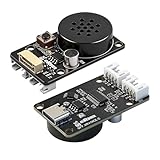
- CI1302 AI Chip with 98-99% Recognition Accuracy——Powered by CI1302 neural processor with echo cancellation and deep learning noise reduction, delivering 98-99% recognition accuracy. On-board coprocessor offloads voice processing from your main controller for faster response
- 5-Meter Long-Range Recognition & 2MB Storage——Supports 5-meter voice recognition for flexible robot and smart home placement. 2MB onboard storage holds firmware and voice data, enabling rich interactions without external memory
- 100+ Customizable Commands & Offline Operation——Supports 100+ preloaded commands with full customization via online tool—edit keywords, generate firmware, and update through web interface. No internet needed after setup. Supports Chinese & English
- IIC & UART Interfaces for Wide Compatibility——Features IIC and UART for seamless integration with Arduino, Raspberry Pi, ESP32, and other popular development boards. Supports ROS1/ROS2. Type-C port enables easy firmware burning and power connection
- Complete Module Kit & What You Get——Includes 1 x XR-Voice AI Module, connection cables, and detailed tutorial. Ideal for voice-controlled robots, smart home devices, and interactive AI systems. Real-time command execution out of the box
Rank #4

- 【Highly customizable voice commands】Supports 110+ preset commands. Users can edit command content online and generate firmware burning through web pages. It supports multi-language commands, which is convenient and efficient to operate and meet the needs of global products.The burning software only supports Windows.
- 【Professional-level voice processing】Built-in CI1302 chip, equipped with neural network processor, integrated echo cancellation and environmental noise reduction technology, the measured recognition accuracy is as high as 99%, effectively suppressing environmental noise and echo interference, ensuring stable operation in complex scenarios.
- 【Fully compatible development support】Provides STM32, ESP32, Ard-uin-o, Raspberry-Pi, Jetson Nano, Jetson Orin and other development board materials, supports ROS1/ROS2 system SDK, and meets the development needs of multiple scenarios such as smart hardware, robots, and homes.
- 【Plug and play interface design】Onboard IIC, serial port, Type-C interface, with a variety of connection cables (PH2.0 to DuPont cable, double-head cable, Type-C cable), adapt to single-chip microcomputer, embedded master control, and quickly realize hardware docking. Slot design, flexible installation.
- 【AI tech accelerates innovation】Yahboom provides development data solutions and technical support services. Through open source software and hardware design and low-power solutions, this product provides developers with full support from prototype to mass production, helping the smart hardware industry move towards a new era of human-computer interaction. Modify the command word page account: 15338857526, password: Yahboom123.
Product prices and availability are accurate as of the date/time indicated and are subject to change. Any price and availability information displayed on Amazon at the time of purchase will apply.

