
Do these 3 things before closing this tab:
1Clear out junk files and repair common Windows errors2Fix the driver behind crashes, sound loss and screen glitches3Repair Windows errors before they cause bigger problemsCombining camera and radar data can improve performance on specific perception tasks: cameras contribute visual detail and clues about what an object is, while radar contributes range and velocity information. But a benchmark improvement is not proof of fewer crashes or greater reliability across an entire vehicle fleet. Results depend on how sensors are aligned, what data is fused, and which conditions were tested.
Why combine a camera and radar?
The sensors measure different aspects of the scene. A camera captures appearance, color, shape and other visual cues that help characterize objects. Radar measures distance and motion-related information, including velocity. Used together, these signals may help a perception system reason about both what an object looks like and where it is or how it is moving.
That complementarity is a design opportunity, not a guarantee. A camera’s visual information and a radar’s measurements can each be incomplete or difficult to interpret, and fusion depends on correctly associating measurements that refer to the same object. Yao et al., in their 2023 review, describe camera–radar systems as potentially useful across lighting and weather conditions; that characterization should not be read as a quantified guarantee for every condition or installation.
What does “fusion” mean in practice?
Fusion describes where and how information from the sensors is combined. The main approaches differ in what information is retained and what demands they place on alignment and computation. Yao et al.’s 2023 review does not identify one approach as best for every task.
#1 Best Overall
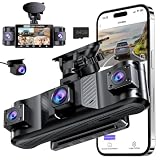
- 4-Channel 360° Full Coverage: 4 Channel Dash Cam records front, rear, left and right simultaneously with four lenses, providing 360° all-around protection. Front camera captures 2.5K QHD video while the other three record in 720P HD, ensuring every angle around your car is monitored. Ideal for Uber, Lyft, taxi, truck and fleet drivers who need complete evidence in case of accidents or disputes. Split-screen display lets you view all 4 channels at once or or switch to any camera with one click.
- 2.5K QHD + F1.8 Aperture + WDR: Front camera records in 2.5K QHD (2560x1440P) with a large F1.8 aperture lens capturing 50% more light than standard F2.4, delivering sharper details than 1080P and clear license plates even at high speed or low light. Rear, left and right cameras use F2.4 aperture for balanced coverage. WDR balances exposure in tunnel entrances, sunrise glare or oncoming headlights. F1.8 aperture plus WDR ensures clear footage day and night.
- 8 IR LEDs Night Vision: 8 infrared IR LEDs provide true night vision for the interior camera, recording clear footage inside the cabin even in complete darkness. The IR LEDs automatically activate when the car interior is too dark, switching between color and infrared modes. Combined with the F1.8 large aperture front lens, this dashcam delivers clear footage day and night, making it the ideal choice for 24-hour ride-share and commercial drivers needing reliable evidence around the clock.
- 5GHz WiFi + Viidure APP: Built-in 5GHz WiFi offers faster transfer speeds than standard 2.4GHz WiFi. Download the free Viidure APP on iOS or Android to view live footage from all 4 cameras, playback recordings, download videos to your phone, and share clips to social media instantly without removing the SD card. The APP also lets you adjust settings, switch camera views, format the card and update firmware. WiFi password is customizable. No subscription fees, all transfer happens locally.
- Parking Mode + G-Sensor: 24-hour parking monitor protects your car while parked. When the G-sensor detects a collision or sudden movement, the car dash cam automatically locks and saves the current recording to prevent it from being overwritten. G-sensor sensitivity is adjustable to Low, Medium or High. Parking mode requires the ACC hardwire kit(!!!ASIN: B0GS5W9XJX - Sold separately, not included). Loop recording in 1, 2 or 3-min intervals automatically overwrites oldest unlocked files.
| Fusion stage | What is combined | Key consideration |
|---|---|---|
| Data-level | Input data or representations from the sensors | Can preserve detailed input information, but depends heavily on compatible, well-aligned data. |
| Feature-level | Intermediate representations learned from each sensor | Combines model-generated features; the design must still account for sensor alignment and model complexity. |
| Object- or decision-level | Detections or decisions produced later in each sensor pipeline | Combines later outputs, allowing sensor processing to remain more separate, but the result depends on the quality and correspondence of those outputs. |
| Mixed-level | Information at more than one stage | May combine advantages of different stages, with corresponding integration and complexity trade-offs. |
A meaningful comparison therefore starts with the task and output—such as 3D detection, segmentation or tracking—not simply the method’s fusion label. It should also specify the radar representation, alignment requirements, compute and latency, and how the system handles missing or corrupted sensor inputs.
What has to be aligned before fusion can work?
A model can only make useful cross-sensor associations when the measurements can be related in space and time. Camera–radar systems therefore depend on sensor placement and calibration, coordinate transformations, time synchronization, and enough overlap between their fields of view. Annotation coverage matters too: a dataset cannot evaluate objects outside the area its labels cover.
Rank #2

- UPSCALED 4K FRONT + 1080P REAR DUAL DASH CAM: The ROVE R2-4K DUAL records the road ahead and behind at the same time. The front camera captures at 2.5K (QHD) and intelligently upscales to 4K (2160P) for higher-detail playback, while the rear camera records at Full HD 1080P. This is upscaled 4K, not native 4K, engineered to show sharper everyday detail than standard 1080P dash cams, so you can read license plates, signs, and surroundings in front and rear footage.
- SONY STARVIS 2 IMX675 SENSOR + SUPER NIGHT VISION: The front camera uses a Sony STARVIS 2 IMX675 5MP image sensor with a wide F1.5 aperture (F1.8 rear) and HDR to pull in more light for clearer low-light footage. This advanced sensor enhances nighttime clarity, helping capture license plates, road signs, and surrounding vehicles with greater reliability when driving after dark, through tunnels, or in dusk and dawn conditions.
- ULTRA FAST 5.8GHz WIFI/ UP TO 20MB/s DOWNLOAD SPEED: With its built-in dual-band 5.8GHz and 2.4GHz WiFi, you can use the ROVE dash cam app to view and manage dash cam recordings instantly on your iPhone and Android smartphone. Using the ROVE app, download your recorded videos directly to your smartphone at up to 20 MB/sec, then easily share them on social media with friends and family. Additionally, manage camera settings and update the latest firmware over-the-air via the ROVE App.
- CAR CAMERA WITH GPS: The new front and rear dashcam comes with built-in GPS, which enables you to view real-time live speed and compass on the 3” IPS wide camera screen. It records precise driving routes, locations, and speed stamps directly on the video so you can watch dashcam videos with GPS data using ROVE's free GPS Player on your PC or Mac & get additional evidence when you need it.
- FEATURES WITH STATE-OF-THE-ART TECHNOLOGY INCLUDED: Experience peace of mind with this front and rear car dash cam. It comes with a free 128GB microSD card and offers advanced features such as an f1.5 aperture, motion detection, G-sensor, seamless loop recording, emergency video lock, screen saver, live speed and compass direction, voice guidance, ring of threads for optional CPL filter, a built-in supercapacitor for extended product life, support for up to 1TB microSD cards, and many more.
Radar inputs also vary. Some systems use sparse detections or points; others use richer radar representations, such as radio-frequency tensors. The representation determines what information is available to the model and complicates comparisons between methods. These alignment and representation issues are emphasized in Yao et al.’s 2023 review and in Wang et al.’s 2023 CRUW3D paper.
What do published results show—and what do they not show?
Benchmark gains are task- and dataset-specific
A 2025 paper on MSSF, a 4D radar and camera fusion framework for 3D object detection, reports improvements in 3D mean average precision over state-of-the-art methods: 7.0% on View-of-Delft (VoD) and 4.0% on TJ4DRadSet. These are the paper’s comparisons on those benchmarks, not a general reliability percentage, a crash-reduction estimate or a result that can be assumed for other hardware and road conditions.
Recommended Free Tools
Rank #3

- 【360° All-Around Protection with 4-Channel 4K Dash Cam】 This 4-channel dash cam features a 3"" IPS display that simultaneously records front, rear, left, and right views in crystal-clear detail. With a 4K front lens and three adjustable 1080P cameras, it eliminates every blind spot around your vehicle—giving you full visibility and total confidence on every drive.
- 【Loop Recording & G-Sensor – Your Reliable Witness】 Comes with a 64GB memory card pre-installed and ready to use. Loop recording ensures uninterrupted footage, while the built-in G-sensor automatically detects sudden impacts or collisions and locks critical clips to prevent overwriting. In case of an incident, the evidence is securely saved and protected.
- 【5GHz WiFi + GPS & App Control – Instant Access Anywhere】 Built-in dual-band 5GHz WiFi and GPS let you view and manage recordings in real time via the Viidure App on iOS or Android. Track your vehicle’s route visually, pinpoint incident locations with accuracy, and download videos or photos to your phone at high speed—then share them instantly with friends, family, or your insurance provider.
- 【Superior Night Vision with WDR & F1.6 Aperture】 Equipped with 8 infrared LED lights and Wide Dynamic Range (WDR) technology, this D65 dash cam prevents glare from headlights and balances extreme lighting conditions. The F1.6 large aperture automatically adjusts exposure in low light or overexposed scenes, so you get clear, well-balanced footage—day or night.
- 【24/7 Parking Surveillance – Always on Guard】 Once your vehicle is parked and turned off, the dash cam seamlessly switches to Parking Mode for round‑the‑clock protection. The front motion sensor detects objects approaching within 3–4 meters and triggers a 1‑minute recording in just 5 seconds. (Note: Parking mode requires the separate purchase of a hardwire kit.)
Different environments test different questions
The 2024 WaterScenes paper reports improved accuracy and robustness from 4D radar–camera fusion for autonomous driving on water surfaces, especially in adverse lighting and weather. That is evidence about the paper’s maritime setting, not proof of equivalent performance on roads; the available summary does not give a numerical performance figure.
TIAND, presented at the 2024 IEEE Intelligent Vehicles Symposium, describes data collected in and around Hyderabad, India, across structured and unstructured environments. Its coverage is useful when considering whether evaluations span different geographies and road conditions. Dataset coverage alone does not show that a particular model generalizes successfully; that requires measured results.
Rank #4

- ❗❗❗NOTE: This product must be powered by the original cigarette lighter charger; it cannot be powered by a USB cable or a Type-C cable. IIWEY N5 dash cam equipped with a 3" IPS screen, FHD 1080P+1080P+1080P+1080P, which can record 360° all-round including front, rear, sides, and interior. It also features a 2.5K+1080P+1080P+1080P mode for diverse needs. In addition, N5 is equipped with 170° super wide-angle front and rear cameras and 150° wide-angle side cameras, providing a wide field of view.
- ❗❗❗NOTE: N5 dash cam DON'T HAVE GPS function. The 128GB SD card has been installed in the card slot. It connects to your cellphone via built-in WiFi, no Bluetooth. The rear camera must be wired and connected to the front camera for use. It uses a super-capacitor instead of a battery, so please keep the dash cam connected to a power source while in use, we recommend to use the included car charger, or you can use our HARDWIRE KIT (ASIN B0DHJNRPB9, sold separately).
- 【Loop Recording & Free 128GB SD Card】N5 Dashcam comes with a 128GB Micro-SD card. (supports up to 256GB) Loop recording will start immediately once you turn on the engine. No seconds will be missing. The video will be saved in segments, and the storage space will be automatically detected. When memory is full, the earliest recorded video will be automatically deleted to achieve seamless loop recording.
- 【5GHz WiFi & Free App Control】❗❗❗NOTE: There are currently two free apps available: iiwey and viidure. You can find both apps on the Google Play Store and the Apple Store. The N5 dashcam boasts built-in 5GHz WiFi for 4x faster connectivity than 2.4GHz (with 2.4GHz support). It pairs with a free app for Android or iOS, enabling seamless control, video preview, download, and sharing.
- 【WiFi Using Note】Please note that each time you want to connect the APP to the dash cam, you need to long press the " ◀ " button to turn on WiFi before you can connect. ❗❗❗If the WiFi is not connected to the APP for more than 5 minutes, the dash cam will automatically turn off the WiFi function. This measure is to prevent the dash cam from overheating.
CRUW3D provides scale, but not universal coverage
Wang et al.’s 2023 CRUW3D paper reports a dataset of synchronized camera, radar and LiDAR frames. The dataset statistics below describe that research resource, not a representative sample of every road or production fleet.
| CRUW3D statistic | Reported value |
|---|---|
| Total frames | 66,000 |
| Sequences | 74 |
| Driving duration | 40 minutes |
| 3D bounding boxes | 80,000 |
| Labeled object tracks | 576 |
| Training and test frames | 56,000 training; 10,000 test |
| Training and test 3D boxes | 57,000 training; 23,000 test |
| Captured scenarios with adverse lighting | Approximately 30% |
The CRUW3D authors say annotations cover only the area where the sensors overlap, and identify dataset scale as a limitation relative to larger autonomous-driving datasets. The paper describes the data as intended for public availability; that does not establish its current access terms or license.
Best Value

- 4-Channel Dash Cam for Complete Vehicle Coverage: This dash cam is equipped with four Full HD 1080P cameras, capturing footage of the front, rear, left, and right sides of your vehicle simultaneously. The adjustable front cameras enhance visibility and offer flexible recording angles, including interior footage.
- Time-Lapse Recording & Parking Mode: With time-lapse recording, 60 minutes of footage is compressed into 1 minute, saving memory card space. Activate parking mode with the optional ACC hardwire kit (sold separately) for security when your vehicle is parked.
- Enhanced Night Vision & WDR Technology: The dash cam features advanced night vision and Wide Dynamic Range (WDR) technology for clear, balanced footage, even in low-light conditions. Eight infrared lights ensure optimal visibility, and WDR adjusts exposure to capture detailed images in varying lighting.
- Optional GPS for Real-Time Vehicle Tracking: Purchase the GPS logger (sold separately) to add location, speed, and time tracking, providing a visual representation of your vehicle's route. This feature is perfect for documenting travel details in case of incidents.
- 5GHz Wi-Fi & App Integration: Share videos easily via Wi-Fi using the mobile app for both iOS and Android devices. This feature allows for quick video downloads and sharing on your preferred platforms.
Does radar–camera fusion make autonomous vehicles safer in every condition?
No universal safety conclusion follows from the evidence described here. The reported results are dataset-scale counts and task-specific benchmark findings. They do not establish a reduction in real-world crashes, a fleet-wide reliability rate, or better performance in every combination of weather, lighting, road type, sensor installation and object range.
Reliability claims should be matched to the evidence. A benchmark score addresses performance on a defined dataset and metric. Real-time results address whether a system can meet timing demands under specified conditions. Evidence of field reliability or crash reduction would require separate real-world evaluation; the cited studies do not provide a general deployed-fleet safety outcome.
How should you evaluate a fusion claim?
Check the specific evidence behind the claim rather than treating “fusion” or “robust” as a result in itself. Useful questions include:
- What task and output were measured? Distinguish, for example, 3D detection from tracking or segmentation.
- Which sensors and radar representation were used? Hardware and input formats affect what information the system can use.
- How were sensors aligned? Look for information about calibration, timing, coordinate transforms, field-of-view overlap and annotation coverage.
- What conditions does the evaluation cover? Consider lighting, weather, road type, object range and geography represented in the data.
- Were failures tested directly? Look for explicit tests involving corrupted inputs, sensor loss or temporal instability rather than inferring resilience from a paper’s terminology.
- What kind of result is reported? A benchmark metric, a real-time demonstration and a field safety outcome answer different questions.
Can developers prototype radar perception with an evaluation kit?
Texas Instruments documents the AWR6843AOPEVM as a 60 GHz automotive millimeter-wave radar evaluation platform. Its documentation describes point-cloud access over USB and raw ADC access through a connector, with development resources listed on TI’s MMWAVE-SDK page. It is relevant to radar prototyping, not a complete camera–radar fusion stack, production vehicle radar or consumer safety upgrade.
The Tool Desk
Outbyte PC Repair FREERepair Windows errors before they cause bigger problemsFix Now →Outbyte Driver Updater FREEFix the driver behind crashes, sound loss and screen glitchesFind Drivers →For more specialized automotive radar development, NXP documents an S32R41/TEF82xx platform and describes the TEF82xx as a 77 GHz automotive radar transceiver. That is a development resource, not a plug-in solution for improving a consumer vehicle’s safety. Current availability should be checked with the manufacturers.
Quick Recap
Product prices and availability are accurate as of the date/time indicated and are subject to change. Any price and availability information displayed on Amazon at the time of purchase will apply.

