
You can add CompactFlash (CF) or IDE/PATA storage to an Arduino Mega using the approach documented by Hackster.io project author Doctor Volt. It supports either raw sector reads and writes or, with extra SdFat V2 setup, file access on a FAT volume. The project is specific to the Mega: it does not establish that the wiring or method works with an Uno or other Arduino boards.
Choose the storage and access method
The project describes two storage paths: a CF card connected through a CompactFlash-to-IDE adapter, or an IDE/PATA drive connected through a matching interface. It lists an Arduino Mega and a CompactFlash-to-IDE adapter among its hardware. Before buying or wiring anything, identify the connector on your storage device and match it to the adapter and the project’s 44-pin IDE wiring diagram. The project page does not establish compatibility by card or drive model, capacity, speed, power use, or reliability.
It also describes two ways to use the storage. Raw sector I/O reads or writes sectors directly; FAT access works with files and requires additional library configuration. These are different software paths, not interchangeable descriptions of the same operation.
| Approach | What it provides | Documented requirements or limits |
|---|---|---|
| Raw sector I/O | Read or write individual sectors, as shown in the project’s raw_io.ino example. |
The project targets an Arduino Mega and provides a 44-pin IDE wiring diagram. It does not establish compatibility for every storage model. |
| FAT file I/O | Read and write files on a FAT-formatted volume using SdFat. | Requires SdFat V2 configuration described below. The project says the library handles only volumes with an MBR. |
Install and configure SdFat for FAT file access
Skip this setup if you intend to use only the raw-sector example. The project author says most SdFat functions should work with the configuration below; that is the author’s compatibility claim, not an independently verified guarantee.
Quick wins for a faster PC:
Fix the driver behind crashes, sound loss and screen glitchesFind Drivers →Repair Windows errors before they cause bigger problemsFix Now →Scan for outdated or missing drivers - takes under a minuteDriver Scan →#1 Best Overall

- Connect a CF card to a computer through an IDE connector
- Compatible with compact flash memory cards and desktop computers with an IDE slot
- Compact flash IDE adapter / CF to IDE adapter / CF to IDE converter / IDE to CF card reader
- Compact flash adapter
- Quick and driver free installation into any IDE 40 pin and 44 pin slot
-
Install Bill Greiman’s SdFat library V2. Arduino’s official guide covers installation through Library Manager, adding a ZIP library, or manually placing the extracted library in the sketchbook’s
librariesfolder and restarting the IDE: Add libraries to Arduino IDE. -
In
SdFatConfig.h, setSPI_DRIVER_SELECTto3, as directed by the project.Rank #2
 Ximimark 2Pcs Compact Flash CF Card to 3.5 Female 40 Pin IDE Hard Drive Bootable Adapter Converter Module
- The CF-IDE adapter converts the CF card into a 2.5" or 3.5" IDE bus and converts the CF card into an IDE hard drive. It has the characteristics of low power consumption, no noise, and is not easy to damage.
- Standard IDE interface, true IDE mode, support for DMA and Ultra DMA mode (CF card must have some functions), the maximum transfer rate can reach 40MB/sec.
- Can be used for Linux-based set-top boxes, routers, firewalls, diskless network clients, industrial PCs, etc.
- Complies with CF Type I, Type II, and Micro-drive 40-way (2.54mm) standards.
- System requirements: PC or Mac with an IDE connector; MS Windows, Mac OS, Linux operating system.
-
In
CFCard.h, uncommentUSE_FAT.
For the raw-sector route, consult the project’s raw_io.ino example and wiring diagram rather than applying the FAT-specific setup. The project page is the source for those implementation details: Extend an Arduino with a CF Card or IDE Drive.
Check the partition layout before using FAT access
The project says SdFat can handle only volumes with a master boot record (MBR). It warns that CF cards formatted with Windows may lack an MBR usable by the library and suggests Rufus as a formatting workaround. Treat that as the project’s stated guidance, not a guarantee that a particular format will work with every card or drive.
What’s actually slowing this PC down?
Pick the symptom - the matching free tool is one click away.
Rank #3
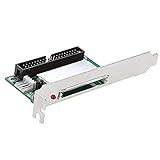
- Computer peripheral equipment manufacturers use CF-IDE cards in conjunction with CF cards to test motherboards, sound cards, graphics cards and other products. In these occasions, the power supply needs to be turned on/off frequently. Traditional mechanical hard drives are easily damaged. CF is a kind of electronic hard disk, which is completely different from mechanical hard disk in principle, and it is not easy to be damaged in these occasions
- Portable instruments that use embedded X86 or RISC cores usually have IDE interfaces. If the CF card cannot be directly connected to these instruments, you can use this adapter to complete the transfer
- Personal computers (PCs): These computers are usually x86 kernels, which are the main platforms used by the card. Some digital cameras have a CF card interface. You can access your picture data on a desktop computer through this card
- Industrial PCs use this card and CF card together to store embedded operating systems such as embedded LINUX or WIN CE
- Support CF-I and CF-II two types of cards: also support IBM micro hard disk with CF-II interface. 5.0V or 3.3V power supply: select the appropriate power supply voltage according to your CF card
- Check the drive’s partition layout and confirm it has an MBR before troubleshooting file access.
- Back up anything you need before reformatting; formatting can erase data.
- If you use the suggested Rufus workaround, inspect the resulting partition layout rather than assuming the formatting step produced a compatible volume.
Use the wiring diagram and verify electrical compatibility
The project page includes a diagram for a 44-pin IDE connector and identifies a PATA adapter as an option for CF cards. Follow the diagram for the documented Mega build; do not infer pin mappings from the connector name or transfer the wiring to another Arduino board without a suitable schematic.
The project page states that the drive works at 5V TTL and can connect directly to Arduino I/O pins. That statement is not enough to establish electrical safety or compatibility for every drive, adapter, or board. Check reliable documentation for the exact hardware’s voltage and pin behavior before connecting it. The available project information does not establish a universally safe direct-wiring arrangement.
Quick Recap
Best Value

- With this adapter, you would replace HDD with CF card as SSD. Excellent for Laptop with IDE slot and mini-ITX
- Type I, II & Microdrive Compact Flash supported Jumper Selectable for Master/Slave
- Support all FIXED DISC MODE CF card in the market Operate in TRUE IDE MODE and support UDMA mode, Bootable on any Operating System, e.g. Linux, DOS and Windows
- ATTENTION!!!UDMA requires Support from your Notebook Bios and also the CF card
- Special male IDE connector, check carefully the side of the IDE connector before purchase.
Rank #4

- CF to IDE adapter is a portable solid-state electronic drive with IDE interface, which enables seamless conversion between CF card and IDE hard disk. The adapter comes with a PCI bracket, suitable for integrating CF card into systems with IDE interface for data transfer and storage
- Standard IDE interface: true IDE mode, and supports DMA-66 transfer mode, unleashing the potential of CF cards and enjoying fast transfer. 【 Note 】 DMA support requires compatible Notebook Bios and CF cards
- Compact Flash CF to IDE adapter card features a jumper selectable master-slave setting, allowing the CF card to be used as a module mounted disk (DOM) and automatically powered from the IDE's 20 pin or external floppy drive power connector, choosing between a 5.0V or 3.3V power supply
- CF to IDE expansion cards support CF Type I Type II and Micro drive compact flash cards, used for PC computers (x86 kernels) and digital cameras with CF card interfaces to access image data
- Widely used in laptops, PDA, Portable instruments and industrial equipment, compatible with Windows, OS X, and Linux systems, adapters provide an alternative solution for data storage or testing. It is very suitable for routers, firewalls, and diskless network clients
What to verify before choosing a card or drive
- Board: The described build targets an Arduino Mega. No equivalent wiring or verified method is established here for Uno-class boards.
- Connector and adapter: Match a CF card to a CompactFlash-to-IDE or PATA adapter, or match an IDE/PATA drive to its interface and the project’s connector diagram.
- Software path: Decide whether the application needs raw sectors or files on a FAT volume; only the FAT path needs the specified SdFat V2 configuration.
- Volume layout: For SdFat file access, check for the MBR requirement described by the project.
- Specific-device evidence: The project does not report model-by-model or capacity-by-capacity compatibility results. Confirm documentation for the particular card, drive, adapter, and board rather than assuming they will work together.
Product prices and availability are accurate as of the date/time indicated and are subject to change. Any price and availability information displayed on Amazon at the time of purchase will apply.

