
Quick wins for a faster PC:
Scan for outdated or missing drivers - takes under a minuteDriver Scan →Clear out junk files and repair common Windows errorsFree Scan →Fix the driver behind crashes, sound loss and screen glitchesFind Drivers →Qualcomm announced an agreement to acquire Arduino on October 7, 2025, and introduced the Arduino UNO Q, a single-board computer that pairs a Debian Linux application processor with a separate Arduino microcontroller. The combination is the board’s defining feature: Linux can run higher-level applications, while the MCU handles timing-sensitive hardware control. Qualcomm later called Arduino “a Qualcomm company” in a March 9, 2026 release, so the announcement and later status should not be conflated.
What the Arduino UNO Q is—and what Qualcomm’s announcement means
The UNO Q is not simply a faster version of a traditional Arduino UNO. It combines two processors with different jobs: a Qualcomm Dragonwing QRB2210 application processor (MPU) running Debian Linux, and an STMicroelectronics STM32U585 microcontroller (MCU) running Arduino sketches on Zephyr OS. That lets a project use Linux software alongside a dedicated controller for real-time inputs and outputs. Arduino’s UNO Q product page and its hardware documentation describe the board and its components.

On October 7, 2025, Qualcomm said it had agreed to acquire Arduino; that wording describes an agreement, not a completed acquisition on that date. A Qualcomm release dated March 9, 2026 later referred to Arduino as “a Qualcomm company.” Qualcomm’s October 2025 announcement said the Arduino brand, tools, mission, and support for microcontrollers and microprocessors from multiple providers would continue. Arduino’s FAQ describes its platform as open-source and community-focused. Qualcomm’s October 2025 announcement and its March 2026 release provide the respective statements.
Qualcomm reported 33M+ active users in the Arduino community in its 2025 announcement. That is Qualcomm’s published figure, not an independently audited count or a current user tally.
Recommended Free Tools
#1 Best Overall
![Arduino® UNO™ Q 4GB [ABX00173]- Hybrid Board, Qualcomm Dragonwing QRB2210 microprocessor (MPU) & STM32U585 Microcontroller(MCU), AI Vision, Voice, IoT, Robotics, Linux Debian OS, Wi-Fi 5, USB-C](https://m.media-amazon.com/images/I/51cl4xygwGL._SL160_.jpg)
- Dual-Brain Hybrid Power: Combines the Qualcomm Dragonwing QRB2210 MPU (Quad-core Arm Cortex-A53 @ 2.0 GHz CPU, Adreno GPU, AI acceleration) and the real-time, low-power STM32U585 MCU for advanced applications like object recognition, voice commands, and motion detection.
- AI & Linux Capabilities: Unlocks AI-powered vision and sound solutions; runs Linux Debian OS for coding in Python and supports the Arduino ecosystem with libraries and Sketches; quick start with Arduino App Lab.
- Advanced Features: Equipped with 4 GB LPDDR4 RAM, 32 GB eMMC built-in storage, ideal for single-board computer (SBC) mode, running multiple simultaneous high-level processes, more complex AI or ML models, extensive logs. Dual-band Wi-Fi 5 (2.4/5 GHz), Bluetooth 5.1, and high-speed headers for vision, audio, and display peripherals.
- Seamless Expansion & Connectivity: Features the classic UNO form factor for shields compatibility, an 8x13 LED matrix, and a Qwiic connector for easy expansion with Modulino nodes; power and connect via the USB-C connector.
- Intended Use & Development: The perfect platform for prototyping robotics or IoT projects, empowering innovators with a unified development experience to mix Arduino Sketches, Python scripts, and containerized AI models in a single interface.
UNO Q hardware: two processors, two kinds of work
| Component | What it does | Published specifications |
|---|---|---|
| Qualcomm Dragonwing QRB2210 MPU | Runs Debian Linux and application-level software. | Quad-core Arm Cortex-A53 at up to 2.0 GHz, Adreno GPU, and dual image signal processors. Arduino’s hardware documentation lists image processing at 13 MP + 13 MP or 25 MP at 30 fps. |
| STMicroelectronics STM32U585 MCU | Runs Arduino sketches on Zephyr OS for control tasks. | Arm Cortex-M33 up to 160 MHz, 2 MB flash, and 786 kB SRAM. |
| Memory and storage | Supports Linux applications and local data. | Arduino presents 2 GB and 4 GB RAM variants; its product page describes 16 GB eMMC storage. Confirm the specific model and regional listing before purchase. |
These are manufacturer-published specifications, not independent performance results. In practical terms, the MPU is suited to Linux applications such as Python software, while the MCU is intended for deterministic sensor and actuator control. The split can simplify a design that otherwise would need a Linux computer and a separate microcontroller, but software and I/O choices still depend on the project.
Connectivity, expansion, and software options
Arduino lists dual-band Wi-Fi 5, Bluetooth 5.1, USB-C, traditional UNO headers, a Qwiic connector, and high-speed connectors for carriers and peripherals. UNO Q schematics and Gerbers are released under the CC-BY-SA 4.0 license, according to Arduino’s hardware documentation.
Rank #2
- Dual-Brain Hybrid Power: Combines the Qualcomm Dragonwing QRB2210 MPU (Quad-core Arm Cortex-A53 @ 2.0 GHz CPU, Adreno GPU, AI acceleration) and the real-time, low-power STM32U585 MCU for advanced applications like object recognition, voice commands, and motion detection.
- AI & Linux Capabilities: Unlocks AI-powered vision and sound solutions; runs Linux Debian OS for coding in Python and supports the Arduino ecosystem with libraries and Sketches; quick start with Arduino App Lab.
- Advanced Features: Equipped with 2 GB LPDDR4 RAM, 16 GB eMMC built-in storage, ideal to develop in PC-connected mode, running the OS, Python scripts, and basic network services (SSH) without a demanding GUI or heavy multitasking; great for lightweight AI and memory-optimized TinyML applications, needing local storage for basic OS and core libraries. Dual-band Wi-Fi 5 (2.4/5 GHz), Bluetooth 5.1, and high-speed headers for vision, audio, and display peripherals.
- Seamless Expansion & Connectivity: Features the classic UNO form factor for shields compatibility, an 8x13 LED matrix, and a Qwiic connector for easy expansion with Modulino nodes; power and connect via the USB-C connector.
- Intended Use & Development: The perfect platform for prototyping robotics or IoT projects, empowering innovators with a unified development experience to mix Arduino Sketches, Python scripts, and containerized AI models in a single interface.
Arduino App Lab brings sketches, Python, and AI models into one development environment. It is not the only way to program the board: Arduino also documents Arduino IDE and CLI workflows for MCU programming. Check the relevant software documentation for the task and workflow you intend to use; App Lab should not be treated as a prerequisite. Arduino App Lab information and Qualcomm’s developer resources describe the available software direction.
Arduino and Qualcomm promote embedded AI, vision, image classification, object detection, sound recognition, smart sensing, automation, and prototyping as potential applications. These are vendor-described use cases; the published material cited here does not establish independent test results for those workloads.
What’s actually slowing this PC down?
Pick the symptom - the matching free tool is one click away.
Standalone setup: power and peripherals to plan for
Arduino says UNO Q can work as a standalone single-board computer with an external display, keyboard, mouse, and other USB peripherals connected through a USB-C dongle. For that configuration, the dongle needs both Power Delivery (PD) and video output. Arduino’s US Store listing calls for a PD-compatible supply and recommends at least 15 W, with 5 V/3 A given as an example. The hardware documentation recommends the 4 GB variant for standalone use. Check the current documentation and the exact regional product listing before selecting accessories.
- Choose a USB-C dongle or hub that supports PD and video output if you plan to connect a display and USB peripherals.
- Use a PD-compatible supply meeting Arduino’s stated recommendation for the store listing; do not assume any USB-C charger or adapter will work.
- Consider the 4 GB model for standalone SBC use, following Arduino’s hardware documentation recommendation.
- Check the connector and compatibility requirements for each shield, Qwiic sensor, camera, display, or carrier before buying.
The necessary setup depends on whether the UNO Q will be headless or used with a display and desktop peripherals. Arduino’s US Store page gives the dongle and power details for its listing.
Rank #4
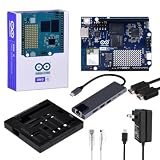
- High-performance single-board computer kit: Includes the official UNO Q with 2 GB of RAM and 16 GB of eMMC storage for demanding AI and embedded projects.
- Dual operating modes: Use the UNO Q as a standalone single-board computer with a monitor and keyboard, or connect it to a PC via USB-C for a familiar Arduino experience.
- Rugged aluminum case: The sturdy aluminum housing protects the board from dust, impacts, and static electricity while ensuring efficient heat dissipation.
- Comprehensive accessory package: Includes a USB-C hub with Ethernet, USB-C PD power supply, HDMI cable, Cat6 Ethernet patch cable, screw set, and a screwdriver.
- Versatile connectivity: The included USB-C hub with an Ethernet port significantly expands the UNO Q's connectivity options for professional applications.
UNO Q versus UNO R4: choose by workload
Arduino characterizes UNO R4 as a microcontroller board for straightforward real-time hardware control, and UNO Q as the option for projects that need Linux, Python, AI models, or computer vision alongside MCU control. The useful distinction is the software and workload the project needs—not a claim that one board is universally faster or better.
| Project need | Better fit based on Arduino’s guidance | Why |
|---|---|---|
| Real-time hardware control without a Linux application environment | UNO R4 | Arduino describes it as a pure microcontroller board for straightforward real-time control. |
| Linux applications, Python, AI models, or computer vision plus MCU control | UNO Q | It combines a Debian Linux MPU with a dedicated STM32 MCU. |
Before choosing, also consider RAM and storage needs, power and setup complexity, required real-time I/O, and compatibility with existing shields and peripherals. Arduino also compares UNO Q with Raspberry Pi, emphasizing the integrated STM32 MCU, UNO form factor and shield ecosystem, eMMC, and App Lab. That is the vendor’s comparison, not a neutral benchmark: the reviewed official material does not provide a like-for-like performance test establishing that UNO Q is faster or better than a Raspberry Pi.
Do these 3 things before closing this tab:
1Repair Windows errors before they cause bigger problems2Scan for outdated or missing drivers - takes under a minute3Clear out junk files and repair common Windows errorsBest Value
![Arduino UNO R4 WiFi [ABX00087] - Renesas RA4M1 + ESP32-S3, Wi-Fi, Bluetooth, USB-C, CAN, 12-bit DAC, OP AMP, Qwiic Connector, 12x8 LED Matrix for Advanced IoT & Embedded Projects](https://m.media-amazon.com/images/I/416S910MpBL._SL160_.jpg)
- Dual-Core Processing with Renesas RA4M1 and ESP32-S3: The Arduino UNO R4 WiFi combines the Renesas RA4M1 microcontroller (ARM Cortex-M4) and the ESP32-S3 Wi-Fi/Bluetooth chip, delivering powerful dual-core processing capabilities. This combination offers flexibility for a wide range of projects, from high-speed communications and wireless control to real-time data processing and edge AI applications.
- Comprehensive Wireless Connectivity: Equipped with Wi-Fi and Bluetooth 5.0, the UNO R4 WiFi ensures robust wireless communication for IoT projects, remote sensors, smart devices, and wireless control applications. Whether connecting to the cloud, other devices, or local networks, the board offers stable and high-speed wireless connectivity for seamless operation.
- Modern USB-C, CAN, & Qwiic Connector: The USB-C port enables efficient power delivery and fast programming, improving ease of use compared to traditional USB connections. The Controller Area Network (CAN) support allows for reliable, real-time communication in industrial, automotive, or robotic systems. Additionally, the Qwiic Connector makes it easy to add I2C sensors and peripherals, simplifying the connection process and reducing the need for complex wiring.
- High-Precision 12-bit DAC & OP-AMP: For projects that require high-quality analog output, the 12-bit DAC (Digital-to-Analog Converter) and integrated operational amplifier (OP-AMP) provide precise analog signal generation and amplification. This feature is ideal for audio projects, sensor interfacing, or applications where analog signal control and processing are necessary.
- Integrated 12x8 LED Matrix: The UNO R4 WiFi includes a built-in 12x8 LED Matrix, enabling users to display dynamic visuals, messages, or real-time data on the board itself. This makes it perfect for projects that require immediate visual feedback, such as status indicators, event displays, or interactive user interfaces.
Availability and what to verify before buying
Arduino’s product page names the Arduino Store and distributors including RS Components, DigiKey, Mouser, and Macfos. The list does not establish current stock in every country. The US Store page displayed a $59 price for the 2 GB UNO Q during the cited research period; price and availability can change, so check the live regional listing and confirm which memory variant it covers. Arduino’s product page links its stated sales channels.
For a purchase decision, verify the selected RAM variant, included storage and accessories, local availability, power-supply requirements, and compatibility with the shields or peripherals you plan to reuse. Published specifications can establish what Arduino says the board includes; they do not replace checking a particular seller’s current listing.
Quick Recap
Product prices and availability are accurate as of the date/time indicated and are subject to change. Any price and availability information displayed on Amazon at the time of purchase will apply.

