
Recommended Free Tools
New Horizons had not crossed the heliospheric termination shock as of NASA’s July 7, 2026 mission update. A 2023 article by members of the mission’s science team estimated the shock at about 92 astronomical units (AU) and forecast an encounter in the early 2030s. That is a model-based estimate, not a scheduled date: the shock’s position varies, and New Horizons is traveling a different path from the Voyagers.
What is the termination shock zone?
The termination shock is where the solar wind—the stream of charged particles flowing outward from the Sun—slows from supersonic to subsonic speed as it encounters the surrounding interstellar environment. It is a transition in the flow, not a solid wall or the edge of the solar system.
Beyond the shock is the heliosheath, the outer layer of the heliosphere. Farther out, the heliopause marks the boundary between the Sun’s solar-wind bubble and the interstellar environment. Crossing the termination shock therefore does not mean a spacecraft has entered interstellar space.
When did the Voyager spacecraft cross it?
| Spacecraft | Termination-shock crossing | What the date means |
|---|---|---|
| Voyager 1 | December 16, 2004 | NASA’s Voyager chronology records its crossing of the shock. |
| Voyager 2 | August 30, 2007 | NASA’s chronology records a later crossing along a different trajectory. |
| New Horizons | Not crossed as of July 7, 2026 | A 2023 mission-team paper projected an encounter in the early 2030s; this is a forecast, not a confirmed date. |
Voyager 1’s later crossing of the heliopause is a separate milestone: NASA gives August 25, 2012 as the date it exited the heliosphere. In NASA’s 2013 account, Voyager project scientist Edward Stone described Voyager 1 as having explored the heliosheath since its December 2004 shock crossing.
#1 Best Overall
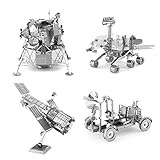
- HOBBY MODEL KITS – Unassembled model packed in an envelope with easy to follow instructions. Ideal for ages 14 and up
- HUBBLE TELESCOPE – 1 Sheet Model with an easy difficulty level. Assembled Size: 3"x2"x2.5"
- APOLLO LUNAR ROVER – 2 Sheet Model with a moderate difficulty level. Assembled Size: 3.54" x 1.77" x 2.28"
- APOLLO LUNAR MODULE - 2 Sheet Model with a moderate difficulty level. Assembled Size: 2.34" x 2.34" x 2.15"
- MARS ROVER – 2 Sheet Model with a moderate difficulty level. Assembled Size: 3.67" x 3.35" x 2.34"
How far away is the shock from New Horizons?
The New Horizons science-team overview in the Johns Hopkins APL Technical Digest estimated the termination shock at about 92 AU. An AU is the mean Earth–Sun distance. The paper also presented comparison distances of about 94 AU for Voyager 1 and 84 AU for Voyager 2; these are estimates shown in that paper, not a universal fixed radius.
The shock is not a permanently spherical boundary at one exact distance. Solar-wind conditions and the spacecraft’s location matter, so an estimate of its distance cannot by itself establish when New Horizons will cross it. The same paper discusses a possible boundary region about 30 AU thick and estimates roughly 10 years to cross that region. Those figures describe the authors’ forecast, not a guaranteed width or transit time for New Horizons.
Rank #2

- Relive the Crewed Apollo Moon Missions: Celebrate the historic Apollo missions with this detailed 32-inch tall model of NASA's Saturn V rocket. This iconic model replicates the rocket that launched from Cape Canaveral, making it the first to put a man on the moon. It features 3 removable rocket stages, including a lunar lander and landing module, offering a truly out-of-this-world building experience
- Awesome Out-of-This-World Design: This 3D model is packed with authentic details, including the S-IVB third stage with the lunar lander and module. Perfect as a centerpiece for your home or office, it provides a challenging and nostalgic DIY project for any space enthusiast or puzzle lover
- Designed for Space Enthusiasts: This intricately detailed model kit is a must-have for anyone passionate about space exploration and NASA's history. Whether you're keen to learn about space travel or want to enhance your cognitive skills, the NASA Apollo Saturn V 3D puzzle is an excellent choice
- Safe Material and Easy-to-Follow Instructions: Made from green paper foam board, this model is safer than metal or wood and lighter than plastic, while still being highly realistic. The detailed 3D illustrated instructions make assembly straightforward, even for beginners. Build-up size: 14" L x 6.7" W x 32" H
- Celebrate NASA's Legacy with a Unique Gift: This NASA Apollo Saturn V 3D puzzle is more than just a model—it's a tribute to the spirit of exploration and innovation that defined the Apollo missions. Perfect for space enthusiasts, this puzzle offers a rewarding experience that captures the imagination. Whether as a christmas gifts for teens for a fellow NASA fan or a treat for yourself, this model brings the wonder of space exploration into your home, making it a thoughtful addition to any collection
NASA’s July 2026 status report placed New Horizons about 5.9 billion miles (9.5 billion kilometers) from Earth. That is its reported distance from Earth, not its distance from the termination shock.
Why won’t New Horizons simply repeat Voyager 1’s encounter?
The spacecraft travel through different parts of a changing heliosphere. The 2023 mission-team paper says New Horizons is near Voyager 2’s longitude but remains in the ecliptic plane. It also reports that solar-wind slowdown begins around 42 AU along New Horizons’ path. Those observations provide trajectory context; they do not locate the shock at a single distance that applies everywhere.
Do these 3 things before closing this tab:
1Clear out junk files and repair common Windows errors2Fix the driver behind crashes, sound loss and screen glitches3Repair Windows errors before they cause bigger problemsRank #3

- HOBBY MODEL KIT – Unassembled model packed in an envelope with easy to follow instructions. Ideal for ages 14 and up.
- NO GLUE OR SOLDER NEEDED – Parts can be easily clipped from the metal sheets. Tweezers are the recommended tool for bending and twisting the connection tabs.
- PREMIUM SERIES SPACE SHUTTLE LAUNCH KIT - 3 Sheet Model with a moderate difficulty level. Once assembled, dimensions are 3.54 W x 4.13 L x 6.70 H inches. 1:342 Scale.
- FROM STEEL SHEETS TO 3D – Pop out the pieces and connect using tabs and holes. Includes illustrated instructions
- HIGHLY DETAILED ETCHED MODEL – Display your 3D model once completed - collect and build them all.
The paper emphasizes interpreting spacecraft measurements alongside models of the solar wind and the heliosphere. As New Horizons continues outward, its local measurements can help constrain how conditions change along its route rather than simply reproducing Voyager 1’s crossing.
What can New Horizons measure that Voyager could not?
Pickup ions with SWAP and PEPSSI
The Solar Wind Around Pluto (SWAP) instrument and the Pluto Energetic Particle Spectrometer Science Investigation (PEPSSI) measure hydrogen and helium pickup ions in the outer heliosphere. The mission-team paper says Voyager was not equipped to make these measurements. Pickup ions help scientists investigate material from the interstellar environment that becomes incorporated into the solar wind.
Rank #4

- HOBBY MODEL KIT – Unassembled model packed in an envelope with easy to follow instructions. Ideal for ages 14 and up
- NO GLUE OR SOLDER NEEDED – Parts can be easily clipped from the metal sheets. Tweezers are the recommended tool for bending and twisting the connection tabs
- APOLLO LUNAR MODULE – 2 Sheet Model with a moderate difficulty level. Once assembled, dimensions are 2.34 x 2.34 x 2.15 inches.
- FROM STEEL SHEETS TO 3D – Pop out the pieces and connect using tabs and holes. Includes illustrated instructions
- HIGHLY DETAILED ETCHED MODEL – Display your 3D model once completed - collect and build them all
Hydrogen with Alice
New Horizons’ Alice ultraviolet spectrograph can provide more sensitive Lyman-alpha diagnostics of interplanetary and interstellar hydrogen than Voyager’s spectrograph, according to the science-team paper. NASA’s July 2026 update said Alice was set to observe hydrogen distribution after the spacecraft resumed active operations.
Dust with the Venetia Burney Student Dust Counter
The student-built dust counter continued gathering and storing measurements during New Horizons’ 321-day hibernation, NASA reported in July 2026. The 2023 paper says the instrument may eventually detect interstellar dust penetrating the heliosphere. That is a possibility described by the authors, not a reported detection.
Quick wins for a faster PC:
Fix the driver behind crashes, sound loss and screen glitchesFind Drivers →Clear out junk files and repair common Windows errorsFree Scan →Best Value

- 100+ PIECE SPACE ACTIVITY KIT – Discover the wonders of space with this all-in-one kit! Packed with over 100 pieces, kids can explore, create, and learn with dazzling crafts and hands-on science activities.
- SEND A FOAM ROCKET SOARING – Kids will get hands-on with science as they launch a foam rocket into the sky! This thrilling experiment introduces kids to basic physics and inspires curiosity about space exploration.
- CREATE GLOWING CONSTELLATIONS – Use the glow-in-the-dark stars and constellation cards to build and learn about constellations. Spark imagination and expand knowledge of the night sky while crafting these celestial designs.
- PAINT & DISPLAY A GLOWING SOLAR SYSTEM – Paint and assemble a vibrant solar system that glows in the dark, then display it as window art with the included suction cups. It’s a creative and educational way to learn about the planets.
- EVERYTHING INCLUDED & EASY TO USE – The kit comes with all materials needed to complete each activity, along with step-by-step instructions and a Learning Guide packed with interstellar facts. It’s the perfect combination of fun and education!
Is New Horizons still operating?
Yes. NASA reported that flight controllers confirmed the spacecraft had safely awakened from a 321-day hibernation on June 23, 2026. Mission operations manager Alice Bowman said that weekly status reports during hibernation had remained “green,” meaning the spacecraft was well. NASA’s report said the radio confirmation took 8 hours and 52 minutes to travel from the spacecraft to Johns Hopkins Applied Physics Laboratory.
During hibernation, New Horizons continued collecting and storing measurements from SWAP, PEPSSI, and the Venetia Burney Student Dust Counter. Its continued operation keeps those outer-heliosphere observations going, but it does not change the distinction between a projected shock encounter and a confirmed crossing.
Quick Recap
Product prices and availability are accurate as of the date/time indicated and are subject to change. Any price and availability information displayed on Amazon at the time of purchase will apply.

