
A magnetic tunnel junction (MTJ) is a nanoscale device made of two magnetic layers separated by an ultrathin insulating barrier. Electrons can tunnel through that barrier, and the junction’s resistance changes depending on whether the layers’ magnetizations point in the same or opposite directions. That resistance difference lets electronics read a magnetic state.
What is a magnetic tunnel junction?
An MTJ is a spintronic device with a basic three-layer structure: ferromagnet, insulator, ferromagnet. The magnetic layers act as electrodes, while the insulating layer is thin enough—only a few atomic layers in some devices—for electrons to cross by quantum-mechanical tunneling rather than through an ordinary metallic connection. NIST’s description and an IEEE overview of MTJs explain this structure and operating principle.


Device materials vary. Examples include cobalt–iron–boron (CoFeB) magnetic layers and a magnesium oxide (MgO) barrier; aluminum oxide is another barrier material. These are examples, not a universal recipe: the precise composition, thickness, and geometry depend on the device.
How does an MTJ produce a resistance signal?
Parallel magnetizations: lower resistance
When both magnetic layers point in the same direction, they are in the parallel configuration. Electrons tunnel more readily through the junction, so its resistance is lower.
The Tool Desk
Outbyte Driver Updater FREEScan for outdated or missing drivers - takes under a minuteDriver Scan →Outbyte PC Repair FREERepair Windows errors before they cause bigger problemsFix Now →#1 Best Overall
Antiparallel magnetizations: higher resistance
When the layers point in opposite directions, they are in the antiparallel configuration. Tunneling is less probable, producing higher resistance. The resistance contrast between these configurations is called tunneling magnetoresistance (TMR); the relative change from the parallel to the antiparallel resistance is commonly expressed as a TMR ratio. IEEE’s MTJ overview describes this effect.
A read circuit measures the junction’s resistance and uses it to infer the magnetic configuration. The signal is electrical, even though the stored or sensed state is magnetic.
Rank #2

- Product Name: Door Magnetic Sensor Switch
- Sensing distance: 10mm-15mm
- Product size: 29*15.5*9mm Wire length: 33cm
- Sensing distance: 10mm-15mm Service life: 1000000 times
- Working current: 0.5A/Working voltage: 100V (1-100V)/Maximum power: 10W
How are MTJs read and switched?
Reading and switching are different operations. During readout, a circuit measures resistance. In suitable designs, writing can use current-induced spin torque: a spin-polarized current exerts torque that switches a magnetic layer, often called the free layer, without requiring an external magnetic field. IEEE’s overview discusses spin-transfer torque, while NIST describes current-driven switching. Designs can use different write schemes, so this mechanism is not a specification for every MTJ.
NIST’s figure caption gives one device-specific example: the pictured junction switches from high resistance to low resistance after a voltage higher than 500 millivolts is applied. That value describes the illustrated device, not a general MTJ switching threshold or recommended operating voltage. NIST
PC Slower Than It Used to Be?
A free scan shows the junk files, broken settings and background clutter dragging Windows down - then fixes them in one click.Free scan · Windows 10 & 11Crashes, No Sound, or Screen Glitches?
Random freezes, missing sound and display glitches usually trace back to one bad driver. Find and replace yours safely.Free scan · under a minuteWhere are magnetic tunnel junctions used?
- Magnetic random-access memory (MRAM): An MTJ’s resistance states can represent data that electronics read. IEEE’s MTJ overview identifies MRAM as an application.
- Magnetic-field sensing: TMR sensors use resistance changes to detect magnetic conditions. IEEE’s review of magnetic-field sensor technologies covers TMR alongside other sensor principles.
- Hard-disk read heads: IEEE also describes MTJs as sensing elements in hard-disk read heads. IEEE’s MTJ overview
How does an MTJ differ from other magnetic sensors?
An MTJ detects magnetism through tunneling magnetoresistance. Other sensor approaches use different physical effects, including anisotropic magnetoresistance (AMR), giant magnetoresistance (GMR), the Hall effect, fluxgate operation, search coils, or SQUIDs. These are distinct technologies, not automatically interchangeable choices; performance and suitability depend on the application and design. IEEE’s sensor review discusses their operating principles, calibration, error sources, and applications.
Quick Recap
Best Value

- Product name:Surface Mount Magnetic Reed Switch.Type:MC-31B.Color:Black.Material: fireproof ABS material.Product size: 55X12.5X11.5mm / 2.17" x 0.45" x 0.45"(L*W*H).Maximum Switch Voltage: 100V DC.Maximum switch current: 0.5A.Maximum switch power: 10W.
- Contact Type: NC/NO/COM: NC means Normally Closed.When the magnet together, the circuit is conductive; when the magnet separate, the circuit is not conductive.NO means normally open: when the magnets are separated, the circuit is turned on ; when the magnets are together, the circuit is not turned on. Actuation Distance: 10-20mm.
- Reed switch can be used in home security and burglar alarm system. It is an ideal choice for wooden doors and windows in homes and factories.
- Magnetic Reed Switch can not connect directly to power, It needs to work with the alarm system. It provides a switching signal.
- Package Content:2 sets Magnetic Reed Switch+8pcs Screws
Rank #4
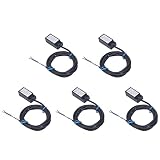
- 【Magnetic Detection】This magnetic switch sensor supports proximity detecting distance use in control setups. 2 wire magnetic proximity sensor design helps simplify connection for DC AC systems.
- 【Wide Voltage Input】Built for DC AC 5 to 200V operation, this normally open magnetic proximity sensor fits varied equipment voltage needs while keeping wiring and installation straightforward.
- 【ABS Housing】Made of ABS material with model 3 24, this inductive proximity switch sensor offers a compact option for sensing tasks where magnetic switch input is required.
- 【Output Configuration】DC AC two wire normally open output with 100mA current supports signal switching needs in circuits, equipment panels, and basic automation setups.
- 【Pack and Use】Package includes 5 magnetic switch sensors. Install and use directly for equipment control, detection points, replacement needs, or multi position sensing applications.
Product prices and availability are accurate as of the date/time indicated and are subject to change. Any price and availability information displayed on Amazon at the time of purchase will apply.

