
A 48-V BLDC drive turns a vehicle’s electrical power into controlled motion for auxiliary thermal-management loads such as coolant pumps, fans, HVAC blowers and, in some designs, an electric compressor. Its inverter handles motor commutation and speed or torque response; a separate vehicle-level strategy determines when and how much cooling or heating the system needs. A 48-V auxiliary drive is not evidence that the vehicle’s traction system or every thermal subsystem also runs at 48 V.
Where 48-V motor control fits in an EV
Electric vehicles can combine multiple electrical architectures. Texas Instruments discusses 48-V systems alongside 400-V and 800-V heating and cooling modules, while Infineon presents 48-V pump and fan solutions within a broader EV thermal-management portfolio. The 48-V motor-control problem is therefore best understood as one auxiliary-drive design choice, not a description of the whole vehicle.
Thermal systems use electrically driven components to move air, coolant, oil or refrigerant. Relevant loads include coolant pumps for battery and inverter cooling, electric oil and water pumps, cabin HVAC blowers, and cooling fans. HVAC architectures may also include refrigerant and HVAC loops, valves, electric pumps, and electric or PTC heaters. A BLDC motor can drive an AC compressor; heat pumps and PTC heaters are other parts of the overall heating-and-cooling system, not simply motor-drive loads.
How the inverter controls a BLDC motor
From DC bus to winding current
In the auxiliary-drive example described by Texas Instruments, a six-transistor inverter applies the 48-V DC bus to the motor windings using pulse-width modulation (PWM). By changing the switching pattern, the inverter controls the electrical power delivered to the motor and thus its operating response.
Do these 3 things before closing this tab:
1Clear out junk files and repair common Windows errors2Scan for outdated or missing drivers - takes under a minute3Repair Windows errors before they cause bigger problems#1 Best Overall

- 【Enhanced Thermal Clarity】Start with 128x128 thermal imaging and enhance to 240x240 resolution with TISR technology for greater details. The wide 40°x 30° field of view and a 25Hz refresh rate deliver accurate, smooth thermal images—ideal for detailed inspections in homes and on electrical systems and machinery
- 【Wide Application with Smart Alerts and Photograph】From underfloor heating to leak detection and electrical inspections, the TC004 Mini adapts to every challenge. When temperatures exceed preset levels, an on screen warning alerts you instantly while automatically capturing a photo to streamline your diagnostics. In addition, TC004 Mini also supports manual photo taking to help you record and solve problems, and the built-in 512MB eMMC storage can store up to 8,000 photos
- 【Effortless Temp Measurement with Alerts】Easily measure temperatures between -4°F to 842°F (-20°C to 450°C), with an accuracy error within ±3.6°F/2%, the thermal camera automatically pinpointing the highest, lowest, and central spots. Plus, you can choose from 5 different color palettes - White Hot, Black Hot, Iron, Rainbow, and Red Hot - to meet your specific work needs. Instant warnings will alert you when the temperature exceeds your preset level, making your job more efficient
- 【Longer Runtime, Fewer Charges】Designed for efficiency, this thermal imaging camera gives you 15 hours of power and automatic shut-off options at 5, 10, and 20-minute intervals to extend battery life. Keep going without the hassle of frequent charging, no matter how long your inspections last. A charging cable is given with the machine, but no charging head.
- 【Portable, Durable & Hassle-Free】Take this thermal imaging camera anywhere with its mini, pocket-friendly design. The ergonomic design makes it easier for you to hold during use, and the lightweight design is more suitable for long-term use. Engineered for durability, it can survive drops up to 2 meters without skipping a beat. Supports IP54 waterproof rating to ensure worry-free daily use. Get peace of mind with TOPDON's lifetime technical support to keep it running smoothly
The example describes PWM switching from 10 to 50 kHz. That range belongs to the cited example; it is not a universal switching-frequency requirement. A real design must select a switching frequency and power stage to suit the motor, inverter components, acoustic and electromagnetic constraints, and thermal limits.
Commutation and feedback
The microcontroller determines rotor position from Hall sensors or from back electromotive force (EMF), then commutates the motor and generates PWM signals for the requested speed and torque response. As Texas Instruments technical article author Peter Fundaro puts it: “The main microcontroller controls commutation, which calculates the rotor position based on hall sensors or back electromotive force (EMF) from the motor and generates the PWM signals for the desired motor speed and torque response.”
Rank #2
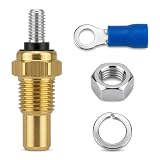
- Practical Function: The 1/8 NPT temperature sensor accurately monitors engine coolant, water, or oil temperatures from 32°F to 302°F (0°C to 150°C). It serves as a direct replacement for faulty or old sensors—no changes to the vehicle's original wiring required
- Durable Material: The water/coolant/oil temperature sensor is crafted from high-quality metal with excellent corrosion resistance and high thermal conductivity. It maintains structural integrity under prolonged exposure to engine heat and oil, ensuring stable, reliable signal transmission
- Package and Size: Each package includes one 1/8 NPT water/coolant/oil temperature sensor and a wire terminal connector. The sensor measures 0.46 × 0.46 × 1.54 inches, with thread diameters of 0.15 and 0.38 inches; the connector is 0.22 × 0.97 inches in size
- Easy to Use: The temperature sensor uses a one-wire (single connection) design: one end sends signals to the instrument, and grounding is achieved through the threads when screwed into the engine/sandwich plate. The operation is simple—no extra circuit changes or complex tools needed
- Broad Application: The electrical sender transmission sensor unit is compatible with a wide range of vehicles on the market, such as cars, trucks, and SUVs. The sensor meets temperature monitoring requirements for daily driving, long trips, and vehicle maintenance
That embedded control loop is only one layer of the system. The vehicle’s thermal strategy decides what the battery, inverter, cabin or other managed component needs; the motor controller translates its command into motor operation. The available application descriptions do not establish one universal vehicle-level algorithm, sensor set, protection threshold or calibration. Those choices depend on the specific vehicle and components.
What changes when the load is a pump, fan or compressor
The control principles are shared, but the application changes the operating point and integration problem. A pump moves coolant or oil through a circuit; a fan moves air across a radiator or other heat exchanger; a blower serves the cabin HVAC system. Their required speed and torque vary with the system’s thermal demand. The controller and motor must be selected for the actual load and operating range, rather than for a nominal voltage alone.
Rank #3

- [Thread Size]: 1/8" NPT. Fan Switch Temperature Fahrenheit: 190'F On - 175'F Off
- [Fan Thermostat Temperature Switch]: Closes electrical circuit at turn-on temperature and grounds fan
- [Package included] 1x Thermostat Switch
- [Application Range] The switch features a universal size design, making it suitable for installation on various components such as radiators, oil coolers, condensers, and water hoses. This versatile adaptability makes it an ideal choice for a range of vehicle cooling systems
- [Ease of Installation] Designed with NPT size for threaded connections, this switch is easy to install and integrates seamlessly with different devices. Its universal sizing allows for straightforward installation into existing cooling systems without the need for extensive modifications
An electric compressor illustrates a more integrated design. A 2018 IEEE Energy Conversion Congress and Exposition contribution studied a 48-V mild-hybrid e-compressor with a three-leg MOSFET inverter module integrated with the motor. The work considered assembly, electrical reliability and thermal management, including direct-bonded-copper (DBC) substrates, air cooling, ribbon bonding, finite-element modeling and experimental calibration. These are methods and findings for that studied module, not a universal construction recipe for 48-V compressors.
Electrical and thermal constraints to design around
Motor temperature and lifetime
Excess heat can degrade winding insulation, demagnetize magnets, increase Joule losses and reduce motor efficiency and lifetime. The motor’s hottest location and cooling path matter, so a single case-temperature reading may not describe the winding or magnet margin.
Rank #4

- 【High Definition Thermal Imaging】The MILESEEY TR10 delivers enhanced 192×192 thermal clarity infrared sensor. Its 25Hz high refresh rate provides smooth real time image transitions and refined detail recognition, allowing users to inspect components and surfaces with greater precision and ease
- 【Accurate Temperature Measurement】This thermal imager has high thermal sensitivity NETD <50mk. The temperature range is -4°F to 1022°F. With an accuracy of ±2°C that make the temperature readings dependable.Automatically locks and displays the maximum, minimum, and center-point temperatures within the scanned area. Enhances efficiency in identifying hot spots or anomalies
- 【Fast Anomaly Recognition】High/Low Temperature Alarm will alart users to areas exceeding or falling below preset temperature.Detects anomalies in temperature patterns, highlighting potential issues such as overheating components or abnormalities in structures
- 【Adjustable Emissivity】TR10 IR camera allows users to adjust emissivity settings according to different materials, ensuring accurate temperature readings across diverse surfaces and objects
- 【Durable and Sturdy】(1)The 6.6ft drop test and Recessed lens protection enable you to operate confidently in a variety of work settings, including harsh environments. (2)3000mAh battery support 8-hours continuous operation.(3)Built-in 8GB storage capacity can store more than 30,000 pictures
A 2011 SAE paper abstract describes a computational-fluid-dynamics study of a fan-cooled BLDC motor with different fin geometries in a finned housing. It reports that the highest temperature occurred at the end windings and that a suitable finned housing reduced that highest temperature by up to 15% in simulation. The abstract notes that experimental tests were still underway; the result is not validated vehicle performance.
Inverter parasitics and device temperature
In an integrated motor-inverter assembly, parasitic inductance and resistance, concentrated current density and semiconductor temperature can affect electrical stress and heat removal. The cited 2018 e-compressor study reports approximately 57% lower stray inductance and approximately 53% lower overshoot voltage for its manufactured and experimentally calibrated design. It also reports that module temperature remained below the allowable MOSFET temperature in that study. These outcomes describe that module and setup; they are not expected performance figures for other controllers.
Recommended Free Tools
Best Value

- Image Enhancement Technology: The VEVOR thermal imager adopts TISR enhancement technology, upgrading the original IR resolution of 96x96 to a super resolution of 240x180. With a 25Hz refresh rate, ≤60 mK thermal sensitivity, and a wide 50.0°(H)x50°(V) /72.1°(D) field of view, combined with image sharpening algorithms and a high-performance AI chip, its 2.4-inch LCD screen captures and displays heat details with greater clarity
- Accurate Temperature Measurement: This infrared camera supports a wide temperature range of -20℃ to 550℃ / -4°F to 1022°F. It automatically tracks hot and cold spots and displays center, maximum, and minimum temperature data. With 4 thermal color modes and 6 palette options, it adapts to different working needs, delivering more intuitive and clearer imaging
- Quick Fault Detection: Our infrared thermal imager features built-in high/low-temperature alarms to automatically monitor deviations and issue alerts instantly. It helps you quickly identify overheating or low-temperature zones, precisely locate faults, and detect hidden heat risks, making potential problems clearly visible for early action
- Multiple Upgrades: This thermal camera is equipped with a 3200mAh high-capacity battery that provides up to 7 hours of runtime. It supports auto power-off, photo and video recording, and LED lighting. The lightweight yet sturdy body withstands drops up to 1.5m and, with IP54 dust- and water-resistant protection, is ready for challenging environments
- Wide Applications: Our thermal imaging camera supports USB charging for convenience and comes with 8GB built-in storage, capable of saving over 30,000 images. It supports 10 language settings and is widely applicable for circuit board inspection, HVAC troubleshooting, electrical checks, building diagnostics, vehicle maintenance, and industrial detection
Limits are component- and vehicle-specific
The cited material does not establish a universal winding-temperature limit, magnet limit, MOSFET junction limit, current limit or protection setting. Engineers need the actual motor and semiconductor datasheets, the intended operating conditions, and the vehicle’s validated requirements to set limits and protection behavior. The examples above are useful evidence about design concerns, not substitutes for those values.
Independent reader supportYour contribution helps us test, update, and keep practical guides available for everyone.How to interpret the published performance figures
| Reported result | What was studied | How to read it |
|---|---|---|
| About 30% greater efficiency than a conventional DC motor | SAE International’s 2015 abstract on a tested 48-V drive-integrated BLDC radiator-fan design | A result for the paper’s comparison, not a market-wide efficiency advantage. |
| Approximately 57% decrease in stray inductance and approximately 53% decrease in overshoot voltage | IEEE Energy Conversion Congress and Exposition, 2018; experimental calibration of the studied integrated 48-V e-compressor module | Reported outcomes for that module and study setup, not general controller specifications. |
| Up to 15% reduction in the highest motor temperature | SAE Mobilus/Automotive Research Association of India paper abstract, 2011; finned-housing CFD study | A simulation finding; the abstract says experimental testing was still underway. |
These figures measure different things in different systems and under different methods. They should not be ranked against each other or used to predict the performance of a particular current vehicle.
Compare designs by the system, not by voltage alone
A useful comparison starts with the actual thermal load and its duty cycle, then checks the motor, inverter, sensing and vehicle integration together. The relevant questions include:
- Load and operating point: What does the pump, fan, blower or compressor need to deliver across its expected operating range?
- Efficiency and electrical demand: What are the motor-and-inverter efficiency and current requirements at relevant operating points? A 48-V arrangement can reduce current and wiring-harness weight compared with a lower-voltage arrangement for a given power, but the sources do not provide a complete vehicle-level comparison.
- Commutation and sensing: Does the design use Hall sensors or back-EMF-based rotor-position estimation, and does that approach suit the motor and operating conditions?
- Thermal margin: Can the motor, inverter and integrated packaging manage heat under the intended conditions?
- Noise and packaging: What are the acoustic requirements and available installation space, and how does integration affect cooling and serviceability?
- Diagnostics and fault response: How will the vehicle detect faults and respond? The cited descriptions do not specify a universal diagnostic scheme.
- Qualification and cost: Are the parts qualified for the intended vehicle application, and does the complete design meet cost targets? The sources do not establish an overall winner or a comparative lifecycle-cost result.
A category label such as “48V BLDC motor controller” is not enough to establish automotive suitability. A design intended for a bench or general-purpose application is not, by that label alone, evidence of road-vehicle readiness. Check the controller’s actual ratings and qualification against the application and vehicle requirements.
Quick Recap
Product prices and availability are accurate as of the date/time indicated and are subject to change. Any price and availability information displayed on Amazon at the time of purchase will apply.

