
Do these 3 things before closing this tab:
1Scan for outdated or missing drivers - takes under a minute2Clear out junk files and repair common Windows errors3Fix the driver behind crashes, sound loss and screen glitchesLake Shore Cryotronics’ SMU-10 is a source-measure module for its MeasureReady M81-SSM synchronous source measure system—not a standalone instrument. It combines DC and AC sourcing and measurement with lock-in and resistance functions, making it a candidate for nanoscale and 2D semiconductor characterization when those capabilities fit the measurement workflow. Its sensitivity figures are manufacturer specifications under stated conditions, not a guarantee of performance for an entire test setup.
What the SMU-10 is—and how it fits the M81-SSM
Lake Shore describes the SMU-10 as the latest module addition to the MeasureReady M81-SSM synchronous source measure system. The module must be used as part of that system; it is not presented as a self-contained bench instrument. The manufacturer positions it for low-noise characterization of nanoscale and 2D semiconductor devices.
The distinction Lake Shore emphasizes is the combination of DC and AC source-measure functions with integrated lock-in capability. The product documentation lists six functions: DC current, DC voltage, AC current, AC voltage, lock-in, and resistance. Lake Shore says synchronous sourcing and measurement can help avoid sampling misalignment in pulsed I-V testing. This is the manufacturer’s stated rationale, rather than an independent comparison with other SMUs.
Published measurement specifications
Lake Shore’s current product page lists the following ranges and capabilities. Specifications are subject to change, so confirm the current configuration and documentation before specifying a system.
#1 Best Overall
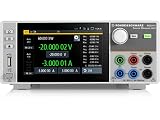
- Four quadrant source measure unit
- Catalog number 3639.3763P99
- This version includes the NGU-K103 option (digital I/O Ports)
- Ideal for semiconductor testing
- Can act as bipolar power supply or bipolar electronic load
| Item | Manufacturer-listed value | Qualification |
|---|---|---|
| Voltage measure sensitivity | Below 3 nV | Manufacturer specification; no additional condition is given in the cited sensitivity statement. |
| Current measure sensitivity | Below 1 fA | Manufacturer specification at a 10-second time constant and 24 dB roll-off. |
| Voltage ranges | 10 mV, 100 mV, 1 V, 10 V | Listed measurement ranges. |
| Current ranges | 1 nA, 10 nA, 100 nA, 1 µA, 10 µA, 100 µA, 1 mA, 10 mA, 100 mA | Listed measurement ranges. |
| Maximum source levels | Up to 10 V and 100 mA | Product-page capability; the page also lists maximum power of 1 W. |
| Resistance range | Milliohms to 100 GΩ | Product-page description. |
| Other listed specifications | Four-quadrant operation; ±200 VDC overvoltage protection; operation in DC magnetic fields up to 50 mT | Manufacturer-listed capabilities. |
The product overview also describes DC current measurement below 100 fA, while its detailed sensitivity specification states below 1 fA with the time-constant and roll-off conditions above. Treat the detailed figure as conditional: it does not establish that a complete device, cabling, probe station, and environment will achieve that level of system performance.
Why the combination may suit nanoscale and 2D device work
At very small currents and voltages, researchers may need to resolve device behavior across different operating regimes. A setup that offers DC sweeps, AC measurements, and lock-in techniques can support more than one measurement approach without requiring the researcher to treat each technique as a separate instrument workflow. Lake Shore’s technical article argues that DC and AC methods have complementary strengths and that having both available lets researchers select or combine methods for a given test environment. That is the manufacturer’s explanation, not a universal performance guarantee.
Rank #2

- 7-inch capacitive touch screen, resolution 800×480
- Linux operating system
- Four-quadrant precision power output and measurement
- Single/dual channel output and measurement
- Up to ±210V DC voltage, ±3A DC current/±10.5A pulse
In a 2025 press release, Lake Shore called the SMU-10 ideal for characterizing ultra-low-voltage regimes in nanoscale and 2D nanomaterial semiconductors. This is product positioning. The available manufacturer material does not establish an independent head-to-head performance advantage over competing source-measure units.
Low-current performance depends on the whole measurement chain
An instrument’s sensitivity specification is only one part of a femtoamp-level measurement. Lake Shore’s low-current application note identifies cabling, the environment, and device fixturing as factors that affect results. It recommends triax cable configuration for measurements below 1 nA. Triax adds a driven guard conductor between force and shield; holding guard and force at the same potential can reduce leakage and charging currents.
Rank #3
- 7-inch capacitive touch screen, resolution 800×480
- Linux operating system
- Four-quadrant precision power output and measurement
- Single/dual channel output and measurement
- Up to ±210V DC voltage, ±3A DC current/±10.5A pulse
The same note warns that contamination and humidity can compromise low-current measurements. It recommends evacuating the probe-station chamber or purging it with dry gas to limit contamination. These steps address setup-related leakage; they do not guarantee a particular noise floor or make every probe arm and station compatible with a given cable.
The application note includes an illustrative temperature-dependent leakage result: a silicon JFET measured at 300 K and 80 K in a Lake Shore CPX-VF probe station, with triax cabling and a grounded sample holder, showed subthreshold leakage falling to approximately 6 fA after cooling below 100 K. That result applies to the specific device and setup in the note; it is not an SMU-10 performance result.
Rank #4

- The PXI-4131A is distinguished by its integrated high-speed digitizer, which can record waveforms at up to 1.8 MS/s.
- This device allows various SMU configurations, which makes parallel testing setups easier and test execution more efficient.
- The item may have some signs of cosmetic wear, but is fully operational and functions as intended. This item may be a floor model or store return that has been used.
- Measurements may be trusted even in the most demanding situations because to this instrument's exceptional resolution and accuracy.
- Its adaptable architecture, which offers four channels for precise voltage and current sourcing and measurement, enables it to be employed in a range of testing applications.
Check the M81-SSM system requirements and configuration
The M81-SSM system supports up to three source modules and three measure modules. Lake Shore lists a 375 kSa/s sample rate for the system; this is a system specification, not a guarantee of an application’s effective measurement rate. The system specifications also list LabVIEW, Python, MeasureLINK, and IVI.NET support. It is a half-rack system, with mains options and ambient operating guidance specified by Lake Shore; consult the current specifications for the exact requirements and configuration.
For setups that measure multiple devices or need electronics near a device under test, Lake Shore’s technical article discusses remote amplifier modules placed near the device to reduce noise pickup and coordinating measurements across devices. Whether that arrangement suits a particular experiment depends on the device layout, cabling, channel needs, and system configuration.
How to decide whether it fits your experiment
- Match ranges to the device. Confirm that the listed voltage and current ranges cover both the intended operating point and the sweep or transient conditions you need.
- Check the sensitivity conditions. Compare required resolution with the stated sensitivity conditions, especially the 10-second time constant and 24 dB roll-off attached to the below-1-fA current figure.
- Decide whether AC, lock-in, or pulsed I-V synchronization matters. The SMU-10’s stated differentiation is combining these methods with DC measurement in the M81-SSM workflow.
- Plan channel count and synchronization. The system allows up to three source and three measure modules; determine whether that capacity and the intended synchronization meet the experiment’s needs.
- Account for the station and cabling. For sub-1 nA work, assess triax cabling, guarding, humidity and contamination control, and compatibility with the probe arm and fixturing.
- Verify software and operating requirements. Confirm the current system configuration, supported software route, mains option, and ambient operating guidance against Lake Shore’s specifications.
Lake Shore presents the SMU-10 as an M81-SSM module for low-noise nano- and 2D-device work, particularly where DC, AC, lock-in, or synchronized pulsed measurements belong in the same workflow. The published sensitivity numbers are useful specification points, but deciding whether they translate to a real experiment requires evaluating the complete measurement setup.
Quick Recap
Product prices and availability are accurate as of the date/time indicated and are subject to change. Any price and availability information displayed on Amazon at the time of purchase will apply.

