
A quartz crystal can set the frequency of an IoT or wearable device’s clock, but it is not a complete clock source on its own: it works with an oscillator circuit in the host MCU or radio. Choose the resonator to match that circuit’s frequency, load capacitance, ESR, and environmental requirements. For designs that can accept a complete oscillator component, an integrated MEMS oscillator is another option—not a drop-in replacement for every crystal circuit.
What a quartz crystal does in a connected device
A quartz crystal is a resonator: paired with an oscillator circuit, it helps establish a clock frequency. That timing can support an MCU or radio’s operation, including wireless functions in a connected product. The crystal itself does not generate a usable clock independently; the host circuit must be designed to drive the resonator correctly.
That is why nominal frequency alone is not enough to choose a part. The MCU or radio documentation defines what kind of timing component the circuit expects and the electrical constraints it must meet. A crystal resonator and a complete oscillator module are different component types, even if both are associated with a clock frequency.
How to choose a crystal for an MCU, radio, or wearable
- Start with the host documentation. Identify the exact MCU or radio oscillator requirements, including whether the design calls for a crystal resonator or a complete oscillator module.
- Match the frequency and circuit conditions. Confirm the required nominal frequency, then check that the crystal’s load capacitance and equivalent series resistance (ESR) fit the oscillator circuit’s limits. A mismatch can prevent reliable operation.
- Check timing accuracy across conditions. Compare initial tolerance and frequency stability over the temperature range the finished device will actually experience. Use the selected part’s specified values, not just its nominal frequency.
- Verify the physical fit. Confirm the package and footprint suit the board and assembly process, and account for product-specific environmental demands such as shock and vibration.
- Evaluate power in the complete circuit. Consider startup and operating current in the intended mode. The resonator and oscillator electronics together determine practical power behavior, so crystal specifications alone do not establish system current. Analog Devices discusses the relationship between crystal selection, oscillator design, and current in Design a Crystal Oscillator to Match Your Application and Oscillator Design Considerations for Low-Current Applications.
Compare candidate parts using the same operating conditions. A useful shortlist weighs circuit and frequency compatibility, startup and operating behavior, initial tolerance and temperature stability, footprint and integration, and environmental requirements. Validate the final choice against the exact component and host datasheets; board-level measurements in the intended operating modes are needed to establish how a particular design behaves.
The Tool Desk
Outbyte Driver Updater FREEScan for outdated or missing drivers - takes under a minuteDriver Scan →Outbyte PC Repair FREEClear out junk files and repair common Windows errorsFree Scan →#1 Best Overall
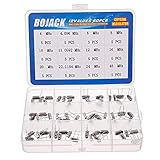
- BOJACK High Quality Crystal Resonators Assortment Kit
- Output Frequency: 16MHz
- Frequency stability: â± 20ppm
- Model:12 type-(4MHz, 4.096MHz, 6MHz, 8MHz, 10MHz, 11.0592MHz, 12MHz, 16MHz, 20MHz, 22.1184MHz,24MHz,48MHz )
- Package Quantity: 60 pcs (Each model 5 pcs), Packed in A plastic storage case
Manufacturer example: CTS 416W quartz crystal
CTS describes its 416W as an IoT-enhanced, high-Q quartz resonator optimized for low ESR and load capacitance. The manufacturer lists a family frequency range of 24–80 MHz and a surface-mount package measuring 1.6 × 1.2 mm. It also lists selectable tolerance and stability values. Those are CTS product specifications, not independent test results.
CTS identifies low-power MCUs and portable RF ICs among the intended applications, and names Bluetooth Low Energy, Zigbee, Z-Wave, LoRa, and other wireless uses. The application list does not mean every 416W variant fits every radio: check the chosen variant’s specifications against the host circuit. See the CTS 416W product page and its 416W specifications.
Rank #2

- 15 Values 77 Pcs HC-49 Quartz Crystal Oscillator 32.768K 4 MHz, 7.6 MHz, 8 MHz, 10 MHz, 11.0592 MHz, 12 MHz,14.7456MHZ, 16 MHz, 20 MHz, 22.1184 MHz,24 MHz,48 MHz,50 MHz,100 MHz Assortment Kit
- Mounting Type: DIP; Number of Pins: 2; Load Capacitance: 20pF; Equivalent Resistance: 30 OHM
- Body Size: 11 x 4.65 x 3.6mm / 0.43" x 0.18" x 0.14" (L*W*H); Lead Pitch: 4.88mm / 0.19"
- DIP Quartz Crystal Oscillators for RISC & CISC Microcontrollers
- Widely used in TV, electronics, PC cards, electronical meter, DVD, MP3, MP4, etc
Quartz crystal or MEMS oscillator?
A quartz resonator is appropriate when the host design expects a crystal and its oscillator circuit can meet the resonator’s requirements. An integrated MEMS oscillator is a different category: it packages an oscillator with its resonator and supplies a clock output. Whether that simplifies a design depends on the circuit, part specifications, and system requirements—not just the technology name.
Microchip’s DSC61xxB is one MEMS oscillator family described for battery-powered wearable and IoT devices. Its 2019 datasheet lists a supply range of 1.71–3.63 V, small package options, and stability grades. Treat these as specifications for that family and datasheet revision, not as a general MEMS-versus-quartz result. Compare the exact part’s current, stability, package, supply, and environmental specifications with the needs of the design. The DSC61xxB is not a drop-in substitute for a two-terminal crystal unless the host circuit supports an oscillator module.
Free tools Windows power users keep installed
One-click scans. No signup required.
Rank #3

- What You Will Get: You will get 96pcs 12 types resonator crystal oscillator set, including 4MHZ, 6MHZ, 8MHZ, 10MHZ, 12MHZ, 16MHZ, 20MHZ, 24MHZ, 25MHZ, 27MHZ, 30MHZ, 32.768MHZ, 8pcs each type, all items are packed in a plastic box for easy storage, various style can meet your different needs.
- Durable Material: Crystal oscillators resonators are made of metal material, feature a compact size, high precision, strong compatibility, and resistance to aging and temperature changes, ensuring long-term stability. Making it ideal for long-running circuits, repairs,and production across its 12-frequency kit.
- Faction: This quartz crystal oscillator provides stable signals for integrated circuits and stabilizes radio frequencies. It offers lower cost, greater versatility, and multi-purpose functionality. Resonator crystal oscillator set supports small to medium-scale production or repair, saves circuit space, and suits compact devices.
- Tight Hold for Your Projects: This 12-value quartz crystal resonator kit covers most everyday needs with a 2-pin design compatible with breadboards and PCB through-hole soldering, perfect for manual prototyping. These quartz crystal oscillators deliver stable, reliable timing signals for timing and control circuits and precision clock applications.
- Wide Application: These crystal oscillators are perfectly suited for electronic circuits, RTC real-time clock, and other devices with strict timing requirements. Common applications include TV, DVD/MP3/MP4 players, remote controls, digital clocks, PC cards, electronic instruments, and consumer electronics.
Microchip’s MEMS and crystal oscillator overview and the DSC61xxB datasheet (DS20006155A, 2019) describe these products. Neither a vendor overview nor a family-level specification establishes a universal winner; there is no basis here to claim that one approach always uses less power, costs less, or performs better.
Independent reader supportYour contribution helps us test, update, and keep practical guides available for everyone.Practical comparison before committing to a part
- Interface: Does the host expect a resonator in an oscillator circuit, or can it accept a complete oscillator’s output?
- Electrical fit: Do frequency, load capacitance, ESR, and supply requirements fit the host and the candidate part?
- Timing: Are initial tolerance and stability over the actual operating temperature range sufficient?
- Energy and startup: What do startup and operating current look like in the intended mode, measured or established for the complete implementation?
- Mechanical and environmental fit: Does the package suit the layout and assembly, and does the part meet the product’s shock, vibration, and other environmental needs?
Use exact datasheets for the candidate and host, then validate the selected design on its board. Specifications describe components; only the implementation can confirm startup and operating behavior in the finished device.
Quick Recap
Rank #4

- Frequency: 16MHz; Frequency Tolerance : ±20ppm; Type: HC-49S
- Mounting Type: DIP; Number of Pins: 2; Load Capacitance: 20pF; Equivalent Resistance: 30 OHM
- Body Size: 11 x 4.65 x 3.6mm / 0.43" x 0.18" x 0.14" (L*W*H); Lead Pitch: 4.88mm / 0.19"
- DIP Quartz Crystal Oscillators for RISC & CISC Microcontrollers
- Widely used in TV, electronics, PC cards, electronical meter, DVD, MP3, MP4, etc
Product prices and availability are accurate as of the date/time indicated and are subject to change. Any price and availability information displayed on Amazon at the time of purchase will apply.

