
Windows Errors? Fix Them Before They Spread
Repair common Windows errors and clear accumulated junk for a smoother, more stable PC - no reinstall needed.Free scan · no reinstallOutdated Drivers Are Slowing You Down
One free scan finds every outdated or missing driver and matches the right update for your exact hardware.Free scan · exact hardware matchSTMicroelectronics is bringing 18-nm fully depleted silicon-on-insulator (FD-SOI) and embedded phase-change memory (ePCM) to its STM32V8 general-purpose microcontroller family, paired with an Arm Cortex-M85 core. The move is intended to balance processing performance, power use, logic density, and on-chip non-volatile memory for demanding embedded applications. The published advantages and benchmarks are ST’s claims; the available company materials do not provide independent, matched-device validation.
What ST announced
STM32V8 is the named next-generation, high-performance STM32 family at the center of ST’s 18-nm announcement. ST describes it as the first of its general-purpose MCU families publicly presented with the combination of 18-nm FD-SOI and embedded phase-change memory. The product campaign pairs that platform with an 800-MHz Arm Cortex-M85. ST’s STM32V8 product campaign presents the family as a technology and product platform; check the datasheet for a particular part number before assuming every listed feature is present in every device.
Published family specifications
ST lists up to 4 MB of embedded non-volatile memory, 1.5 MB of RAM with error-correcting code (ECC), and up to 5,072 CoreMark. The campaign also lists USB high-speed and full-speed with PHYs, FDCAN, I3C, SPI, UART, and 1-Gbit Ethernet with time-sensitive networking (TSN), alongside graphics functions. These are maximum or family-level figures as published by ST, not a guarantee that every variant has the same memory, interfaces, or performance.
FD-SOI and PCM do different jobs
FD-SOI describes the semiconductor process and transistor platform. In fully depleted silicon-on-insulator technology, a thin silicon layer sits over an insulating layer; this structure is the basis for the process’s electrical characteristics. PCM, or phase-change memory, is the embedded non-volatile memory technology: it stores data without power and is distinct from the transistor platform. ST uses the shorthand ePCM for embedded PCM.
Quick wins for a faster PC:
Repair Windows errors before they cause bigger problemsFix Now →Fix the driver behind crashes, sound loss and screen glitchesFind Drivers →Clear out junk files and repair common Windows errorsFree Scan →#1 Best Overall

- High-performance foundation line, ARM Cortex-M4 core with DSP and FPU, 512 Kbytes Flash, 180 MHz CPU, ART Accelerator, Dual QSPI
- On-board ST-LINK/V2-1 debugger/programmer with SWD connector
- Can be powered from USB
- Three LEDs, Two Push-buttons
- Support of wide choice of Integrated Development Environments (IDEs) including IAR, ARM Keil, GCC-based IDEs
The pairing matters because an MCU must fit both logic and program/data memory into a constrained die and power budget. ST’s PCM technology overview says its PCM supports higher memory density than flash-based embedded non-volatile memory, single-bit alterability, and high-temperature data retention, including through solder reflow. Those statements describe ST’s technology; specific device behavior and limits depend on its datasheet.
Why ST says it chose 18-nm FD-SOI with PCM
ST frames the combination as a way to improve performance and power consumption while allowing more memory and integration than bulk CMOS paired with conventional floating-gate embedded non-volatile memory. On its PCM overview, ST reports the following comparison with no complete benchmark setup stated on the page:
Rank #2

- Ultra-low-power with FPU ARM Cortex-M4 MCU 80 MHz with 1 Mbyte Flash, LCD, USB OTG, DFSDM
- On-board ST-LINK/V2-1 debugger/programmer with SWD connector
- Can be powered from USB
- Three LEDs, Two Push-buttons
- Support of wide choice of Integrated Development Environments (IDEs) including IAR, ARM Keil, GCC-based IDEs
| ST-reported comparison | What ST says | How to interpret it |
|---|---|---|
| Performance-to-power ratio | More than 50% better | ST’s stated comparison; the page does not provide a full workload or test setup. |
| Non-volatile memory area | 2.5 times smaller | ST’s stated comparison for its PCM platform, not a universal ratio for all processes or designs. |
| Digital density | 3 times higher | ST’s stated comparison; matched design conditions are not detailed on the page. |
The company also says its PCM-plus-FD-SOI technology supports 3-V operation down to 18 nm. These are platform-level company claims, not independent measurements of an STM32V8 device. A meaningful head-to-head assessment would need equivalent devices, workloads, memory configurations, operating conditions, and reproducible measurements.
What the published performance figures do—and do not—show
ST advertises an 800-MHz Cortex-M85 and up to 5,072 CoreMark for STM32V8, and says machine-learning and DSP processing can be up to six times faster than in previous product generations. The product campaign does not establish the comparison configuration or provide a benchmark method sufficient to verify a like-for-like result. Treat the six-times figure as ST’s claim, not a general performance guarantee.
Free tools Windows power users keep installed
One-click scans. No signup required.
Rank #3

- Experience the power of the ARM Cortex M4 with this STM32F411CEU6 Development Board, featuring a blazing fast 100Mhz frequency and zero-wait state access to 512KB ROM and 128KB RAM for seamless programming
- Unlock endless possibilities with the STM32F4 Core STM32F411CEU6 Module System Board, equipped with FPU floating-point unit for efficient calculations and a plethora of interfaces including USART, I2C, SPI, and USBFS for versatile connectivity options
- Dive into the world of embedded systems with this Learning Board, boasting 20 Pin 2.54mm I/O interfaces, 4 Pin 2.54mm SW debugging interface, and user-friendly buttons like KEY (PA0), NRST, and BOOT0 for convenient operation and development
- Stay powered up and connected with the 3.3V-5V power input, 3.3V LDO with a maximum output current of 100mA, and a USB-C interface with built-in diode to prevent power backflow, along with high-speed and low-speed crystal oscillators for reliable performance
- Elevate your programming projects with the STM32F411CEU6 Development Board, featuring a SPI Flash for additional storage options, 12-bit ADC, 12-bit 5 S for accurate measurements, and 32.768K 6pF low-speed crystal oscillator for precise timing control
The intended use cases include factory automation and robotics, energy management, medical and audio applications. ST’s whitepaper also discusses automated factories, smart vehicles, real-time processing, networking, edge analytics, and complex motor control. These are target application areas in company materials, not evidence that every STM32V8 variant is qualified or deployed in each use. See ST’s whitepaper landing page.
Temperature and security claims need their own scope
ST’s STM32V8 product campaign lists a junction temperature up to 140°C. Separately, its PCM overview says the technology meets automotive AEC-Q100 Grade 0 requirements for operation up to +165°C. The latter is a statement about the PCM technology overview, not the STM32V8 junction-temperature specification; it should not be used to infer that an STM32V8 part is rated for a 165°C junction temperature.
Rank #4
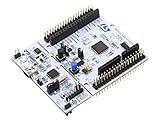
- STM32 STM32F401RE microcontroller Cortex-M4 in LQFP64 package
- 1 user LED shared with UNO 1 user and 1 reset push-button
- Board expansion connectors: Uno V3 ST morpho extension pin headers for full access to all STM32 I/Os
- On-board ST-LINK/V2-1 debugger/programmer with USB re-enumeration capability. Three different interfaces supported on USB: mass storage, Virtual COM port and debug port
- Comprehensive free software libraries and examples available with the STM32Cube MCU Package
The product campaign describes PSA Level 3 and SESIP3 as targets. It does not establish that those certifications have been achieved, so they should not be treated as completed certifications.
Independent reader supportYour contribution helps us test, update, and keep practical guides available for everyone.Where ST says the process will be made
ST’s technical blog says the STM32V8 process was developed with Samsung Foundry and that ST will manufacture it in its 300-mm fab in Crolles, France. ST’s 2024 Capital Markets Day manufacturing presentation also lists integration of 18-nm FD-SOI with ePCM in the Crolles 300-mm fab evolution for automotive, industrial, and consumer electronics. These are ST’s manufacturing statements; the cited materials do not establish production volume, external foundry confirmation, or shipment status. ST’s STM32V8 process blog and its 2024 Capital Markets Day technology and manufacturing presentation provide the company’s context.
Best Value

- STM32F103C8T6 ARM STM32 minimum system development module.
- ST-Link V2 support the full range of STM32 SWD interface debugging, simple interface (including power supply), 4 line speed, stable work.
- Use the current smart phones of Mirco USB interface, easy to use, USB communication and power supply can be done.
- The board lead to all the I/O resources.Download with SWD debug interface, which requires a minimum of 3 wires to complete debug a download task
What this means for MCU buyers and designers
The announcement is significant as a platform choice: ST is combining a newer FD-SOI process, embedded PCM, and a high-performance Cortex-M85 in a general-purpose MCU family, aiming to integrate substantial memory and processing capability. It does not by itself prove lower system power, a specific performance gain in a customer workload, or qualification for a particular end product.
Quick Recap
- For a design decision, compare exact STM32V8 part numbers and datasheets, not family-level maximums.
- Match the intended workload, memory footprint, peripherals, package, and thermal conditions when comparing it with an existing MCU.
- Confirm current availability and the required qualification or security status for the specific application.
- Use independent measurements under comparable conditions to evaluate performance and power claims for a real workload.
Product prices and availability are accurate as of the date/time indicated and are subject to change. Any price and availability information displayed on Amazon at the time of purchase will apply.

