
What’s actually slowing this PC down?
Pick the symptom - the matching free tool is one click away.
Japan’s Hi-Vision system brought high-definition television to satellite broadcasting decades before HD became commonplace. Its MUSE transmission method used digital processing to squeeze an HDTV picture into a satellite channel, then sent it by analog FM. That combination was technically ambitious—but it did not become the world’s lasting broadcast standard.
What were Hi-Vision and MUSE?
Hi-Vision was Japan’s HDTV production and broadcast system developed under NHK’s leadership. Its production format used 1125 lines, 60 fields per second, and 2:1 interlaced scanning. MUSE—short for Multiple Sub-Nyquist Sampling Encoding—was a separate bandwidth-reduction method for delivering that high-definition signal by satellite. The names describe related parts of a system, not the same thing.
That distinction also clarifies the phrase “analog HDTV.” MUSE used digital video processing and memory to reduce and reconstruct picture information, but the satellite broadcast transmission itself used frequency modulation (FM). It was a hybrid system, not an entirely analog signal chain. The 1125-line production format later became SMPTE 240M in the United States; MUSE remained the distinct satellite transmission scheme. Peter B. Seel’s historical account discusses the format’s standardization and the separate MUSE system.
How did MUSE fit HDTV through a satellite channel?
Uncompressed HDTV required too much bandwidth for straightforward delivery through a single satellite transponder channel. NHK researcher Junji Kumada described MUSE as a bandwidth-reduction system designed to transmit HDTV through one satellite channel 24 or 27 MHz wide. A historical technical account from the Society of Historical Radio and Television Technology reports that MUSE reduced the HDTV baseband bandwidth from 20 MHz to 8.1 MHz before FM transmission.
#1 Best Overall

- Enjoy More Tv antenna for Local Channels: Get more channels by antenna for smart TV, receive local broadcasting, ABC, CBS, NBC, CPS, FOX, CW, ION, UMAS, etc.
- HD Antenna for TV: Our digital TV antenna indoor adopts an upgraded Smart IC Chip, receives TV broadcasts including 4K, UHD and 1080 HDTV for the hd picture.
- 16FT Coax Cable: Coaxial cable is composed of a solid center conductor, dielectric insulation, three aluminum shielding layers, and a durable outer layer. so that you will never lose signal or suffer distortion even in bad weather.
- Compatibility and Usage Tips: Not suitable for older analog televisions; supports smart TVs and digital TVs. For optimal signal reception, try placing the antenna near a window or in other locations, and test both vertical and horizontal orientations.
- Easy to Install: Plug the coaxial cable from your digital indoor HDTV antenna into the ANT/IN connector on the back of your TV, point the TV antenna toward your local TV tower and scan for channels. (Check "dtv gov maps" for available channels).
The system saved bandwidth by treating still and moving picture areas differently:
- Still areas: Picture information could be subsampled across four fields, stored in picture memory, and reconstructed. Combining information over multiple fields preserved more detail where the image was not changing.
- Moving areas: Motion detection directed the signal through field-by-field processing at reduced resolution, limiting the risk of smearing motion across stored frames.
This motion-adaptive tradeoff made the channel fit possible, but moving regions received less detail than static ones. It also meant a MUSE receiver needed substantial processing and memory rather than a simple plug-in converter. One early discrete prototype used about 3,800 TTL and ECL components and consumed about 1 kW, according to the Society’s historical account. Those figures describe period engineering prototypes, not consumer equipment specifications.
Rank #2

- 【TV Antenna Indoor-Enjoy High-Definition Channels】Say goodbye to the huge bill!! Digital TV Antenna is ours life's necessity. With this Digital HD TV Indoor Antenna you can enjoy your favorite TV shows. Such as ABC, CBS, NBC, PBC, Fox and SO MUCH MORE. Also you can access all of the news, sitcoms, kids and sports programs! Note:This TV Antenna does not include an amplifier. TV Antenna,TV Antenna Indoor,Antenna for Smart TV
- 【TV Antenna-4K Crystal Pictures and HD Sound Quality】Smart TV Antenna support 4k/1080p hd channels, no more eye strain due to unclear tv pictures, reduce damage to eyes. Our digital hd tv antenna use next generation & crystal clear filter technology, which can filter invalid signals and noise, improve the clarity of picture and sound quality, access to more HDTV signals.Digital TV Antenna for Smart TV Indoor,TV Antenna Indoor,TV Antennas
- 【9.8ft Digital Cable HD Digital TV Antenna】The long cable makes it easy to place the tv antenna in the best reception spot in your home. The hd digital tv indoor antenna with 9.8ft coax cable can work great in your bedroom, living room, or game room. Get this hd digital tv antennas now, Let digital antenna bring you and your family, friends and customers more happier time. Smart TV Antenna,HD/TV Antenna,Digital Antenna for TV
- 【TV Antenna for Smart TV Indoor】TV Antenna is easy to install, Unique black classic can be well matched with your decor and surroundings. you can hide it behind the TV set or stick it on the window wall or anywhere you like, of course, TV signals must be accepted there. Before you scan the channels. Please find out what channels are available in your local area before. Reminder:Re-scan channels after moving the antenna.TV Antenna for Local Channels,Digital TV Antenna Indoor
- 【TV Antennas-Setup Guide】Step 1: Connect one end of the coaxial cable to the ANT/IN connector on the back of your TV. Tips: For European countries, use the Coaxial Euro Adaptor. Step 2: Hold the antenna near the TV on the wall, and by the window and place it horizontally from vertical direction.Note:Detailed operation instructions can be found on the listing a+ details page. Tips: This TV Antenna does not include an amplifier. If needed, please purchase separately,thank you!
Was Japan broadcasting HDTV in the 1980s?
Japan was developing and demonstrating HDTV production and delivery in the 1980s, but that should not be confused with full commercial nationwide service. NHK had developed production equipment and proposed its 1125-line system by the mid-1980s. Equipment was demonstrated experimentally at Expo ’85, including transmission over optical-fiber links to other cities.
| Date | Milestone |
|---|---|
| Mid-1980s | NHK’s HDTV production equipment and 1125-line proposal were in development; equipment was demonstrated at Expo ’85. Junji Kumada’s 1985 technical report describes the system and its bandwidth goal. |
| March 1991 | Japan’s Ministry of Posts and Telecommunications adopted Hi-Vision and MUSE as fundamental parts of the country’s HDTV broadcast system, according to Seel’s historical account. |
| November 1991 | NHK author Junji Matsuzaki described the beginning of daily, eight-hour direct-to-home satellite HDTV test broadcasting. The 1992 NHK-authored abstract records this test-broadcast detail. |
| 1994 | The Society’s historical account identifies practical-use test broadcasting as a later stage. |
The Society’s account dates experimental MUSE satellite broadcasting to 1989 and test broadcasting to 1991. These labels refer to successive experimental and test phases, not a claim that nationwide commercial service began in 1989.
Rank #3

- 1080p High-Definition - Watch TV in crisp, clear 1080p Full HD resolution and experience a brilliant picture with the VIZIO D-Series..Voltage : 120V.Viewable Area : 39.5''. Standby Power : <0.5W
- Full Array LED Backlight - Evenly distributed LEDs across the screen’s backlight deliver superior light uniformity and picture performance.
- IQ Picture Processor - Delivers superior picture processing, faster navigation, and quicker load times to get to your favorite content faster.
- V-Gaming Engine Automatically optimizes picture mode for gaming and makes next-gen console gameplay more responsive with Auto Game Mode, Variable Refresh Rate with AMD Freesync, D-Series lowest input lag, and newly added gaming menu.
- SmartCast - With intuitive navigation, enjoy instant access to the best selection of apps from top-tier streaming services like Netflix, Disney+, YouTube, HBO Max and many more right out of the box.
Why was Hi-Vision ahead of its time?
Hi-Vision paired an HDTV production format with a practical satellite-delivery strategy at a time when transponder capacity was limited. Instead of attempting to send the full HDTV baseband signal unchanged, MUSE used sampling, motion-adaptive processing, memory, and reconstruction to make transmission through one satellite channel feasible. Japan was building and demonstrating the production and broadcast chain decades before high-definition television became ordinary consumer technology.
The receiver side shows both the sophistication and the cost of that approach. MUSE needed dedicated processing and picture memory, while later generations of LSI decoder components reduced the size and power demands of early hardware. The system was not simply an HDTV picture format; it depended on a particular encoding method and compatible decoding equipment.
Rank #4
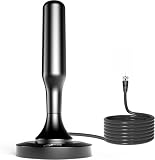
- 𝗡𝗲𝘃𝗲𝗿 𝗣𝗮𝘆 𝗠𝗼𝗻𝘁𝗵𝗹𝘆 𝗕𝗶𝗹𝗹: Watching local channels with this HD digital tv antenna for smart tv indoor 4K, you can watch crystal HDTV channels without cable service and enjoy local tv channels.
- 𝗜𝗻𝗱𝘂𝘀𝘁𝗿𝘆 𝗟𝗲𝗮𝗱𝗶𝗻𝗴 𝗧𝗲𝗰𝗵𝗻𝗼𝗹𝗼𝗴𝘆: This digital indoor tv antenna for local channels is made of eco-friendly flame-retardant dual PC soft material (not ordinary PVC), providing moisture resistance and lightning protection for indoor use.
- 𝗢𝗺𝗶𝗻𝗶-𝗱𝗶𝗿𝗲𝗰𝘁𝗶𝗼𝗻𝗮𝗹 𝗥𝗲𝗰𝗲𝗽𝘁𝗶𝗼𝗻 & 𝗠𝗮𝗴𝗻𝗲𝘁𝗶𝗰 𝗕𝗮𝘀𝗲: The indoor HDTV antenna brings omini-directional Reception; Whether hd digital tv antenna indoor is installed on the TV stand or on the table, you can receive the crystal clear picture
- 𝗖𝗼𝗺𝗽𝗮𝗰𝘁 𝗮𝗻𝗱 𝘀𝗺𝗮𝗹𝗹 𝗗𝗲𝘀𝗶𝗴𝗻: The indoor antenna for tv without cable features a compact and slim design, making it easy to hide without taking up space. The lightweight build allows you to move it conveniently and adapt to different living environments effortlessly.
- 𝗡𝗼𝘁𝗲 𝗮𝗻𝗱 𝗖𝘂𝘀𝘁𝗼𝗺𝗲𝗿 𝗦𝗲𝗿𝘃𝗶𝗰𝗲 : Read the manual first, set up your TV properly, and scan for channels. 𝐅𝐨𝐫 𝐨𝐩𝐭𝐢𝐦𝐚𝐥 𝐫𝐞𝐜𝐞𝐩𝐭𝐢𝐨𝐧, 𝐭𝐞𝐬𝐭 𝐛𝐨𝐭𝐡 𝐯𝐞𝐫𝐭𝐢𝐜𝐚𝐥 𝐚𝐧𝐝 𝐡𝐨𝐫𝐢𝐳𝐨𝐧𝐭𝐚𝐥 𝐩𝐥𝐚𝐜𝐞𝐦𝐞𝐧𝐭. Mount the antenna high, near a window facing local broadcast towers (Check "dtv gov maps" for available channels), to avoid obstacles and interference. Actual Reception depends on location, terrain, and weather, always re-scan for channels after moving the antenna. If you have any issues, please contact us. We will provide professional service and a satisfactory solution for you.
Why didn’t MUSE become the world HDTV standard?
Technical leadership did not settle the international standards contest. Seel’s 1998 history says Japan’s 1986 effort to promote the 1125-line, 60-Hz format internationally met European resistance and competing 1250-line, 50-Hz proposals. The United States later compared Narrow MUSE with emerging digital systems, and Seel reports that it did not fare well in that competition.
Seel also interprets Japan’s continued commitment to analog HDTV in light of institutional and industrial investments by NHK, government ministries, broadcasters, and manufacturers. That is a historical explanation of the policy and market trajectory, not a technical specification. As digital transmission developed and international standards coalesced around digital systems, MUSE’s specialized receiver requirements and analog broadcast approach became less attractive. Japan’s early lead produced a major engineering achievement, but not global adoption.
How did MUSE differ from later digital HDTV?
| Aspect | Hi-Vision and MUSE | Later digital HDTV systems |
|---|---|---|
| Picture format | 1125 lines, 60 fields per second, 2:1 interlaced production format. | Not specified in the historical sources cited here; digital HDTV systems used varying standards. |
| Delivery method | Satellite FM transmission, with MUSE reducing bandwidth to fit a constrained channel. | Digital transmission rather than MUSE’s FM satellite delivery; the cited historical sources do not establish a single later delivery specification. |
| Bandwidth strategy | Motion-adaptive subsampling and reconstruction reduced a reported 20 MHz baseband signal to 8.1 MHz. | Digital compression and transmission methods; comparable numerical values are not stated in the cited sources. |
| Motion and detail | Still areas could draw on information across four fields; moving areas were sent field by field at reduced resolution. | Not established as a single shared tradeoff; digital HDTV systems use different encoding approaches. |
| Receiver demands | Required dedicated decoding, memory, and signal processing. | Required compatible digital decoding; a directly comparable complexity figure is not stated in the cited sources. |
The comparison is about the design and delivery strategy, not a claim that all later digital HDTV used one format or compression scheme.
Quick Recap
Product prices and availability are accurate as of the date/time indicated and are subject to change. Any price and availability information displayed on Amazon at the time of purchase will apply.

