
In Windows 11, press Ctrl+Shift+Esc, open Performance > Memory, and check Speed. That is the current speed Windows reports. To tell whether it matches your RAM’s advertised speed, first confirm whether the number on the kit refers to a standard default profile or an optional XMP/EXPO profile, then account for what your CPU, motherboard, or PC supports.
Check the current speed in Windows 11
- Press Ctrl+Shift+Esc to open Task Manager.
- Select Performance, then Memory.
- Read the Speed field. This is Windows’ reported current memory speed, not a list of every profile stored on the RAM modules.
Compare that number with the profile you expect the system to be using. If the reading is unexpected, confirm it in UEFI/BIOS or with a separate utility rather than assuming Task Manager is always definitive. Microsoft documents an SMBIOS-related Task Manager discrepancy for supported Windows Server versions; that specific issue does not establish that all Windows 11 readings are inaccurate. Microsoft’s explanation of the discrepancy is scoped to those Windows Server versions.
Make sure you are comparing the same kind of speed
“Rated speed” can mean the standard JEDEC speed the system uses by default, or a higher advertised XMP or EXPO profile. A kit’s label alone does not show which profile is active. Intel describes XMP profiles as tested combinations of speed, timings, and voltage; enabling one requires a compatible system. Intel’s XMP documentation also advises checking motherboard and memory compatibility.
Pay attention to units, too. DDR memory transfers data twice per clock cycle, so a tool displaying the physical DRAM clock may show about half the effective transfer rate. For example, a clock near 1,500 MHz corresponds to roughly 3,000 MT/s. Some interfaces and product labels use “MHz” loosely for the effective rate; the different-looking numbers do not necessarily indicate a problem.
PC Slower Than It Used to Be?
A free scan shows the junk files, broken settings and background clutter dragging Windows down - then fixes them in one click.Free scan · Windows 10 & 11Crashes, No Sound, or Screen Glitches?
Random freezes, missing sound and display glitches usually trace back to one bad driver. Find and replace yours safely.Free scan · under a minute#1 Best Overall

- Disclaimer: Maximum Speed requires overclocking/PC BIOS adjustments. Maximum speed and performance depend on system components, including motherboard and CPU
- Hand-sorted memory chips ensure high performance with generous overclocking headroom
- VENGEANCE LPX is optimized for wide compatibility with the latest Intel and AMD DDR4 motherboards
- A low-profile height of just 34mm ensures that VENGEANCE LPX even fits in most small-form-factor builds
- A solid aluminum heatspreader efficiently dissipates heat from each module so that they consistently run at high clock speeds
If the reported speed is below the kit’s advertised profile
Confirm the kit’s profile and system support
Look up the exact memory kit model and determine whether its advertised figure is its standard profile or an optional XMP/EXPO setting. Then check the specifications and compatibility information for the exact CPU, motherboard, or prebuilt PC. A marketed profile is not a guarantee that every CPU and board combination will run it. AMD’s EXPO guidance applies to supported Ryzen processors for Socket AM5 and DDR5, and its compatibility list identifies kits tested across systems for rated speed and latency. AMD EXPO and compatibility information can help with that check.
Check the memory profile in UEFI/BIOS
Restart into UEFI/BIOS and look for the memory profile control. Depending on the vendor and platform, it may be labeled XMP, EXPO, or A-XMP. The exact menu path varies by motherboard, firmware version, OEM desktop, and laptop. Intel advises owners of OEM PCs and laptops to check with the system maker about XMP compatibility.
Rank #2

- Requires overclocking/BIOS adjustments. Maximum speed and performance depends on system components, including motherboard and CPU.
- G.SKILL RipjawsV Series DDR4 U-DIMM Memory Kit, Model: F4-3200C16D-16GVKB
- Non-ECC, DDR4 U-DIMM, 288-pin, for Desktop PC & Gaming
- Includes JEDEC default profile, and Intel XMP memory overclock profile
- Do not mix memory kits. Memory kits are sold in matched kits that are designed to run together as a set. Mixing memory kits will result in stability issues or system failure.
If the system supports the profile and you want to use it, select the appropriate setting, save, and restart. MSI’s Click BIOS X guide, for example, shows selecting XMP1 or EXPO1; this is an example menu, not a universal path. MSI’s Click BIOS X instructions illustrate the process.
After restarting, return to Task Manager’s Performance > Memory page and check Speed again. If the PC will not boot or becomes unstable, return to a supported setting and follow the PC or motherboard manufacturer’s guidance. Avoid guessing at voltage or timing adjustments.
Rank #3
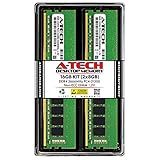
- Compatible with select DDR4 Desktop computers + Easy to install at home, no expertise required
- Maximize your system's performance, boost loading speeds and multitask with ease
- Backed by A-Tech's Lifetime Warranty + Friendly tech support team available to help before and after your purchase
- 16GB RAM Kit ( 2 x 8GB Modules ) | DDR4 DIMM 288-Pin | Speeds up to 2666MHz (2667MHz), PC4-21300 / PC4-2666V
- NON-ECC Unbuffered | 1Rx8 or 2Rx8 - Single or Dual Rank | JEDEC DDR4 standard 1.2V
XMP and EXPO are memory-overclocking profiles relative to default settings, not guaranteed operating rates for every system. Intel characterizes XMP as overclocking; AMD warns that overclocking outside published specifications carries risks and may affect warranty coverage. Use the profile only when you accept those conditions and your system documentation supports it.
Independent reader supportYour contribution helps us test, update, and keep practical guides available for everyone.Cross-check with CPU-Z
CPU-Z is a Windows system-information utility that provides a separate view of memory information:
Rank #4

- Boosts System Performance:16GB DDR4 laptop memory RAM kit (2x8GB) that operates at 3200MHz to improve multitasking and system responsiveness for smoother performance
- Easy Installation: Upgrade your laptop RAM with ease—no computer skills required Follow step-by-step how-to guides available at Crucial for a smooth, worry-free installation
- Compatibility Guaranteed: Ensure seamless compatibility with your laptop by using the Crucial System Scanner or Crucial Upgrade Selector—get accurate recommendations for your specific device
- Trusted Micron Quality: Backed by 42 years of memory expertise, this DDR4 RAM is rigorously tested at both component and module levels, ensuring top performance and reliability
- ECC Type = Non-ECC, Form Factor = SODIMM, Pin Count = 260-pin, PC Speed = PC4-25600, Voltage = 1.2V, Rank and Configuration = 1Rx16, 1Rx8 or 2Rx8
- On the Memory tab, check the current DRAM Frequency and timings. The frequency is the physical clock, so it may be roughly half the effective DDR transfer rate.
- On the SPD tab, view module identification and stored profile information. That data describes what the module reports it can support; it does not by itself prove which frequency is active.
For instance, a DRAM Frequency near 1,497 MHz is consistent with an effective rate around 3,000 MT/s. This is a unit-conversion example, not a recommendation for a particular product.
Quick Recap
What each check tells you
| Check | What it shows | What it cannot establish by itself |
|---|---|---|
| Task Manager, Performance > Memory | Windows’ reported current memory speed. | Every stored module profile or whether a higher profile is supported by the whole system. |
| CPU-Z Memory tab | Current DRAM frequency and timings. | Whether the shown physical clock matches the effective DDR rate unless you account for the doubled transfer rate. |
| CPU-Z SPD tab | Module identification and stored profile information. | Proof that a stored profile is currently active. |
| UEFI/BIOS | Configured memory profile and related firmware settings. | A guarantee that the setting will be stable on every CPU, board, or system configuration. |
Product prices and availability are accurate as of the date/time indicated and are subject to change. Any price and availability information displayed on Amazon at the time of purchase will apply.
What’s actually slowing this PC down?
Pick the symptom - the matching free tool is one click away.

