
Multi-sense sensing combines different sensing methods in one system—often one microcontroller—so a design can detect more than one kind of input without adding a separate controller for each function. It can simplify an appliance’s electronics and board layout, but the savings depend on the design; available sources do not quantify total-system cost, energy, or engineering time for a specific product.
The featured example comes from an Infineon-sponsored EE Times article by Vibheesh Bharathan, Infineon’s Director of Marketing and Project Lead for PSoC 4 Multi-Sense, published April 22, 2025. Its product claims should be read as vendor claims, not independent test results.
What does multi-sense sensing mean?
Multi-sensing is a design approach: combine sensing capabilities that might otherwise use separate devices or channels in one system. It is not one universal sensor technology. The implementation described in EE Times’ sponsored article brings capacitive, inductive, and liquid-level sensing together in an MCU-based design.
Capacitive sensing
Capacitive sensing detects changes in capacitance caused by nearby conductive or dielectric material. It is commonly used for touchscreens, touch buttons, and proximity detection; depending on the implementation, it can also be used to detect humidity or liquid level.
Inductive sensing
Inductive sensing drives a coil with an alternating magnetic field and detects changes caused by nearby conductive material, including induced eddy currents. That makes it useful for detecting metal targets, such as metal-surface HMI controls, and for some harsh-environment or position-tracking applications.
Liquid sensing
Liquid sensing can detect presence, level, flow, or composition. The appropriate method depends on the task and may be capacitive, ultrasonic, optical, or conductive. “Liquid sensing” therefore describes a goal, not a single sensing mechanism.
#1 Best Overall

- 【New-Gen Multi-Sensor Fusion Edge AI Chip】Hidden camera detectors equipped with multi-sensor AI chip, it runs lightweight deep learning algorithms locally without cloud computing. The chip cross-analyzes RF radio waves, magnetic induction and infrared lens reflection data simultaneously, intelligently filter interference from routers, mobile phones and household electronics, cutting false alarms by over 90% while locking pinhole cameras, wireless bugs and magnetic GPS trackers accurately.
- 【9-in-1 Complete Privacy Guard】Combines 9 practical detection & alert functions, covering hidden camera scanning, RF signal detection, magnetic GPS tracker locating, audio bug tracing, infrared lens recognition, laser detection night vision camera, electromagnetic interference filtering, SOS emergency alarm and abnormal motion detection. camera detector works perfectly in hotels, offices, vehicles, fitting rooms and meeting rooms to block all potential privacy threats comprehensively.
- 【6 Levels of Sensitivity & Precise Target Locating Scan Mode】Hidden camera detector features six levels of adjustable detection sensitivity, Adopts segmented signal attenuation positioning technology, Built-in high-brightness concentrated IR light array amplifies tiny lens reflections, even ultra-mini pinhole cameras concealed in wall holes can be visually pinpointed without extra auxiliary tools. Perfect for deep inspection of Airbnb rooms, fitting rooms and business vehicle interiors.
- 【3-in-1 AI Sentinel Alarm System& Green Night Vision Laser】Once the radio frequency detector abnormal motion, and the spy detector will emit vibration, buzzer sound and strobe triple alarms. A self-developed cat-e ye night vision detection algorithm keenly captures infrared nanometer wave signals from hidden cameras; laser full-area scanning combined with a green light guide precisely locks onto night vision lenses, leaving no place for various hidden pinhole night vision cameras to hide.
- 【Fast Charging & Ultra-Long Standby】Privacy pen upgraded large-capacity 2000 mAh low-power consumption lithium battery, within 1 hour via Full charge quickly (compatible with phone power bank, laptop charger). Achieves continuous 8-hour non-stop scanning or can achieve 50 days of long standby time when not in use. No need to carry extra dedicated chargers during cross-city business trips, overseas travel or long road trips; solves the trouble of frequent power loss of traditional detectors.
How could one MCU handle several appliance functions?
The article’s illustrative coffee-machine design uses one PSoC 4 MCU to detect water in the tank, operate touch controls on a metal front panel, and perform system-control functions. The example shows how different modalities can complement one another: capacitive sensing can serve touch and liquid-level functions, while inductive sensing can detect metal targets. It is an illustration in sponsored content, not a reported independent deployment or test.
Infineon also documents touch and HMI applications for induction cooking and microwave ovens. Its application pages describe intended uses, reference designs, responsive or liquid-resistant interfaces, and goals such as reducing chip count and PCB space; these are vendor descriptions rather than comparative product tests.
Where can time, energy, and cost savings come from?
Fewer components and less board complexity
If one MCU can replace multiple sensing devices or controllers, a design may need fewer components, less PCB area, and less assembly work. Infineon presents these as potential benefits of integrating sensing functions. Whether the complete product is cheaper depends on the sensors, MCU, board, validation, and manufacturing process in the particular design.
Rank #2

- 【High-Precision Radar Sensing】Unlike traditional PIR motion sensors, this advanced 24GHz millimeter wave radar sensor can stably detect human presence even when people are sitting still or stationary, ensuring accurate detection in bathrooms, bedrooms, living rooms and other home scenarios.
- 【Wide Zigbee Compatibility】 A Zigbee Hub is required. Works seamlessly with Echo devices (4th Gen, Plus, Studio, Show 10/8), SmartThings, Home Assistant, Hubitat, Tuya, and more.
- 【True Presence Automation】 Create smart routines in Alexa: lights turn on instantly when you enter, and stay on while you are present—even if you are reading or sleeping motionless. Solves the "lights turning off" issue of standard motion sensors.
- GREAT RANGE AND LONG BATTERY LIFE : Capable of detecting motion up to 20 feet (6 meters) away. 2 AAA batteries can last for 2 years in typical usage.
- 【Detects Even When You Are Still】 Say goodbye to waving your hands to keep the lights on! This Zigbee Human Presence Sensor uses sensitive radar waves to detect your presence even when you are sitting perfectly still, sleeping, or reading. It brings a truly intelligent experience to your home automation.
Potential power reduction
Infineon says fifth-generation CAPSENSE in PSoC 4000T has up to 10× lower power consumption than previous generations. Its technical blog attributes the reduction to autonomous always-on sensing and Multi-Sense operation that can leave the CPU dormant. This is a vendor comparison between generations, not a measured energy saving for every finished appliance.
Less integration work, potentially
Infineon’s ModusToolbox Sensor Designer is described as a GUI-based environment for using preconfigured sensor libraries, configuring and tuning sensors, real-time debugging, and autotuning. These tools may help engineers bring up a design, but the sources do not provide a measured reduction in development time.
Rank #3

- [Multiple Detection Zones & Headcount Automations] A single FP400 can replace multiple traditional presence sensors by dividing large spaces into independent custom zones with real-time headcount tracking for up to 10 people. Leveraging precise location, zone tracking, and occupant counts, you can create tailored automations—such as lighting up the kitchen island upon approach, activating a movie scene when someone is detected in the sofa zone, or adjusting A/C based on how many people are in a room.
- [AI Spatial Understanding & Adjustable Sensitivity] No longer will lights randomly turn on from a blowing curtain or shut off while you’re lounging on the couch. With next-gen 60GHz mmWave radar that has 5x the point-cloud density of previous generations, the FP400 combines AI background learning with 3 adjustable sensitivity levels. Set high sensitivity in study or reading zones to capture micro-movements to keep the lights on, and lower it in high-traffic areas to filter out environmental noise, drastically reducing false triggers for highly reliable occupancy tracking.
- [Matter over Thread & Zigbee Connectivity] FP400 supports Thread+Zigbee, compatible with Apple Home, Home Assistant, Google Home, Alexa and SmartThings. With a Thread Border Router, up to 8 custom zone occupancy sensors can sync directly to your Matter platform(*Aqara Home App v6.4.1+ is needed. Availability differs by device/platform.)
- [AI-Assisted Spatial Setup] Setting up multi-zone radar tracking no longer requires complex environmental calibration or tedious grid drawing from scratch. Using AI enhanced software, the FP400 identifies and generates room boundaries, entrance/exit doors, and learns to exclude background noise in real time. Create and define your custom automation zones in under a minute, ensuring a quick, easy setup experience for your space.
- [Flexible Mounting & 120° Wide Coverage] Eliminate dead zones in any room layout with ultimate placement flexibility. Featuring a 120° ultra-wide field of view and a magnetic base, the FP400 supports side, corner, ceiling mounting. Achieve up to a 10×8m(32.8×26.2 ft) detection reach when side-mounted, a full 7x7m (23x23 ft) sweep to cover entire room corners, or a 5-6m ceiling zone at a 3m (10 ft) height—delivering optimized, privacy-friendly coverage across versatile spaces.
For the cited product claims, Infineon’s home-appliances page also frames integration as a way to reduce chip count, PCB space, and assembly complexity. No independent head-to-head study or end-to-end measurement of time, energy, or cost for a named product design is established by the cited sources.
What do Infineon’s 10× figures actually mean?
Infineon reports two distinct comparisons for PSoC 4000T’s fifth-generation CAPSENSE, each against a previous generation:
Rank #4
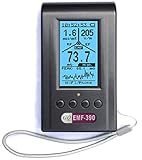
- Multiple high sensitivity sensors installed for detecting Power line, Smart meter, Cell phone, Microwave etc.
- Identify/recognize the common possible sources, such as Power line, Cell Tower, Microwave, Static etc.
- Safety suggestion lets you understand current situation instantly.
- Detects 5G network signal and RF up to 10Ghz
- Built-in RF Spectrum analyzer and GQ RF Browser for real time RF monitoring.
| Claim | What is being compared | Qualification |
|---|---|---|
| 10× better signal-to-noise ratio | Fifth-generation CAPSENSE in PSoC 4000T versus the previous generation | Infineon-reported figure; the cited vendor page does not establish an independent test result for a finished product. |
| Up to 10× lower power consumption | PSoC 4000T controller versus previous generations | Infineon-reported comparison; the actual power outcome in an appliance depends on its design and operating conditions. |
The vendor blog attributes the signal-to-noise improvement to a ratio-metric architecture and differential sensing front end. Neither figure means that an entire appliance will achieve ten times better overall performance or use one tenth the total energy.
Independent reader supportYour contribution helps us test, update, and keep practical guides available for everyone.Which devices and development resources are relevant?
The EE Times article identifies PSoC 4000T and PSoC 4100T Plus as PSoC 4 Multi-Sense MCU examples, with capacitive, inductive, and liquid-level sensing capabilities. It describes a migration path from earlier PSoC 4000/4000S devices based on software and package compatibility. That is the vendor’s stated path; it does not establish that every older design can transfer without changes.
Best Value

- Record and playback your own speech, music or sound effects using the built-in microphone and high-quality speaker. Includes 3 volume level options.
- Our PIR Motion Sensors also have a unique MP3 sound file download feature. Upload your own MP3 voice messages, music or sound effects using the USB socket. 4MB internal memory provides up to 8 minutes playback.
- Your sound file will playback automatically after the PIR sensor detects movement within 4 metres. Select a Single-Track playback or a Multi-Track Loop feature.
- Create audio signs and talking posters. Raise attention and create impact by adding speech, music or sound effects to a point-of-sale display.
- Create a security alarm or an audible caution warning for hazardous areas. Offer support to people living with Dementia or Alzheimer's by recording reminders or step-by-step instructions.
For prototyping, Infineon’s home-appliance materials point engineers to PSoC 4000T prototyping kits. Confirm the exact MCU, package, kit compatibility, and required software before choosing hardware; the cited materials do not specify a verified kit SKU. The company’s microwave-oven and induction-cooking pages provide further examples of the application areas it targets.
What’s actually slowing this PC down?
Pick the symptom - the matching free tool is one click away.
How should an engineer decide whether to use multi-sensing?
Start with the sensing tasks and materials, not the promise of integration. A useful evaluation should establish:
- What must be detected—touch, proximity, metal position, liquid presence, level, flow, or another property—and whether sensing must be contact or non-contact.
- How the target material and environment affect readings, including liquid exposure, humidity, temperature, and electrical noise.
- Whether the MCU’s sensing channels, signal-to-noise performance, and power behavior fit the intended operating modes.
- Whether the available sensor libraries, tuning tools, package options, and migration path match the existing design.
- How the integrated approach compares with separate components using the project’s own BOM, board area, power budget, assembly needs, and engineering effort.
The available sources do not compare competing vendors or provide apples-to-apples measurements on those criteria. A prototype in the intended enclosure and operating environment is needed to establish whether integration delivers a net benefit in a particular product.
Quick Recap
Product prices and availability are accurate as of the date/time indicated and are subject to change. Any price and availability information displayed on Amazon at the time of purchase will apply.

