
A Thunderbolt add-in card is not a universal PCIe upgrade: it works only when the motherboard supports that specific card and the required slot, headers, power, firmware, and BIOS settings are in place. Check exact motherboard-and-card compatibility first; then troubleshoot installation, Windows recognition, peripherals, and video as separate problems.
First, confirm the motherboard supports the exact card
A free PCIe slot—or a USB-C port on the computer—does not establish Thunderbolt add-in card support. The card can depend on motherboard hardware, a specific header, and compatible firmware. PreSonus explains that an add-in card will not work on a system without native motherboard Thunderbolt support, while ASUS directs users to check its compatibility list. See PreSonus’s Thunderbolt compatibility guidance and ASUS’s ThunderboltEX 4 compatibility information.
- Find the exact motherboard model and revision, then check the card maker’s compatibility list for that board.
- Read the motherboard manual for the supported Thunderbolt card, required header, and permitted PCIe slot.
- Verify the card generation and the motherboard’s BIOS support. Do not assume a similar-looking header or USB-C connection is sufficient.
If the board is not listed as compatible or its manual does not support the card, driver changes are unlikely to make the card work. ASRock’s Thunderbolt 3 AIC manual cautions that motherboard BIOS and hardware design can affect the card’s Thunderbolt port functionality.
Check the physical installation and connections
Shut down the computer and disconnect power before opening the case. Use the PCIe slot specified in the motherboard and card documentation, and make sure the card is fully seated. Depending on the model, the card may also need a Thunderbolt motherboard-header cable, a USB 2.0 header connection, auxiliary PCIe power, and a DisplayPort input cable.
#1 Best Overall
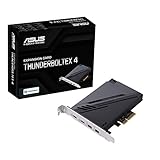
- 1. Intel Thunderbolt 4 JHL 8540 controller
- 2. Ultrafast connectivity: Two Type-C ports with USB 4 support, up to 40Gb/s bi-directional bandwidth, per port allows you to connect up to five Thunderbolt-enabled devices in a daisy-chain configuration using Thunderbolt cables.
- DisplayPort 1.4: support up to 8K resolution monitors
- Quick charge solution: up to 100W quick charge
- PCIe slot: Confirm the required slot and any lane or slot-sharing restrictions in the motherboard manual.
- Thunderbolt header: Connect the correct cable between the card and the board, checking both ends.
- Other required connections: Attach USB 2.0 or auxiliary power only if the card’s manual calls for them.
- DisplayPort input: If you need video through the card, connect its DisplayPort input to the intended motherboard or graphics-card output. This is separate from the card’s PCIe connection.
For its ThunderboltEX 4 installation, ASUS describes the required connections and graphics-source considerations in its ThunderboltEX 4 FAQ. ASRock’s AIC manual likewise directs users to the motherboard documentation for the proper slot and connections.
Enable Thunderbolt in BIOS or UEFI
Firmware settings vary by motherboard maker, model, and generation. Find the Thunderbolt or discrete Thunderbolt support option in the specific board’s manual, enable it, save changes, and restart. Do not rely on a menu path written for another board.
Rank #2

- Intel certified Thunderbolt 5 add-on card
- Dual USB Type-C ports support up to 130 watts total of fast charging, and up to 96W for one device
- Up to five Thunderbolt devices can be daisy-chained
- Up to 120 Gbps of bandwidth for superfast data transfers and video output
- DisplayPort 2.1 port supports up to three 8K 60 Hz displays with DSC
- ASUS’s example setup places “Thunderbolt/USB4 Support” under Advanced > AMD PBS.
- ASRock documents different paths for X570 boards and other models in its AIC manual.
- MSI’s instructions apply to the named Z390 boards in its Thunderbolt BIOS guidance; they are not a universal procedure for MSI boards.
If the setting is missing, check whether the exact board supports the card and whether a required BIOS version or configuration is specified by its manufacturer.
Check PCIe slot and lane constraints
A slot that appears physically suitable may not be available for the card in every CPU or slot configuration. Some motherboards share or reserve PCIe lanes. Consult the board’s lane table and the AIC’s slot requirements before moving the card or changing other components.
Recommended Free Tools
Rank #3

- Ports: 2 x Thunderbolt 3 (USB Type-C)
- PCIe and Lanes: PCIe Gen3 x 4
- Bracket: Low-profile pre-installed; full-height
- Form factor: Low-profile
For example, ASRock’s X299 FAQ, dated October 1, 2017, lists different available slots for processors with 44, 28, or 16 PCIe lanes. That example applies to the specified X299 platform, not to all motherboards. See ASRock’s X299 Thunderbolt AIC FAQ.
Separate controller detection from peripheral detection
Once compatibility, installation, and firmware are confirmed, check Windows recognition. Follow the motherboard or card maker’s instructions for BIOS updates, Thunderbolt controller firmware, controller drivers, and any required Intel Management Engine driver. There is no single driver package established for every card, motherboard, and Windows version; use packages intended for your specific platform.
Rank #4

- User-installable Thunderbolt 3 Option card for Apollo rackmount interfaces
- Two Thunderbolt 3 USB-C ports for daisy-chaining Apollos or peripherals
- Thunderbolt 3 delivers up to 40 Gbps for high bandwidth peripherals such as dual 4K displays and hard drives
- Provides 15W bus power to downstream Thunderbolt peripherals
- Requires macOS Sierra/High Sierra or Windows 10 w/Anniversary (64-bit Edition)
- Check Device Manager for the Thunderbolt controller and any unknown PCI device. If a device is unknown, install or reinstall the correct vendor-provided driver.
- Open the Thunderbolt management software, if your setup uses it, and check whether it detects the connected peripheral.
- If the software sees the device but Device Manager does not, check whether the device needs approval in the Thunderbolt software. Antelope describes this authorization step in its Thunderbolt connectivity troubleshooting guidance.
- Use only firmware and drivers that the motherboard or card maker specifies for your model. Avoid generic or cross-generation packages unless the manufacturer directs you to them.
A visible controller with a missing peripheral points to a different part of the chain than a controller that is not detected at all. In the former case, authorization, the cable or adapter, and the peripheral’s compatibility deserve attention.
Check the cable and peripheral
USB-C describes a connector shape, not proof that a cable, port, or peripheral supports Thunderbolt. Use a Thunderbolt-rated cable suitable for the connection, and check the peripheral’s own host and cable requirements. ASUS explicitly instructs users to use a Thunderbolt cable for Thunderbolt device connections rather than substituting an ordinary Type-C cable in its ThunderboltEX 4 FAQ.
Best Value

- 1.The USB PCIE card can be easily upgraded to 2x USB C and 2x USB A ports by inserting it into the PCIE x1 slot of your computer.The card also comes with an external 19-pin connector and a USB 20-pin Type E port inside that can be flexibly extended to the front panel of the computer as needed without the need for an additional power supply, thus solving the problem of fewer USB ports on the host computer.To help address your unique requirements and enable hassle-free setup on any computer, we additionally equip a standard PC chassis 12 cm bracket (installed) and a small tower chassis 8 cm short bracket
- 2.The card offers theoretical data transfer speeds of up to 5Gbps bandwidth,which is 10x faster than USB 2.0.Ideal for file backup,video editing and data recovery. Note: Actual transfer speeds may be limited by the connected device - USB-C ports aren't compatible with the Thunderbolt protocol
- 3.Compatible with PCIe 3.0 and PCIe 2.0 motherboards for PCI Express x1, x4, x8, x16 slots. Operating system support for Windows XP/Vista/2008 Server/7/8/10 and Linux Mint, Ubuntu 20.04. (Mac isn't supported.) Note: Driver installation is required for Windows XP,Vista/7, Server,not required for Windows 10 .If there are compatibility issues/not working, let me konw
- 4.The internal circuitry has four power supply modules,which eliminate the need for an additional power adapter for installation.the PCIe USB card draws power directly from the PCI-E slots inside the motherboard. Each connector is individually fused with intelligent overcurrent and short-circuit protection to protect your computer equipment
- 5.When installing,note that since the pcie card USB port is vertical, first insert the USB flash drive/USB cable into the card's USB slot to seat it.Then tighten the screws,close the PC case cover, turn on the PC and install the driver. For the narrow slot area at the rear of the PC mainframe, simply cut one of the slot's crossbars with small sheet metal hand pliers
For an older Thunderbolt 2 peripheral connected to a Thunderbolt 3 host, the required adapter and configuration matter. Antelope reports adapter-related communication problems in some setups and recommends trying another adapter when a device works only after startup. Its troubleshooting guidance also suggests temporarily disabling BIOS USB power-saving features as a diagnostic test. Change one setting at a time and record the original value so you can undo changes that do not help.
Independent reader supportYour contribution helps us test, update, and keep practical guides available for everyone.Treat display failure as a separate problem
A card can be detected for Thunderbolt data while video still fails. DisplayPort video needs a separate input path: check that the cable runs from the intended graphics output to the AIC’s DisplayPort input. If you use a motherboard graphics output, the integrated graphics source must be available; if you use a discrete GPU, install its graphics driver. ASUS covers these source and driver requirements in its ThunderboltEX 4 FAQ.
After verifying the input path, check the AIC driver and the monitor or peripheral’s supported resolution and connection capabilities. A working Thunderbolt data connection does not, by itself, confirm that the video path is connected correctly.
What to compare before replacing or upgrading a card
Check these specifications for the exact motherboard revision and card model before buying. A replacement is not a fix for a motherboard that does not support the card.
What’s actually slowing this PC down?
Pick the symptom - the matching free tool is one click away.
| Compatibility point | What to verify |
|---|---|
| Motherboard | Exact model and revision appear in the card maker’s compatibility information. |
| Thunderbolt generation | The card and peripheral support the connection standard and any adapter the setup requires. |
| PCIe slot and lanes | The motherboard manual identifies a suitable slot for the card under your CPU and slot configuration. |
| Headers and cables | The board has the required header type, and the correct cable is included or available. |
| Auxiliary power | Check whether the card requires a separate power connection. |
| Video routing | Determine whether DisplayPort input is needed and whether the intended GPU or integrated graphics can supply it. |
ASUS’s ThunderboltEX 4 compatibility information is relevant only to boards on its compatibility list; it is a possible upgrade for a supported system, not a universal remedy. ASRock’s AIC manual similarly emphasizes that motherboard hardware and BIOS affect functionality.
Quick Recap
Product prices and availability are accurate as of the date/time indicated and are subject to change. Any price and availability information displayed on Amazon at the time of purchase will apply.

