
The Tool Desk
Outbyte Driver Updater FREEScan for outdated or missing drivers - takes under a minuteDriver Scan →Outbyte PC Repair FREEClear out junk files and repair common Windows errorsFree Scan →You do not need complete information to make a considered decision. You need enough to choose responsibly, a clear view of what remains uncertain, and a plan to revisit the choice if important facts change. Waiting can be the right move—but it is still a choice with possible costs.
Why decisions rarely come with complete information
Important choices often involve unknowns: what another person will do, whether a plan will work, or how circumstances may change. The aim is not to make uncertainty disappear. It is to distinguish what you know from what you assume, then decide whether the remaining uncertainty is acceptable for this particular choice.


UK intelligence guidance puts the limit plainly: “Intelligence analysts seek to resolve uncertainty but cannot fully eliminate it.” That guidance concerns professional intelligence assessment, not personal decision-making, but the underlying point is useful: confidence should not be confused with certainty. UK Government, Explaining Uncertainty in UK Intelligence Assessment (published 24 March 2025)
A practical process for deciding with uncertainty
Use these steps to make the choice, the information gaps, and the next action explicit. This is a practical adaptation of methods used in safety and professional risk assessment; it is not a validated self-help intervention or a guarantee of a good outcome.
What’s actually slowing this PC down?
Pick the symptom - the matching free tool is one click away.
#1 Best Overall
1. Set the decision window
Write down when a choice is needed and how long you can reasonably spend gathering information. A deadline can prevent endless research, while a decision made too quickly may overlook a meaningful check. Include the cost of waiting: a delayed response, missed opportunity, or a problem that may worsen.
The UK Government’s TDODAR model begins with Time, followed by Diagnosis, Options, Decide, Assign, and Review. It is a safety-context model, not a universal formula, but its sequence is a useful reminder to consider time before exploring options. The guidance recommends choosing a model that is memorable and works for you. UK Government, Leading for safety: 2. Decision making and risk management
Rank #2
2. State the decision in one sentence
Separate the choice itself from the surrounding worry. For example: “Do I accept this role by Friday?” is more actionable than “What if I make the wrong career move?” Add what outcome matters most and any constraints you cannot ignore, such as a fixed budget, health needs, or a required date.
3. List plausible options, including waiting when it is genuinely available
Keep the list manageable. Depending on the situation, options might include acting now, gathering one specific piece of information, trying a reversible small step, or waiting until a defined date. For each, consider the likely outcome relative to your goal, time to act, how easy it is to reverse, and what could go wrong if it fails.
Do not assign precise probabilities just to make a choice look scientific. If you do use probabilities, state what evidence or assumptions they rely on. Also compare the consequences of acting with those of not acting: inaction is not automatically the risk-free option. The National Academies’ Principles for Decision Making Under Uncertainty (2022) addresses decisions in a technical health context, including PFAS; its subject is different from everyday choices, but it underscores the need to consider uncertainty and the consequences of alternatives.
4. Ask whether more information could change the choice
Before researching further, name the unanswered question and ask what you would do differently depending on the answer. If the answer would not change your choice, or if the check would take more time or money than it is worth, additional analysis may not help.
EFSA’s professional guidance says uncertainty analysis should be refined as far as needed to inform a decision. When the desired precision is infeasible or too costly, decision-makers may manage the uncertainty instead of trying to eliminate it. This is scientific risk-assessment guidance, not a rule that every personal decision should follow. EFSA, Uncertainty Tutorial: Key principles
5. Choose and record what remains uncertain
Once the decision window closes and useful checks are complete, write a short note with four parts:
Do these 3 things before closing this tab:
1Scan for outdated or missing drivers - takes under a minute2Clear out junk files and repair common Windows errors3Fix the driver behind crashes, sound loss and screen glitchesBest Value
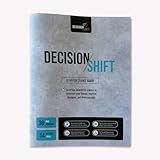
- MAKE BETTER DECISIONS, FASTER: Overcome decision fatigue and stop overthinking with a proven, science backed Productivity guidebook that keeps it simple and sharp. No dates, no Pressure just a clear flexible Undated framework. With our Playbook, gain clarity & confidence to make smarter daily choices quickly - whether at work, home or in life. “Smart decisions start here”
- DECISION QUADRANTS & GUIDED EXERCISES: Level up your decision making with tools like the Decision Quadrant & Guided Prompts. Get clear explanations of biases, heuristics and slow vs. fast thinking. Apply these insights instantly through guided exercises. This Workbook style Organizer is perfect for use as a Productivity Planner or journal - plus, it comes with a free downloadable template you can use again and again.
- TIME & ENERGY SAVING FRAMEWORK: Use this Priority Decision guide with a clear, structured system to focus on what matters most. Categorize decisions in the Time blocking planner by impact & difficulty. streamline low value choices & match your effort to their importance. This Personal Growth tracker helps you make behavior shifts that free up mental energy, reduce stress & move from reactive to proactive thinking.
- VERSATILE USAGE FOR LIFE, WORK & WELLNESS: This Life Companion brings clarity & confident decisions making to every area of life. Build stronger leadership, sharpen your strategy and make smarter career moves with this all-in-one Framework. Take control of your money by using goal setting guide & behavioural science to guide your spending, saving & investing - "For every goal and every role."
- PREMIUM 8.5” x 11” DESIGN: This elegant, compact and durable workbook is built to last. The Brain Dump notepad blends professional style with everyday functionality, making it the perfect task companion for your desk, bag or office. Lightweight and easy to carry wherever you go, this daily Reflection journal features a generous 8.5” x 11” size that fits seamlessly into your Premium collection.
- Known: the facts you can verify.
- Assumed: what you are treating as likely but have not confirmed.
- Unknown: the uncertainty you cannot resolve in time or at reasonable cost.
- Reconsideration trigger: a specific new fact or event that would make you review the choice.
This does not remove risk, but it makes the basis for the decision clearer. EFSA’s guidance on expressing uncertainty emphasizes describing uncertainty and limitations rather than masking them with confident-sounding language. EFSA, Uncertainty Tutorial: Uncertainty expressions
6. Review the result at a useful time
Set a review point that fits the decision—after a trial period, once a deadline passes, or when a key assumption can be checked. Ask whether the action addressed the problem and whether the assumptions held. If the outcome was imperfect, identify what you learned; an unfavorable result does not by itself prove that the decision was unreasonable given what was known at the time.
Independent reader supportYour contribution helps us test, update, and keep practical guides available for everyone.When this approach is not enough
For serious health, legal, financial, or safety decisions, a general decision process cannot replace qualified advice or evidence specific to your circumstances. Identify the right professional or authoritative source, check whether there are urgent deadlines, and ask what is known, what remains uncertain, and what risks come with waiting. The National Academies source cited above concerns a specialized health-decision context; it should not be treated as individualized medical guidance.
How to make the next decision easier
Use the same brief record each time: the decision and deadline, the main options, the most important unknown, the one check most likely to change your choice, and the trigger for review. Over time, this can help you notice whether you tend to over-investigate, decide before checking a critical fact, or overlook the cost of waiting. Treat those observations as prompts for a better process—not proof that you can control every outcome.
Outdated Drivers Are Slowing You Down
One free scan finds every outdated or missing driver and matches the right update for your exact hardware.Free scan · exact hardware matchPC Slower Than It Used to Be?
A free scan shows the junk files, broken settings and background clutter dragging Windows down - then fixes them in one click.Free scan · Windows 10 & 11Quick Recap
Product prices and availability are accurate as of the date/time indicated and are subject to change. Any price and availability information displayed on Amazon at the time of purchase will apply.

