
Quick wins for a faster PC:
Clear out junk files and repair common Windows errorsFree Scan →Scan for outdated or missing drivers - takes under a minuteDriver Scan →Repair Windows errors before they cause bigger problemsFix Now →If a 10GbE connection reports a 1Gbps link, check the operational speed at both endpoints, verify that the exact ports and their settings support 10GbE, then isolate the cable or transceivers with known-good compatible components. A low traffic-test result alone does not prove the link negotiated at 1Gbps.
First confirm the negotiated link speed
Read the NIC’s reported link speed and the switch port’s operational speed. Check both ends: a device may have a mix of 1GbE and 10GbE ports, and the port you selected may not support 10GbE. Link speed is a negotiated connection state; application throughput tests measure traffic performance and cannot establish the link rate on their own.
Record the adapter model, driver and firmware versions, operating system, switch model, port numbers, transceiver part numbers, and cable type. These details help you compare the setup with the right manuals and make each subsequent test useful.
Check port capability and speed configuration
Consult documentation for the exact switch model, port, and software release. Look for a port set to 1Gbps, a port profile that limits speed, a breakout configuration, or a hardware capability restriction. Both endpoints and the selected ports must support the intended speed.
#1 Best Overall
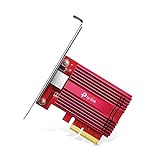
- 10 Gbps PCIe Network Card: With the latest 10GBase-T Technology, TX401 delivers extreme speeds of up to 10 Gbps, which is 10× faster than typical Gigabit adapters, guaranteeing smooth data transmissions for both internet access and local data transmissions[1]
- Versatile Compatibility: With extreme speed and ultra-low latency, 10GBase-T is backwards compatible with multiple data rates (10 Gbps, 5 Gbps, 2.5 Gbps, 1 Gbps, 100 Mbps), automatically negotiating between higher and lower speed connections
- QoS: Quality of Service technology delivers prioritized performance for gamers and ensures to avoid network congestion for PC gaming
- Free CAT6A Ethernet Cable: To maximize TX401's performance, a 1.5 m CAT6A Ethernet Cable is included—rated for up to 10 Gbps while a regular cable is only rated for 1 Gbps
- Low-Profile and Full-Height Brackets: In addition to the standard bracket, a low-profile bracket is provided for mini tower computer cases
Configuration behavior is platform-specific. For example, Cisco’s Nexus 5500 Series NX-OS Interfaces Configuration Guide, Release 7.x says, “By default, all ports are 10 Gigabits,” and documents 1000 and 10000 speed options for relevant interfaces. It also says negotiation configuration does not apply to its 10-Gigabit ports. Those statements describe that platform and guide, not every 10GbE switch.
Match the physical medium and components
Identify whether the path is copper, fiber, or direct attach. Check the manuals and compatibility guides for both endpoints. The cable or transceivers must match the ports, supported link rate, connector and transceiver family, and supported distance; components that work individually are not necessarily compatible as a pair.
Rank #2

- 10GbE Performance & USB-C Requirements: Upgrade to fast wired networking with this USB C to 10Gb Ethernet adapter, supporting 10G/5G/2.5G/1G/100M auto-negotiation for broad compatibility. Great for NAS access, large backups, content workflows, and low-latency gaming. Note: 10GbE is the theoretical link rate; real-world Windows throughput is typically ~7Gbps depending on setup. For best results, use a USB 3.2 Gen 2x2 (20Gbps) USB-C port or higher.
- Real-World macOS Speed: Compatible with Thunderbolt 3/4/5 and USB4 ports. On Macs, macOS may report a 5Gb link rate, while typical real-world throughput is ~5Gbps depending on the Mac model, network equipment, cabling, and test method. We continuously validate macOS performance and publish the latest notes and updates on our support page.
- Stable Performance with Advanced Chipset: Powered by the Realtek RTL8159 USB 10G controller for efficient power use and minimal heat in typical operation. Designed to address the heat concerns common with some 10GbE adapters, this 10Gb Ethernet to USB C adapter delivers cool and reliable performance in a compact design.
- Premium & Durable Design: Built to last with a rugged aluminum housing plus integrated thermal silicone and a heat sink to help dissipate heat and withstand daily wear, scuffs, and impacts. The braided USB-C pigtail cable adds strength and flexibility to help prevent fraying and reduce port strain—ideal for travel kits, mobile workstations, and tight dock setups.
- Easy Setup & Wide Compatibility: Plug-and-play on the latest macOS and Windows. Some older OS releases may limit performance; if speed is reduced on Windows or certain Linux kernels, install the latest Realtek RTL8159 USB 10G driver (macOS typically needs no manual driver—keep macOS updated). Works with USB-C, USB4, and Thunderbolt 5/4/3 devices including MacBook, iMac, Dell XPS, Surface, iPad Pro, and more. Not for Android / Xbox One S.
Cisco’s port and transceiver guidance advises matching transceiver types and checking cable type and distance. Its compatibility tables apply to the Cisco platforms they cover, not to all 10GbE equipment.
Isolate the cable, transceiver, or port
- Reseat the connections. Check that the cable and any removable transceivers are fully seated, and inspect for visible damage or contamination where relevant.
- Substitute one known-good component at a time. If practical, test with a short known-good cable or a known-good compatible transceiver. Keep the endpoint, port, and other components unchanged so the result isolates the variable.
- Test another compatible port or endpoint. If known-good media and correct settings do not restore 10Gbps, moving one end at a time can help distinguish a port fault from an adapter or endpoint problem.
- Reread the speed at both ends after every change. Note whether the link state or operational speed changes before making another adjustment.
Cisco advises testing the adjoining cable when individual ports work but the path between two devices does not. Intel also recommends a known-working cable as a diagnostic check in its Gigabit adapter troubleshooting guidance. That Intel article concerns Gigabit Ethernet; it supports cable substitution as a general diagnostic step, not a conclusion about the cause of a 10GbE link operating at 1Gbps.
The Tool Desk
Outbyte PC Repair FREERepair Windows errors before they cause bigger problemsFix Now →Outbyte Driver Updater FREEScan for outdated or missing drivers - takes under a minuteDriver Scan →Rank #3

- USB4 TO 10G ETHERNET ADAPTER: Adds multi-Gigabit RJ45 port to a USB-C (USB4 Gen 4x4 TB5 TB4 TB3 compatible) computer, enabling connection to 100Mbps, 1G, 2.5G, 5G, 10G networks; Ideal for delivering fast, stable wired connectivity on USB-C devices
- FULL 10GBPS PERFORMANCE: Transfer large files or work directly from the cloud with a reliable 10GbE connection, ideal for 4K/8K editing, large data transfers, and high-speed cloud access; Easy setup on Windows 10/11 and auto-install on macOS 14.2+
- SMART DESIGN FOR QUICK INTEGRATION: Detachable 19.6in (50cm) USB4 cable and advanced features like Wake-on-LAN, Autonegotiation, and NBASE-T deliver a clean, flexible setup; Status LEDs provide clear connection feedback for easy deployment and monitoring
- PORTABLE AND DURABLE: Compact, bus-powered adapter features an all-aluminum housing for optimized heat dissipation and silent passive cooling; Ideal for travel, remote work, or dynamic IT environments where reliability and portability matter
- THE IT PRO'S CHOICE: Designed for reliability in edge and on-prem deployments; TAA compliant and lab-tested and field-proven for seamless integration and maximum uptime; Backed by free lifetime 24/5 multi-lingual technical assistance
Review NIC drivers and endpoint behavior
After checking port settings and the physical path, verify the NIC driver and firmware against the adapter and operating system vendor’s guidance. Intel’s Gigabit troubleshooting page recommends checking or updating the driver and trying a point-to-point test. Treat these as diagnostic possibilities rather than proof that an outdated driver caused a 10GbE fallback.
Change only one setting or component at a time, then check the reported link speed again. Avoid copying a generic speed command or disabling autonegotiation without confirming what the exact devices and ports support. Cisco’s 10/100/1000 autonegotiation guidance is specifically about those speeds; it is not a universal rule for 10GbE. Compare supported modes and configuration in both endpoint manuals.
Rank #4
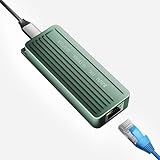
- TEN GIGABIT ON WINDOWS 11: Owners report iPerf runs near line rate over Cat6a once the Realtek 10G driver is on; on macOS this class of adapter settles well short of that, so buy it for a Windows machine
- YOUR PORT DECIDES THE SPEED: Full 10G needs a USB 3.2 Gen 2x2 20Gbps port, or Thunderbolt 3, 4 or USB4; a plain USB 3.0 or 3.1 port still links but tops out lower, so check your laptop before ordering
- INSTALL THE REALTEK 10G DRIVER FIRST: The generic driver Windows ships holds the link well below 10G; the card in the box points to the right Realtek package, and full speed appears after one reboot
- SIX LINK SPEEDS, ONE CABLE RULE: Negotiates 10G, 5G, 2.5G, 1G, 100M and 10M so it drops into any switch; 10G wants Cat6a out to 100m, while Cat5e and Cat6 carry 5G and 2.5G the same way
- ALUMINUM SHELL IS THE HEATSINK: Ribbed alloy body spreads heat with no fan and no noise, so it runs warm under sustained transfers by design; in the box are the adapter with attached USB-C cable and a driver card
Choose replacement parts only after identifying the link type
If a substitution test points to a cable or transceiver, select a replacement using the requirements for both endpoints, not a generic “10GbE cable” label. Compare the medium, port and transceiver compatibility, supported data rate, connector type, and distance. A copper-cable recommendation does not apply to a fiber or direct-attach path, and the available compatibility guidance does not establish one universal cable category for every setup.
- Copper: Confirm the cable requirements and length in both device manuals.
- Fiber: Match the transceiver family and fiber type at both ends, and stay within the supported distance.
- Direct attach: Confirm the cable type and compatibility with both ports.
When the link still reports 1Gbps
If the exact ports support 10GbE, settings are appropriate, and a known-good compatible physical path makes no difference, test a different compatible port or endpoint to narrow down a possible port or adapter fault. Keep your recorded models, versions, and component identifiers available when consulting the hardware vendors’ compatibility information or support service.
Recommended Free Tools
Quick Recap
Product prices and availability are accurate as of the date/time indicated and are subject to change. Any price and availability information displayed on Amazon at the time of purchase will apply.

