
The Tool Desk
Outbyte PC Repair FREERepair Windows errors before they cause bigger problemsFix Now →Outbyte Driver Updater FREEScan for outdated or missing drivers - takes under a minuteDriver Scan →Forward error correction (FEC) helps keep real-time video usable when network packets are lost: the sender transmits extra repair data so the receiver can reconstruct some missing media packets without waiting for a retransmission. It is useful when a retransmission would miss the playback deadline, but it costs bandwidth and cannot repair every loss pattern. Whether it helps depends on the FEC format, the losses, the available latency and bandwidth, and whether both endpoints support compatible implementations.
How FEC repairs lost video packets
Video over IP is carried in packets. If a packet is lost in transit, the receiver cannot use that packet unless it obtains the data another way. FEC adds repair information to the transmission in advance, giving the receiver a chance to rebuild certain missing packets from the packets and repair data that did arrive.
- Group media packets. The sender arranges packets into a protection pattern defined by the chosen FEC format.
- Send repair data. In the generic RTP format specified by IETF RFC 5109, the sender uses XOR parity to create FEC packets associated with the media packets.
- Check for missing packets. The receiver uses the association information and the packets it received to determine whether a missing packet can be recovered.
- Reconstruct what the pattern permits. If the available parity and surviving packets contain enough information for that loss pattern, the receiver can rebuild the missing data in time for playback.
Some protection arrangements can give more protection to selected portions of a payload than to others. Recovery is conditional: which packets were lost and how the sender configured the protection determine whether reconstruction is possible. FEC is not a promise that all loss will be repaired.
When FEC is useful for real-time video
FEC is most relevant when a stream has to play on schedule. A retransmission may eventually deliver a missing packet, but the round trip and retry can take longer than the receiver’s playback deadline. Repair data already travelling with the stream can allow recovery without that wait.
#1 Best Overall

- Compact but Powerful Design: ZowieBox is smaller than a phone, featuring a tally light and LCD screen for streaming status. Capture console gameplay in up to 4K with zero-lag HDMI passthrough, while the built-in video encoder converts video for IP streaming. The IP stream can also be decoded back to a 4K HDMI signal.
- Standalone Game Streaming: Just plug and play—ZowieBox enables PC-free live gaming without affecting gameplay. As an RTMP hardware encoder and HDMI streamer, it delivers stable streaming directly from your source, making it ideal for gaming, live events, and professional broadcasting.
- NDI|HX3 Converter Technology: ZowieBox converts HDMI signals to NDI|HX3/HX2/HX, functioning as an NDI video encoder, or NDI Video Decoder for flexible IP workflows. Certified NDI technology enables low-latency gameplay streaming through OBS/vMix. Note: Encoder and decoder modes cannot run simultaneously; full NDI signals are not supported.
- UVC to HDMI Conversion: Supporting up to 4K@30fps and 1080p@60fps decoding, ZowieBox enables flexible conversion for webcam and video workflows. As a video decoder and HDMI to IP converter, it expands connectivity options for professional video devices. Note: USB capture card functionality is not currently supported.
- All-around Configuration Options: Control ZowieBox through its web UI on a PC, phone, or tablet. Manage connected PTZ cameras, tally light, video/audio, OSD, work mode, streams, network, and system settings. Support for VISCA over IP encoder workflows enables flexible PTZ control, while the dashboard provides video preview and system status.
That protection has a cost. Repair packets use network capacity and require processing at the sender and receiver. RFC 5109 also cautions against allowing total traffic to rise substantially as loss increases: adding more repair traffic to an already congested path can make conditions worse. FEC should therefore be budgeted and monitored alongside the media stream, not treated as free protection.
FEC, retransmission, and packet redundancy are different approaches
| Approach | What is sent | How recovery works | Main constraint |
|---|---|---|---|
| FEC | Media packets plus repair information | The receiver uses received media and repair data to reconstruct some missing packets. | Extra bandwidth is required, and recoverability depends on the loss pattern and protection configuration. |
| Retransmission | The original packet is sent again after a loss is detected and a request can be acted on. | The receiver uses the resent packet if it arrives before the playback deadline. | The request-and-return delay may be too long for real-time playback. |
| Packet redundancy, such as the ST 2022-7 category | Redundant packet delivery paths, rather than FEC repair data alone | The receiver can use packets arriving over the protected paths for seamless protection. | It is a different protection architecture and depends on the paths and system design. |
These mechanisms should not be conflated. SMPTE describes ST 2022-7 as seamless protection using packet redundancy, while ST 2022-1 and ST 2022-5 provide FEC for signals carried by the ST 2022 suite.
Rank #2

- ToVi X2H-KVM AV-over-IP Encoder/Decoder (X2H-KVM-ED) – High-performance AV-over-IP unit delivering 4K@30Hz and 1080p@60Hz video with LPCM 2.0CH 48kHz audio over CAT6/6A/7 or fiber up to 328ft (100m). Supports HDMI 1.4 & HDCP 1.4 for professional AV distribution, control rooms, and digital signage.
- Dual Encoder/Decoder Functionality – Configure the unit as either a transmitter or receiver for flexible deployment. Supports audio routing with 6-pin phoenix analog input/output, HDMI loop-out, and audio extraction. PoE-enabled for simplified installation.
- Advanced Multi-Window & Display Management – Each decoder handles up to 16 signals with window roaming, splicing, overlay, multi-window display, and scrolling text. Ideal for video walls, command centers, and digital signage setups.
- KVM & Flexible System Control – Features KVM seat management for one-to-one or one-to-many PC control. Manage signals via X2UH-CB Control Box, mobile app, or KVM, enabling centralized access, multicast, matrix switching, and video wall layouts.
- Comprehensive Network Compatibility & Protocol Support – Supports H.264/H.265 protocols, point-to-point extension, IPC/camera integration, HD video/image backgrounds, and centralized user rights management. Fully compatible with ToVi network switches and scalable AV-over-IP systems.
Where the standards fit
RFC 5109: generic FEC for RTP
RFC 5109 specifies a generic parity-based FEC payload format for media encapsulated in RTP. It allows different protection lengths and levels and supports unequal protection. It is an RTP payload format, not a universal FEC specification for every video-over-IP system. RFC 5109 obsoletes RFC 2733 and RFC 3009.
SMPTE ST 2022: FEC and other protection for carried signals
SMPTE’s ST 2022 overview describes a suite for carrying signals traditionally transported over serial interfaces across IP. In that suite, ST 2022-6 carries uncompressed video and ancillary data typical of SDI; ST 2022-1 and ST 2022-5 provide FEC; and ST 2022-7 provides seamless protection using packet redundancy.
Rank #3

- 【NOTE】Encoder and Decoder are packaged separately. This link only contain Encoder, You need to buy Decoder here: B0B214QTQT.
- 【Unlimited Scalability vs Fixed HDMI Systems】Basic HDMI extenders are limited to one transmitter → one receiver. With AV over IP, you can add more decoders anytime, scaling from 1 screen to dozens of displays (up to 50)without replacing your system.
- 【Build Video Walls & Multi-Screen Layouts】Traditional HDMI extenders cannot create video walls. This system allows you to build video walls up to 8×8 or manage multiple screens independently for dynamic content display.
- 【Flexible Routing vs Fixed Signal Path】HDMI extenders send signal to only one display. AV over IP allows flexible routing, so any source can be shown on any screen at any time.
- 【Works Over Standard Network Infrastructure】No need for long HDMI cables or dedicated wiring. This system uses standard Ethernet switches, making installation cleaner, more flexible, and easier to expand.
The cited ST 2022-5 document is the 2012 edition and addresses FEC for high-bit-rate real-time media over IP, including burst-loss protection and packet-size and MTU considerations. Check the applicable current edition before relying on edition-specific normative details.
RFC 6015: a legacy interleaved parity format
RFC 6015 defines a one-dimensional interleaved parity RTP payload format and explains its relationship to SMPTE 2022-1. The RFC warns that the format is intended for legacy applications where its limitations are known not to affect system components. Do not assume it is the universal or current choice for a new deployment.
Rank #4
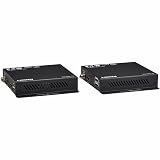
- FULLY SUPPORTED & PROVEN QUALITY: This product is protected by a Manufacturer's 1-Year Limited Warranty. To best support your purchase, Eaton's expert technical team is available via phone, web, or email to address any concerns.
SMPTE ST 2110: professional managed-IP media context
SMPTE ST 2110 defines carriage, synchronization, and description of separate media essence streams over managed IP for professional production, playout, and related applications. It provides important context for modern IP production, but the cited sources do not establish one FEC method as mandatory across all ST 2110 systems. The multipart suite remains in active development, so check the applicable standards and product documentation for the system being built.
Independent reader supportYour contribution helps us test, update, and keep practical guides available for everyone.How to choose and validate an FEC approach
There is no universally best protection setting. Compare the actual sender and receiver options against the network path and the stream’s playback deadline.
Quick wins for a faster PC:
Repair Windows errors before they cause bigger problemsFix Now →Scan for outdated or missing drivers - takes under a minuteDriver Scan →Best Value

- 【NOTE】Encoder and Decoder are packaged separately. This link only contain Decoder, You need to buy Encoder here: B0DCMW8GYW.
- 【Why Choose AV over IP vs Basic HDMI Extender】Unlike traditional HDMI extenders (point-to-point only), this AV over IP system enables one-to-many and many-to-many distribution, allowing you to send one source to multiple screens or switch sources freely across displays.
- 【Unlimited Scalability vs Fixed HDMI Systems】Basic HDMI extenders are limited to one transmitter → one receiver. With AV over IP, you can add more decoders anytime, scaling from 1 screen to dozens of displays (up to 50)without replacing your system.
- 【Build Video Walls & Multi-Screen Layouts】Traditional HDMI extenders cannot create video walls. This system allows you to build video walls up to 8×8 or manage multiple screens independently for dynamic content display.
- 【Flexible Routing vs Fixed Signal Path】HDMI extenders send signal to only one display. AV over IP allows flexible routing, so any source can be shown on any screen at any time.
- Loss pattern: Determine whether the path is expected to produce isolated losses, bursts, or both. Check whether the format’s grouping or interleaving can cover the pattern you need to handle.
- Latency budget: The receiver may need to wait for enough packets in a protection group before it can recover a loss. Ensure the repair window fits within the end-to-end deadline; a repair arriving after playback is not useful.
- Bandwidth headroom: Account for repair packets in addition to media and other traffic. Consider what happens under loss, and monitor total traffic so protection does not compound congestion.
- Packet size and MTU: Repair packets can be larger than source packets. Check their size against the path MTU and verify that they are not fragmented or dropped on the route.
- Interoperability: Confirm that the sender and receiver support the same payload format, signaling, and relevant standard revision. A standards label alone does not prove that a particular pair of products can exchange the intended protection data.
- Protection architecture: Decide whether the requirement is to add FEC repair data, use retransmission where timing allows, or protect delivery with redundant packet paths. These choices have different bandwidth, timing, and network-design implications.
Validate the configuration on the intended path and endpoints. Test representative isolated and burst-loss conditions, observe whether recovery completes inside the playback deadline, and check bandwidth use, packet sizing, and receiver error reporting. The cited specifications define mechanisms and constraints; they do not establish a universal recoverable-loss percentage or guarantee lossless delivery for every network.
Quick Recap
Product prices and availability are accurate as of the date/time indicated and are subject to change. Any price and availability information displayed on Amazon at the time of purchase will apply.

