
The Tool Desk
Outbyte Driver Updater FREEScan for outdated or missing drivers - takes under a minuteDriver Scan →Outbyte PC Repair FREEClear out junk files and repair common Windows errorsFree Scan →Catchers still have two distinct jobs under MLB’s 2026 Automated Ball-Strike (ABS) Challenge System: receive pitches in a way that gives the umpire a clear, controlled look, and recognize when an incorrect called ball is valuable enough to challenge. Statcast scores framing from the umpire’s initial call and tracks the change after a challenge separately, so a successful challenge does not erase the framing result.
Why framing still matters with ABS
Framing is the way a catcher receives and presents a pitch to the umpire. MLB Statcast defines it as receiving a pitch in a way that makes a strike call more likely, either by gaining a borderline strike or by avoiding the loss of a strike through poor presentation. Under ABS, that receiving skill and the ability to challenge an incorrect call are measured separately.
That distinction matters in practice. A catcher can present a pitch well and still get a ball call; a challenge can correct that call, but it is not evidence that the catcher framed it well. Conversely, a strong framing record does not establish that the catcher will recognize which calls ABS will overturn.
What the 2026 ABS Challenge System changes
MLB introduced the ABS Challenge System for the 2026 season. Hawk-Eye tracks the pitch against the individual batter’s strike zone. Baseball Savant’s documentation defines the top of the zone as 53.5% of the batter’s measured height without cleats and the bottom as 27%; pitch location is measured above the middle of home plate, not its front edge. The zone is batter-specific, so it is not one fixed rectangle for every hitter.
Do these 3 things before closing this tab:
1Scan for outdated or missing drivers - takes under a minute2Repair Windows errors before they cause bigger problems3Fix the driver behind crashes, sound loss and screen glitches#1 Best Overall

- DOMINATE THE STRIKE ZONE WITH PRO FRAMING: Master game-winning receiving skills with our catcher framing training aid softball and baseball pros use. The 5-level adjustable resistance (10-30lbs) perfectly replicates live pitcher velocity, training your wrists and hands to steal more strikes and eliminate passed balls. This is the ultimate baseball catcher training tool for getting the call.
- BUILD A CANNON FOR AN ARM - SAFELY: Develop explosive throwing power to shut down the run game. These resistance bands baseball are engineered with reinforced stitching to build arm and shoulder strength safely, preventing elbow strain. Essential for youth athletes building velocity and pros maintaining rotator cuff health through targeted baseball catcher training.
- 2-IN-1 GAME-READY DEFENDER BUILDER: Train like you play. Simultaneously hone explosive blocking reflexes and rotational power for pitching. Our catcher training equipment strengthens the exact muscle chains used behind the plate—wrist stabilizers, obliques, and core. The perfect, efficient complement to daily bullpen sessions.
- YOUR ANYWHERE, ANYTIME DRILL PARTNER: Stop relying on the gym. Weighing only 14oz, this complete catcher framing training aid fits in your gear bag for instant workouts in hotel rooms, cages, or the outfield. Zero setup needed. Get 500+ extra reps per month and out-work your competition.
- ENGINEERED FOR TEAM ABUSE - GUARANTEED: Built to survive a grueling season. Constructed with military-grade TPE and quick-release buckles, this catcher training equipment withstands 10,000+ reps and daily team bag sharing. Backed by a lifetime guarantee, it's the last resistance bands baseball trainer you'll ever need.
- Each team begins with two challenges. A successful challenge is retained; a confirmed call costs the team a challenge.
- MLB’s rules explainer describes additional challenge availability in extra innings for a team that starts an inning with no challenges.
- Only the batter, pitcher or catcher may initiate a challenge. The player taps the cap or helmet; saying “challenge” is encouraged, but the tap is the official signal.
- The result appears on the stadium board and broadcast.
A challenge opportunity is not necessarily a good challenge. It means a rule-eligible called pitch went against the team while a challenge remained. Swings, calls that went the team’s way, a team with no challenges left, position players pitching and technical interruptions are among the exclusions. Baseball Savant’s 2026 documentation says roughly 50% of pitches were challenge opportunities, while roughly 5% met its narrower definition of “reasonable pitches.” Those figures use MLB’s documented definitions.
How to improve receiving and presentation
Start with a relaxed, controlled hand
Little League’s Catching 101 guidance recommends a relaxed glove hand, little glove and body movement, and getting to the pitch’s location early rather than stabbing at it or making a conspicuous late movement. Its coaching summary is: “The less movement with the glove and the body, the better a pitch will look, as if it’s thrown directly to the target.” Treat this as a coaching cue, not a universal glove-path formula. A catcher’s setup should account for their body, mobility, equipment and a coach’s assessment.
Rank #2

- Breathable and Lightweight. Made of durable neoprene and other blends, relieve your stress on fingers during practice.
- Ease of Catching and Holding the Balls. Fits well on the thumb and index finger of kids, teens or adults.
- Symmetrical Design. The Clocean catchers training glove works for both left and right-handed players, designed to improve hand-eye coordination and placement.
- Suitable to Catch Golf-Sized Balls. The net design allows you to catch different practice balls like baseball, softball, tennis ball, racquetball and etc.
- What You Get. 1 x mini baseball glove - blue, and our friendly customer service.
Practice receiving pitches in varied locations
MLB’s account of the Twins’ catcher-development program described machine-thrown pitches at different locations, with positioning and each catcher’s strengths taken into account. Varied locations give a catcher practice arriving at the ball under different conditions rather than repeating one fixed glove path.
Use feedback drills only with suitable coaching
The Twins program also described gently tossed weighted balls received with bare hands and resistance bands used to reinforce certain movements. These are examples from one professional organization, not a proven prescription for every catcher. The account does not establish a safe load or dosage for all ages, or show that the drills improve challenge accuracy. A qualified coach should decide whether a drill and its load suit the player.
Rank #3

- Precision T Guide Alignment: the catcher training mat's bold T-markings provide immediate visual feedback, helping catchers lock in correct foot placement for faster, more stable throwing motions; Correct form early-prevent bad habits before game day
- Improve Throw Accuracy and Stop Steals: reinforce consistent footwork to turn your throw into a reliable out-making weapon; Build the muscle memory needed to shut down steal attempts with sharp, accurate throws
- Game Ready Muscle Memory: repeat proper movements until they become instinct; Train your feet to react instantly in clutch situations-smooth, efficient, and automatic when every second counts
- Reliable and Highly Portable: made of tear-resistant yet lightweight material, this mat rolls up easily for storage and transport; Use it at home, on the mound, or during team drills-no heavy equipment needed
- For All Skill Levels: whether you're a youth player learning basics, a school athlete refining technique, or a pro staying sharp, this baseball sliding mat adapts to your level; Elevate your footwork and throwing performance at any stage
Review game outcomes by location and context
Statcast’s zone breakdowns and called-strike rates can help identify repeatable strengths and misses. When the sample permits, compare by pitch type, pitcher handedness, batter side and month. Look at difficult strikes gained and potential strikes lost, rather than attributing every umpire decision to the catcher or relying only on a season total.
When a catcher should challenge a called ball
A pitch being close is not enough to make a challenge worthwhile. Baseball Savant’s documented confidence framework weighs the count, outs and runners through situation run value. Its example says a situation worth 0.3 runs has a 40% breakeven confidence point for a challenge. That is an illustration of the model, not a universal coaching threshold.
Rank #4
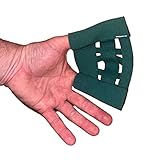
- Designed to catch golf-sized practice balls
- Lightweight
- Durable neoprene material
- Fits over your index finger and thumb
- Universal for left or right-handed players
- Check eligibility. Confirm it was a called pitch, the call went against your team and a challenge remains.
- Recall the pitch and the hitter’s zone. Consider where the pitch crossed the plate and the batter-specific zone; do not judge only by how close the glove looked to the target.
- Account for the game state. Consider the count, outs and runners, since correcting the same call can have different run value in different situations.
- Challenge promptly when confidence justifies it. Use the cap or helmet tap as the formal signal. Agree with the coaching staff on communication and video procedures; clubs may not use their own ball-tracking systems for challenges.
How to assess framing and challenge skill separately
Use separate measures for receiving and decisions. MLB Statcast provides zone-level called-strike rates and framing runs for takes. Its ABS metrics include challenge rate and context-adjusted expected challenges. A raw challenge percentage alone can mislead because it does not account for how many eligible calls a player faced or whether those calls were valuable to challenge.
| Skill | What to review | Useful comparisons |
|---|---|---|
| Receiving and framing | Called-strike rates and framing runs on taken pitches; difficult strikes gained and potential strikes lost. | Zone location, pitch type, pitcher hand, batter side and month, where sample sizes allow. |
| Challenge decisions | Challenge rate among eligible opportunities, overturn or success rate, and context-adjusted expected challenges. | Call location, count, outs, runners and challenges remaining. |
Keep the measures distinct when comparing players or tracking progress. For example, MLB reported that catcher Patrick Bailey had +25 framing runs and Edgar Quero had -13 in 2025; those season figures describe framing, not ABS challenge ability. Statcast’s current leaderboard glossary uses 0.125 runs per strike as the conversion basis for framing runs, a convention rather than a guaranteed value for any individual catcher.
Windows Errors? Fix Them Before They Spread
Repair common Windows errors and clear accumulated junk for a smoother, more stable PC - no reinstall needed.Free scan · no reinstallCrashes, No Sound, or Screen Glitches?
Random freezes, missing sound and display glitches usually trace back to one bad driver. Find and replace yours safely.Free scan · under a minuteBest Value

- Train the Strike Zone with Purpose – The Keyhole Training Mitt features a specialized pocket trap design that helps catchers develop pocket awareness and improve glove presentation throughout the receiving process.
- Convert More Pitches into Strikes – Designed to teach proper ball manipulation and framing techniques, helping catchers receive, control, and present pitches more effectively.
- Game-Size Feel for Realistic Training – Built with a full-size catcher’s mitt profile to replicate the look, feel, and movements used during game situations.
- Perfect for Receiving & Framing Drills – An ideal training tool for catchers focused on improving receiving mechanics, soft hands, and confidence behind the plate.
- Lightweight Training Design – For high-velocity training sessions, use with lightweight foam balls to safely maximize repetitions while reinforcing proper glove control and technique.
What challenge results do—and do not—show
Challenge success rates provide context, not a shortcut for judging a catcher’s receiving. MLB’s 2025 analysis reported that fielders—pitchers and catchers combined in that Triple-A dataset—succeeded on nearly 55% of challenges, compared with 45% for hitters. Early 2026 Spring Training figures were 55% for fielders and 48% for hitters; those are spring figures, not regular-season results. MLB cautioned that minor-league players and umpires are not a one-to-one proxy for MLB. Its examples of two MLB catchers with similar 2025 framing results but different Triple-A challenge accuracy also show why one skill should not be treated as a proxy for the other.
An Associated Press report published October 2, 2026 said ABS overturned 54% of challenged calls in MLB’s first ABS season and that catchers were substantially more successful than batters. This is a season-level result reported on that date; it does not predict a particular catcher’s success or show that a framing technique caused it.
Framing can matter to the count before any challenge occurs. MLB’s 2025 example puts a hitter’s OPS at .806 after a 1-0 count and .607 after an 0-1 count. Those are MLB’s example figures for those counts, not a guarantee about the outcome of any individual pitch.
Quick Recap
Product prices and availability are accurate as of the date/time indicated and are subject to change. Any price and availability information displayed on Amazon at the time of purchase will apply.
Quick wins for a faster PC:
Clear out junk files and repair common Windows errorsFree Scan →Fix the driver behind crashes, sound loss and screen glitchesFind Drivers →
