
Recommended Free Tools
Compare products by their price for the same kind of quantity—such as cost per ounce by weight, per fluid ounce, or per count—not just the total price on the shelf. If the unit prices are not shown, divide each package price by its quantity in a shared unit. Then check that the products, promotion terms, and total checkout costs are genuinely comparable.
How do you compare unit prices?
- Choose a matching measure. Compare weight with weight, volume with volume, or count with count. A price per ounce by weight is not interchangeable with a price per fluid ounce by volume.
- Convert to the same unit. If one label shows price per pound and another per ounce, use a common basis. There are 16 ounces in a pound, so $4 per pound equals $0.25 per ounce. For metric quantities, convert both packages to grams or both to kilograms.
- Use the shelf unit price, if available. Retail labels may show a price per ounce, pound, kilogram, liter, or count. Confirm which measure the label uses before comparing.
- Calculate it if necessary. Divide the package price by the package quantity expressed in your chosen unit. For example, a 24-ounce package at $4.80 costs $0.20 per ounce ($4.80 ÷ 24). This is an illustrative calculation, not a current product price.
- Compare like with like. For equivalent products, the lower price per common unit means you pay less for the same amount. Check suitability, quality, and whether you can use the quantity before it spoils or expires.
The National Institute of Standards and Technology (NIST) describes unit pricing as a way to compare products across package sizes and retail channels, including e-commerce. Its 2025 Unit Pricing Guide (SP 1181-2025) calls unit pricing “one of the best tools available to consumers to facilitate value and price comparison.”
Is the bigger package actually a better deal?
Not necessarily. A larger pack can cost less per unit but require more money upfront, and it is only worthwhile if you will use the contents. Compare both the unit price and the total outlay, then factor in how much you need and whether the product will keep.
Package size can also change while the brand or package design stays familiar. Check the net contents printed on the package and the shelf unit price rather than relying on the package’s appearance or total price alone. Serving size or number of servings may offer a clue to a contents change, but neither replaces checking net quantity and unit price. The FTC explains this use of unit pricing in “The case of the shrinking packaging”.
Free tools Windows power users keep installed
One-click scans. No signup required.
#1 Best Overall

- 𝗘𝗳𝗳𝗼𝗿𝘁𝗹𝗲𝘀𝘀 𝗪𝗲𝗶𝗴𝗵𝗶𝗻𝗴: Supports 5 units (oz/lb:oz/fl'oz/g/mL), tare function, and includes 2 AAA batteries for hassle-free operation
- 𝗣𝗿𝗲𝗰𝗶𝘀𝗲 𝗥𝗲𝘀𝘂𝗹𝘁𝘀: Accurately weighs up to 11 lb/5 kg with 1 g increments
- 𝗦𝗶𝗺𝗽𝗹𝗲 & 𝗖𝗼𝗺𝗽𝗮𝗰𝘁: The small and sleek scale is a perfect fit for most kitchens, occupying little space and easily storable in cabinets
- 𝗘𝗮𝘀𝘆 𝘁𝗼 𝗖𝗹𝗲𝗮𝗻: Just wipe down the 304 food-grade stainless steel surfaces to keep clean
- 𝗟𝗖𝗗 𝗗𝗶𝘀𝗽𝗹𝗮𝘆: Backlit LCD screen with large fonts for easy reading
What can make a unit-price comparison misleading?
- Different measurement bases: Weight, fluid volume, dry volume, length, area, and count are not automatically comparable. Make sure the unit price refers to the quantity that matters for that product.
- Different products: A lower unit price does not prove equal quality, ingredients, concentration, durability, or usefulness. Compare equivalent products and the features that matter to you.
- Promotion conditions: Check whether the advertised price depends on buying multiple items, using a rewards program, or meeting another condition.
- Online add-ons: Compare the full checkout cost, including delivery, shipping, handling, taxes, and other applicable fees. Read the product description and promotion terms; the FTC’s online shopping guidance recommends checking these details.
- Quantity you cannot use: A bulk pack may be poor value if it spoils, expires, or otherwise becomes unsuitable before you finish it.
Are retailers required to show unit prices?
In the United States, there is no federal mandate requiring unit pricing, according to NIST’s 2025 guide. State or territorial rules may require it, and requirements vary. NIST reported that 16 states and three territories had unit-pricing laws or regulations in effect when the guide was published in June 2025; that dated count may change. For a legal answer about a particular store or product, check the current rules in your jurisdiction.
NIST’s guide is best-practice guidance for retailers, not a universal federal requirement. It recommends choosing a consistent, meaningful unit within a product category so shoppers can compare products on the same basis.
Quick Recap
Best Value

- 【Precise Weight】 10kg/22lb capacity, 1g/0.1oz resolution, Great for cooking, baking, weight loss, Meal Prep, Coffee, Package, Postage.
- 【Multifunction Scale】This digital kitchen scale has 6 measurement unit: g, kg, lb, oz, ml, milk ml.
- 【Easy Tare】Remove the weight of any container to get more precise results.
- 【Portable Design】- Small Scale Dimensions:7.4 x 5.5 x 0.6 inches. The digital kitchen scale’s convenient size makes it easy to store in your kitchen.
- 【LCD Display】Big bright LCD display easy to read. The cute gram scale to turn off after 3 minutes inactivity.
Rank #4

- 【Precise Weight Food Scale】Our Food Kitchen Scale equips four high-precision load sensors, waterproof Anti-collision glass weighing panel. Large measuring capacity with 1g precise graduation from 0.1oz/3g to 33 lbs/15kg.
- 【Pratical and Durable Kitchen Scale】5 commonly used measurement units(g/kg/lb:oz/oz/ml). Screen touch and LCD display make it easy to use and read. 7.5" x 5.5" in stainless steel panel provide more stability and space for larger containers.
- 【Weight Control Scale -Easy Tare】 The Tare button allows you to subtract the weight of mug, plate, or different sized bowl, making it easy to achieve accurate readouts of nuts, grains, powder, fruit, milk and more food.
- 【Smart Design Baking Scale 】With a 2min Auto-off function, no need to worry about power consumption. Power-low alarm and overload remind. Hanging hook and 4 no-slip rubbers. Easy to clean and store.
- 【12 Months Support】We cherish every customer, your satisfaction are priority. Feel free to contact us, we will take every consultation and question seriously.
Rank #3

- Contemporary Slim Design: Made of Stainless Steel Material; It is easy to use and clean; Provides accurate weight data with a user-friendly control panel and system; With high precision sensors to ensure correct performance and readouts
- Multiple Unit Conversion Setting: You can easily switch to any unit that you need; It can show units in the following: g / kg/lb/oz/ml/milk ml; Yes! It includes milk volume measurement
- Low Energy Consumption with Included Battery: This unit comes with batteries and doesn’t consume too much power; Plus it has an auto shut off feature
- Backlit Display (Easy to See and Read Panel): The unit has a negative white digital display so it is easy to read and see even in not well-lit rooms
- After Sales Support, and Trusted Customer Support Team assist you with any questions that might arise about your kitchen scale. We take pride in our work and want you to have a great experience from beginning to end
Rank #2
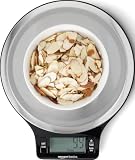
- Digital kitchen scale with food-safe, BPA-free plastic components
- Stainless steel platform with wide LCD screen
- Weighs up to 11 pounds (2 grams minimum, up to about 5000 grams); displays results in pounds, ounces, grams, fluid ounces, and ml
- Tare button for measuring just the food, minus the container weight
- Battery operated; (2) AAA batteries included
Product prices and availability are accurate as of the date/time indicated and are subject to change. Any price and availability information displayed on Amazon at the time of purchase will apply.
Independent reader supportYour contribution helps us test, update, and keep practical guides available for everyone.
