
Quick wins for a faster PC:
Fix the driver behind crashes, sound loss and screen glitchesFind Drivers →Clear out junk files and repair common Windows errorsFree Scan →Scan for outdated or missing drivers - takes under a minuteDriver Scan →Yes. In a specific fault condition—a CAN bus line shorted to a DC voltage—a common-mode choke can contribute to transient voltages at the transceiver’s bus pins. The size of the transient depends on the choke and the rest of the network; it is not an inevitable or uniform result of installing a choke.
How a CAN choke can produce a transient
A common-mode choke presents inductance in the CAN lines. When a line is shorted to a DC voltage, the current through that inductance changes. That change can produce a transient that reaches the CAN transceiver bus pins. Texas Instruments describes this fault scenario in its January 2008 application report, Common-Mode Chokes in CAN Networks: Source of Unexpected Transients.
The report warns that the use of common-mode chokes in CAN systems might cause very high transient voltages at transceiver bus pins. This describes a possible failure mechanism under the report’s conditions, not a prediction that every choke or CAN installation will experience the same voltage.
What affects the transient level?
Choke construction and inductance influence the result, but the choke does not act alone. The report identifies the broader system—including network architecture, termination, other components, and the details of the short circuit—as relevant. Its laboratory comparisons of commercial choke examples show that measured levels can vary with core type and inductance, with winding type also considered.
#1 Best Overall

- Shortwave Choke Magnetic Ring: Specifically designed for high frequency radios operating between 1.8 to 30MHz, it effectively suppresses common mode currents and eliminates electromagnetic interference.
- Powerful: This high magnetic permeability ferrite magnetic ring bears high temperatures and saturation, supporting high power applications without compromising performance.
- Plug and Play: Featuring an M male to M female connector, the installation of the shortwave choke magnetic ring is quick and labor saving. Simply plug it in to start using it immediately.
- Versatile Applications: This magnetic ring is suitable for various scenarios including shortwave communication, radio frequency testing, and emergency communications.
- Specifications: The EM43 magnetic ring has a diameter of 45mm and a power capacity of 150W PEP, ensuring that your communication signals remain pure and undisturbed.
Those measurements are observations from a defined test arrangement, not universal field predictions or current component specifications. A real automotive network distributes capacitance, inductance, and resistance among cables, terminations, and nodes; an actual short may also differ from the laboratory fault. The report gives no general prevalence rate for this event in deployed CAN networks.
Design approaches to evaluate
TI outlines several options, each of which needs to be assessed in the context of the complete CAN design:
Rank #2

- INDUSTRIAL GRADE ANTI INTERFERENCE: This device is designed for 1.8-30MHz high frequency radio stations, eliminating noise wave for pure signal.
- COMMON MODE CURRENT SUPPRESSION: Efficiently eliminates electromagnetic interference EMI, ensuring clean comm signals during outdoor operations and competitions.
- FERRITE RING: Constructed with high permeability ferrite magnetic rings, the EM25 boasts anti high temperature and antisaturation, ensuring no magnetic degradation even under high power usage.
- LIGHTWEIGHT AND PORTABLE: Compact with a diameter of 25mm and fast heat dissipation, the EM25 shortwave choke magnetic ring supports up to 100W PEP.
- PLUG AND PLAY: Featuring an M male (PL 259) to M female (SO 239) connector, this magnetic ring allows for quick and efficient installation, easily connecting your radio and feedlines in just 3 seconds.
- Remove the choke if the application permits operating without it.
- Place transient suppression between the choke and the transceiver bus pins. A suppressor, such as a suitable low-capacitance TVS diode or varistor, must be chosen for the transceiver and the required clamping behavior.
- Evaluate choke and termination choices together. The report identifies choke type and value, along with the CAN termination scheme, as factors that can reduce transients.
Why suppressor capacitance matters
Fast clamping is not the only selection criterion. A suppressor’s capacitance can interact with the choke’s inductance and produce ringing on bus signals. TI notes that this ringing may not corrupt CAN signaling but can appear as higher-frequency electromagnetic emissions. Check clamping behavior and capacitance together, and evaluate the placement and component combination in the complete design.
Independent reader supportYour contribution helps us test, update, and keep practical guides available for everyone.What to check in a real design
Use the reported mechanism as a reason to examine the fault response of the actual circuit, not as a basis for choosing a part by name alone. Relevant factors include:
Rank #3

- HELPS SUPPRESS COMMON-MODE RF CURRENT Designed to help suppress unwanted common-mode RF current commonly found in end-fed and other unbalanced antenna systems, helping reduce RF energy traveling on the outside of the coaxial feed line.
- HELPS REDUCE RF FEEDBACK May help reduce RF feedback and feed-line radiation that can affect compatible radio equipment. Actual performance depends on the antenna system, installation, and operating conditions.
- HIGH-PERFORMANCE FERRITE DESIGN Constructed with a high-performance ferrite sleeve optimized for HF and VHF frequency ranges, providing broadband common-mode suppression in a compact inline design.
- COMPACT AND EASY TO INSTALL Small, lightweight inline design installs easily at the antenna feed point, antenna tuner, transceiver, or other suitable locations along the coaxial feed line.
- FOR AMATEUR RADIO ANTENNA SYSTEMS Suitable for end-fed antennas, HF/VHF mobile radio systems, portable stations, field operation, emergency communication, and other compatible amateur radio antenna systems.
- Choke core and winding construction, inductance, and applicable electrical ratings.
- CAN topology, termination, and parasitic capacitance.
- Suppressor location, clamping behavior, and capacitance.
- The DC short condition being considered and the protection available at the transceiver pins.
The report names Murata DLW43SH510XK2B and DLW43SH101XK2B as examples in its older comparisons. Those references are not endorsements, current availability claims, or a present-day ranking. Confirm that any candidate component suits the bus and protection requirements, then evaluate the complete circuit under the relevant fault conditions.
Quick Recap
Best Value

- Common Mode Filter – Helps reduce common-mode current across 1.3–500 MHz antenna systems.
- High Power Rating – Supports up to 1500 W maximum input power for compatible installations.
- Low Insertion Loss – Designed with insertion loss below 0.4 dB within the specified operating range.
- SO-239 Connectors – Standard UHF connectors provide convenient integration with compatible coaxial systems.
- Durable Construction – Built for amateur radio base stations, portable operation, and fixed antenna installations.
Rank #4
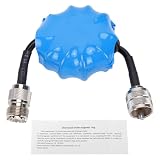
- Common Mode Suppression: Shortwave Choke Magnetic Ring effectively blocks common mode currents across the 1.8-30MHz spectrum, eliminating RF interference to ensure clear communication signals during ham radio operations.
- High Power Handling: This 1:1 current balun supports up to 100W PEP (EM25 model) with a 200W withstand power, utilizing high permeability ferrite that resists saturation and maintains stable impedance under high temperature conditions.
- Plug and Play Setup: Equipped with an integrated M male to M female connector, this HF choke coil installs directly inline without extra cables or soldering, saving setup time for field and base station use.
- Compact & Rugged Build: Featuring a 45mm diameter magnetic ring, this common mode choke fits portable radio kits while delivering lasting mechanical stability in harsh outdoor ham environments.
- Broad Frequency Consistency: Maintains uniform suppression performance from 1.8MHz through 30MHz, making it suitable for multi-band HF operations including contesting, DXing, and emergency communication scenarios.
Product prices and availability are accurate as of the date/time indicated and are subject to change. Any price and availability information displayed on Amazon at the time of purchase will apply.

