
Build an emergency fund from the costs your household actually faces: choose a manageable first target, contribute what your budget can sustain, and keep the money accessible for genuine surprises. Rising prices make it worth refreshing that target, but there is no single balance that fits everyone.
What an emergency fund is—and how much to aim for
The Consumer Financial Protection Bureau (CFPB) defines an emergency fund as “a cash reserve that’s specifically set aside for unplanned expenses or financial emergencies.” A car repair, medical bill, home repair, or sudden loss of income are examples. The point is to have money reserved for an unexpected cost, rather than to save toward a planned purchase.
There is no universal target in the CFPB guidance. Estimate a personal goal by listing plausible unexpected costs and, where possible, reviewing what similar events have actually cost you. Start with a first milestone you can work toward; it need not be a large balance to be worth beginning. Increase the target as your ability to save and your household’s risks change. The CFPB’s guide to building an emergency fund offers this individualized approach.
For a household budget, distinguish essential costs from optional spending and consider which surprise would be hardest to absorb without borrowing. A renter with no car may face a different set of likely costs from a homeowner who depends on a vehicle to get to work. Use your own circumstances and past expenses, not a universal rule of thumb, to decide what a useful reserve would cover.
Quick wins for a faster PC:
Clear out junk files and repair common Windows errorsFree Scan →Fix the driver behind crashes, sound loss and screen glitchesFind Drivers →#1 Best Overall

- 72 HOUR EMERGENCY KIT FOR 2 PEOPLE WITH FOOD AND WATER: Includes 2 emergency food bars totaling 4800 calories and 12 sealed drinking water pouches to support hydration and energy during disasters. Designed for emergency preparedness, survival kits, earthquake kits, and evacuation planning.
- COMPLETE DISASTER SURVIVAL KIT WITH SHELTER AND WARMTH: Equipped with 2 emergency ponchos and 2 survival blankets to help protect against rain, wind, and cold conditions. Critical gear for outdoor emergencies, power outages, and shelter in place situations.
- FIRST AID KIT AND SAFETY PROTECTION SUPPLIES: Features a 33 piece first aid kit, dust masks, and nitrile gloves to support basic medical care and protection from debris and airborne particles. Essential for emergency response, injury care, and disaster safety.
- EMERGENCY LIGHTING AND SIGNALING TOOLS INCLUDED: Comes with 2 long lasting 12 hour lightsticks and a safety whistle for visibility and communication in low light or rescue situations. Ideal for blackout emergencies, nighttime evacuation, and search scenarios.
- COMPACT BACKPACK FOR GRAB AND GO EVACUATION: Lightweight emergency backpack keeps all survival supplies organized and ready for fast response. Perfect for home emergency kits, car emergency kits, office preparedness, and bug out bags.
How rising prices affect your savings target
Prices do not rise evenly across every expense, so national inflation is useful context—not a personal budget or a formula for increasing your savings target. The U.S. Bureau of Labor Statistics reported these changes in the Consumer Price Index for All Urban Consumers (CPI-U) over the 12 months ending August 2026:
| Category | 12-month price change | What it indicates |
|---|---|---|
| All items | 3.4% | National urban-consumer average across the CPI-U basket |
| Food | 2.7% | National average for food prices |
| Shelter | 3.0% | National average for shelter costs |
| Energy | 16.3% | National average for energy prices |
These are price changes for the year ending August 2026, not a forecast. Your own experience can differ depending on where your household spends most—on energy, groceries, housing, medical care, transport, or other essentials. The BLS CPI-U report for August 2026 is the source for these national figures.
Rank #2

- [Preparedness for the Unknown]: While no one can predict when or how severe a disaster or unexpected event will be, our 262pcs survival kit helps your family stay prepared during the critical first 72 hours. Designed for family use, it was developed in collaboration with survival experts, outdoor professionals, special forces operators, and mountain guides. Whether you're preparing for earthquakes, tornadoes, wildfires, or hurricanes, our survival kit provides peace of mind.
- [Comprehensive Emergency Supply Kit]: The included emergency supplies are stored in a bright red pouch, containing tweezers, scissors and pins, non-woven pad, triangular cotton cloth, cotton swabs, cotton balls, a generous supply of adhesive strips etc., meeting your general emergency and outdoor needs. It also includes an emergency information card to record your basic information, helping others quickly access important information when needed.
- [Safety Companion for Journey]: Our emergency kit includes many survival gear and supplies to ensure access to food, water, warmth, and light in a crisis. The fishing kit and multi-usage spoon help you catch and prepare food, while the collapsible water container bag helps store water. Fire starter and stick make it easy to build a fire. A flashlight, camping lamp, and glow sticks provide up to 72 hours of lighting, crucial for signaling for help and safe navigation.
- [Essential Survival Gear]: Additionally, this survival kit includes a detachable multifunctional axe with hammer and a 2-in-1 shovel with pick, made of sturdy carbon steel. Combined with wire saw, emergency tent and blanket, rope, and compass, you can quickly set up an emergency shelter while helping retain warmth. Unlike other mini axes, our axe and shovel are 17 inches long, providing effective protection in the wild against animals or in other emergencies.
- [Convenient Packaging]: The survival gear and supplies are packed in a crossbody bag, making it easy to carry and access in emergencies. The bag features multiple compartments and molle compatible straps and D-rings, allowing you to attach extra pouches or survival tools. The crossbody strap is also detachable, making it easy to connect to a tactical survival backpack using carabiners or the molle system.
Instead of multiplying an old target by the headline inflation rate, review what your essential bills and likely emergencies cost now. If a repair or several weeks of basic expenses would cost more than it did before, consider whether your eventual target should rise. This is a way to apply the CFPB’s advice to account for your own unexpected costs; it is not an official savings formula.
How to start saving when money is tight
First, find the amount and schedule that fit your actual cash flow. The CFPB recommends setting a specific goal, making consistent contributions, monitoring progress, and using automatic recurring transfers when they work for you. A small regular transfer is a valid starting point; it is better to choose an amount you can sustain than to set a schedule that repeatedly leaves you short for necessities.
Rank #3

- 72-HOUR EMERGENCY KIT FOR 2: Built for disaster preparedness at home, work or on the road, this 2-person survival backpack includes food, water, first aid, lighting, hygiene and shelter essentials for up to 3 days.
- FOOD, WATER & PURIFICATION: Includes two 2,400-calorie emergency food bars, six 4.225 oz water pouches, water purification tablets and a 32 oz BPA-free bottle to help support hydration and nutrition during outages or evacuations.
- FIRST AID & PERSONAL PROTECTION: Packed with a 33-piece first aid kit, 2 N95 dust masks, nitrile gloves, hygiene kits, ponchos, survival blankets and tissues for added protection, sanitation and comfort during emergencies.
- POWER, LIGHTING & COMMUNICATION: Includes a hand-crank emergency power station with flashlight, AM/FM radio, siren and cell phone charging, plus 2 emergency lightsticks and a 3-in-1 whistle, compass and thermometer.
- DELUXE SURVIVAL TOOLS IN ONE BACKPACK: Adds a multi-function tool, duct tape, bio-hazard bag and emergency contact card in a portable backpack. Ideal for earthquakes, hurricanes, blackouts, wildfire evacuation, cars and workplaces.
- Update your spending picture. Review recent grocery, housing, utility, transport, insurance, and medical costs. Compare them with income and bills to see whether any amount is genuinely available to save.
- Choose a workable contribution. Set a repeatable amount and frequency that leave room for essential bills. If your income or expenses vary, contribute when money is available rather than forcing a rigid schedule.
- Automate only if it helps. A recurring transfer can make saving easier, but choose its timing and size around paydays and due dates so it does not trigger an overdraft or make bills harder to cover.
- Check progress and adjust. Revisit the amount when bills, income, or the cost of likely emergencies change. If a contribution no longer fits, reduce or pause it rather than treating one missed transfer as failure.
If you have little room after essentials, that may reflect a real income or expense constraint rather than a budgeting mistake. CFPB research on emergency savings and financial security describes how obligatory expenses and insufficient income can limit emergency saving. When feasible, you can also ask creditors whether a due date can be changed to better match your pay schedule, or add a little extra during a higher-cash week. A portion of a tax refund or cash gift can help accelerate progress, but neither is required to begin.
Tracking expenses can be as simple as reviewing bank transactions or using a spreadsheet or free digital tool. If paper works better, a small notebook can help record spending; it is optional, not a prerequisite for saving.
Rank #4
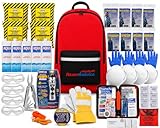
- COMPLETE 4-PERSON DISASTER SUPPLY KIT: Built to support four people for up to 72 hours with emergency food, drinking water, first aid, shelter, lighting, hygiene and survival gear packed together in one portable backpack for fast access at home or work.
- FOOD & WATER FOR 3-DAY PREPAREDNESS: Includes four 2,400-calorie emergency food bars and four 1-liter Aqua Literz cartons, plus survival blankets, ponchos and lightsticks to help support your household during outages, evacuations and major disasters.
- FIRST AID & SAFETY ESSENTIALS: Includes a 107-piece first aid kit, safety goggles, nitrile gloves, leather work gloves, biohazard bags, hygiene supplies and an emergency whistle to help support personal protection and comfort when conditions turn chaotic.
- POWER, LIGHTING & SURVIVAL TOOLS: Hand-crank emergency power station combines flashlight, AM/FM radio, siren and cell phone charging, while a multi-function tool, duct tape and emergency lightsticks add practical support for blackouts and evacuations.
- BUILT FOR HOME, WORK & EVACUATION: Grab-and-go 4-person emergency backpack is ideal for earthquake kits, hurricane supplies, wildfire evacuation, blackout preparedness, offices, vehicles and family disaster planning when critical supplies must move fast.
Where to keep an emergency fund
Choose a place that balances access, safety, costs, and the temptation to spend the money for other purposes. The CFPB identifies a bank or credit union account, prepaid card, and cash as possible ways to hold emergency savings. A dedicated bank or credit union account may make the reserve easier to separate from everyday spending; the CFPB describes such accounts as generally among the safest places to keep the money.
| Option | Access and separation | Points to check |
|---|---|---|
| Dedicated bank or credit union account | May be reachable through the account’s available withdrawal methods and can be kept separate from daily spending. | Check the institution’s current fees, minimums, withdrawal limits or delays, and applicable account protections. Terms vary by institution and account. |
| Prepaid card | May offer convenient access for some needs, depending on the card’s terms. | Check fees, restrictions, and how quickly funds can be accessed; terms vary by card. |
| Cash at home | Can be immediately on hand during some disruptions, but is less separated from everyday cash. | Cash can be stolen, lost, or damaged. |
Current rates, fees, withdrawal rules, protections, and providers are not established by the general guidance above, so check the terms for any specific account or card before choosing it. No one storage option is right for every household.
When to use the fund—and how to rebuild it
Decide ahead of time what you count as an emergency: an unplanned expense or income disruption that your regular budget cannot reasonably absorb. The boundary is personal, but defining it can help keep the reserve for its intended purpose. If such a need arises, do not be afraid to use the money; the CFPB advises using an emergency fund when needed.
After a withdrawal, make rebuilding the reserve your next savings task when your circumstances allow. A reserve can reduce the need to borrow for an unexpected cost. Borrowing instead—such as putting the expense on a credit card or taking a loan—can add interest and fees, so savings may limit that risk. It cannot prevent the emergency or guarantee that debt will never be necessary.
Quick Recap
Product prices and availability are accurate as of the date/time indicated and are subject to change. Any price and availability information displayed on Amazon at the time of purchase will apply.

