
Choose anti-counterfeiting technology only after assessing the product-specific threat and deciding what must be verified, by whom, and where. A security mark, serial number, or digital signature can each serve a different purpose; none is a universal guarantee. The strongest shortlist matches the physical feature, identifier, data system, and verification workflow to the risk and to the organization’s operating constraints.
Start with the risk and the verification job
First define the harm the solution must address: counterfeiting, tampering, fraud, diversion, or a combination. Then specify the object and the claim a check must establish. Is the goal to identify a product type, distinguish a production lot, authenticate an individual unit, or record movement through a supply chain? These needs are related, but they are not interchangeable.
ISO 22383:2020 sets performance criteria and an evaluation methodology for solutions intended to establish material-good authenticity and integrity over a good’s lifecycle. It applies to goods and, where appropriate, components, parts, and related data. Its criteria follow a counterfeiting risk assessment; it does not rank technologies for every product or provide an economic formula for choosing among them. The ISO catalog lists the standard as under review, so check its catalog entry for status when using it as a current reference: ISO 22383:2020.
Separate identification, authentication, and traceability
Identification assigns or carries an identity. Authentication checks whether an item or data is genuine. Traceability records product movement or events. A single system may support all three, but a code that identifies an item does not by itself prove that the physical item bearing it is genuine.
Recommended Free Tools
#1 Best Overall

- What you will get: package includes 500 pieces of tamper evident stickers in 5 sheets, 100 pieces per sheet; Sufficient quantity can meet you different demands
- Suitable size: each holographic sticker measures 0.61 x 2.54 cm/ 0.24 x 1 inch in size, appropriate for sealing and won't take up too much space; Please confirm the size before ordering
- Eye-catching design: adopting bright holographic design, these tamper proof labels are conspicuous, different angles show different colors, and can be easily noticed
- Quality material: these security stickers seals adopt PET film, which are reliable and stable, waterproof and smooth, also suitable for outdoors, not easy to fade or wear, convenient to paste and peel, bring you nice using experience
- Wide rang of use: these tamper seals have a variety of use, suitable for using on the surface of any materials, including glass, plastics, metal, etc., save you time and energy
Markings can derive security from a physical or material feature that is hard to reproduce or tamper with, or from information that is difficult to clone. Some code-bearing markings can also support traceability when movements are recorded. EUIPO’s 2024 guide describes categories including machine-readable codes, security holograms, inks, optical memory stripes, encrypted images, watermarks, microtexts, guilloche or rainbow printing, unique identifier marks, and copy-detection patterns. These categories are not equivalent in assurance or suitability; the appropriate option depends on the risk and verification context. See EUIPO’s overview of marking technologies.
Choose the identifier level that fits the need
GS1 distinguishes three useful levels of identification. A class-level identifier distinguishes a product type; a batch- or lot-level identifier distinguishes a production group; an instance-level identifier adds a serial identifier to distinguish an individual item. A lot code may support a traceability purpose without answering whether a particular unit is authentic.
Rank #2
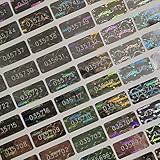
- The stickers protect your resources from being tampered. Permanent mark will be left on the surface of the protected item once the sticker is removed.
- On each sticker there is a unique sequential number which helps you recognize your item easily
- The stickers are waterproof which makes it adaptable outdoors.
- The stickers work well on all kinds of materials, such as paper, plastic, and steel etc. That means, they can be used as all-purpose labels.
- custom order accept
| Identification level | What it distinguishes | Useful distinction |
|---|---|---|
| Class | A product type | Identifies which product category or model is involved. |
| Batch or lot | A group of products | Distinguishes a production lot, not each unit within it. |
| Instance | An individual product | Adds a serial identifier to distinguish one unit from another. |
Serialization can make unit-level identity possible, but the identifier and the system that issues and verifies it matter. GS1’s guidance on traceability sets out these identification levels.
Decide whether a mark needs a data-backed check
A visible or machine-readable feature may be checked directly, while a code may also point to information in a verification system. Ask what the verifier actually learns and whether a copied code could be presented on a counterfeit item. A code’s readability or uniqueness is not, on its own, proof that the object is genuine.
Rank #3

- High security - The stickers protect your resources from being tampered. Permanent mark will be left on the surface of the protected item once the sticker is removed.
- Unique sequential number - On each sticker there is a unique sequential number which helps you recognize your item easily.
- Compatible With Most Surfaces - The stickers work well on all kinds of materials, such as paper, plastic, and steel etc. That means, they can be used as all-purpose labels.
- Waterproof-The stickers are waterproof which makes it adaptable outdoors
- Customizable - Accept customized Jobs with specified Size/Shape/Design/Color, MOQ is 5000pcs, Thanks to contact us for quote for custom jobs.
GS1’s digital-signatures guidance describes signatures as a way to check that encoded data is authentic and untampered and to link it to an accountable signer. Signed data can be tied to a serialized product identifier and, where used, to a code in a physical mark such as a hologram, watermark, microprinting, or UV ink. Serialisation, transaction or traceability data, and digital signatures can complement one another; the physical feature and data checks serve distinct roles. See GS1 Digital Signatures.
Compare candidates against the same requirements
Use a consistent set of questions for every option rather than choosing by the novelty of a mark or code. ISO 22378:2022 describes a generic framework for interoperable object identification and related authentication systems. It includes identifier management and verification, physical representation, participant due diligence, the relationship between a unique identifier and authentication elements, and inspector access history; it does not prescribe a particular technical solution. Consult ISO 22378:2022 alongside the product’s own requirements.
Rank #4

- DESIGNED FOR YOUR BUSINESS: When it comes to securing your inventory against theft and unauthorized access, The Bullseye Protection RF 8.2Mhz Paper Security Labels are the ideal solution. These labels measure 1.5 X 1.5 inch and come equipped with RF 8.2Mhz technology, making them a reliable and effective way to protect your valuable assets. The bright white finish of these labels ensures excellent visibility, while the powerful adhesive ensures that they stay securely in place.
- HOW IT WORKS: Our Security Labels look like a regular label but hides a special RF 8.2Mhz ferrite that triggers the EAS system installed at the store’s entrance. The labels won’t show off or prevent customers from making regular purchases and are incredibly easy to use. Simply apply the label to your item, and it will be instantly protected against theft and unauthorized access. These labels are compatible with a wide range of 8.2Mhz systems, making it easy to integrate them into your system.
- EASY TO ATTACH: Our Security Labels come on a practical roll and they can be applied to the products at the store or via source tagging at the factory level. The strong adhesive allows you to stick them to different flat surfaces. These Paper Security Labels are designed to be used on a wide variety of items including: books, cosmetics, products in carboard boxes, DVD cases, pharma products, hidden under smaller clothing items, wine and liquor bottles and other high-value items.
- COMPATIBILITY: Works with any Radio-Frequency (RF) 8.2Mhz EAS systems. They can be applied in primary packaging and under labels too, allowing you to prevent any type of product damage caused by other solutions such as hard security tags. One of the key benefits of our Paper Security Labels is their compatibility with RF 8.2Mhz technology. These labels are not compatible with AM technology systems and frequencies different than RF 8.2Mhz, please check your compatibility before ordering.
- PRODUCT DESCRIPTION: The set comes with 1 roll of 1000 security labels stickers each. Each label measures 1.5 x 1.5 inch (40 x 40 mm) and can be easily disabled using standard systems. Everything is discrete and allows you to protect your business from theft without creating inconveniences for customers. Each label features a durable construction, making them a long-lasting and cost-effective security solution, these labels are an affordable option for businesses of all sizes.
- Threat and assurance: Which risk is the candidate meant to address, and what must a successful check establish?
- Feature and identity: Does it provide a difficult-to-copy physical characteristic, a unique identity, or both? What exactly does the verifier see?
- Verification workflow: Who checks the product, at what point, how often, and with what equipment, training, or data access? A method that can be inspected visually or with a smartphone is not automatically suitable for every product.
- Identifier and records: Is identification class-, lot-, or instance-level? How are identifiers issued, checked, and linked to authentication elements and relevant records?
- Interoperability and access: Which organizations participate, how are participants vetted, and what information can an inspector retrieve?
- Operational fit: What changes are required in marking, production, packaging, inspection, data management, and customer support?
- Economics: What implementation and ongoing costs are acceptable for this organization and product? Assess these locally rather than assuming a universal cost-performance ranking.
Layer defenses where the risk warrants it
Combining compatible methods can make counterfeiting more difficult than relying on one element, but no single combination is right for every product. For example, a physical feature can support inspection of the item while a serialized identifier and signed data support checks of identity and information. The design should make clear which element authenticates the physical product, which identifies it, and which records an event.
Plan the whole system, not just the mark: identifiers need governance, verification needs to work for the intended inspectors, and data access must suit participating organizations. ISO 22383 explicitly says: “This document does not specify economic criteria aiming to correlate performance and costs of the authentication solutions.” Its catalog lists the 2020 publication as 25 pages; that bibliographic detail is not a performance measure.
Quick Recap
Best Value

- The stickers protect your resources from being tampered. Permanent mark will be left on the surface of the protected item once the sticker is removed.
- On each sticker there is a unique sequential number which helps you recognize your item easily
- The stickers are waterproof which makes it adaptable outdoors.
- The stickers work well on all kinds of materials, such as paper, plastic, and steel etc. That means, they can be used as all-purpose labels.
- custom order accept
Turn the shortlist into a deployment decision
- Document the risk and scope. Identify the product, relevant components or data, likely threats, and the consequence the authentication system is meant to prevent.
- Set the verification requirement. State whether checks need to distinguish a type, lot, or individual unit, and who needs to perform them at which points.
- Specify the system around the feature. Define how identifiers are issued and verified, how authentication elements relate to them, what records exist, and what data each participant or inspector can access.
- Compare operational impact. For each candidate, assess changes to manufacturing, packaging, inspection, support, and data handling, alongside costs acceptable to your organization.
- Validate the fit for the product and threat. The cited standards and guides provide criteria and system concepts, not a recommendation for a particular product, industry, geography, production line, or budget. A product-specific risk assessment is needed to select and validate a solution.
Product prices and availability are accurate as of the date/time indicated and are subject to change. Any price and availability information displayed on Amazon at the time of purchase will apply.

