
Quick wins for a faster PC:
Fix the driver behind crashes, sound loss and screen glitchesFind Drivers →Clear out junk files and repair common Windows errorsFree Scan →Scan for outdated or missing drivers - takes under a minuteDriver Scan →You can stream Android sensor readings to a live Grafana dashboard by discovering a sensor with Android’s sensor framework, publishing its events to an MQTT broker, and subscribing to the MQTT topic in Grafana. The key limitation: Grafana’s MQTT data source displays incoming messages but does not retain them as historical data.
What you need for the sensor-to-dashboard pipeline
The basic flow is: Android sensor → Android app → MQTT broker → Grafana MQTT data source → panel. Grafana must be able to reach the broker, and the documented MQTT data source supports MQTT v3.1.x, not MQTT v5. The plugin documentation lists Grafana 11.0 or later as a requirement; check the current documentation when choosing versions because compatibility can change. See Grafana’s MQTT data source documentation.
- An Android device with the sensor you want to visualize.
- An Android app that reads sensor events and publishes them over MQTT.
- An MQTT v3.1.x broker reachable by the Grafana server.
- Grafana 11.0 or later with the MQTT data source configured.
The app, broker, and Grafana can be hosted in different places, but network access between the publisher and broker, and between Grafana and broker, must work. This is a software pipeline; no additional sensor hardware is inherently required.
Choose and check a phone sensor
Start with a sensor whose readings make sense for your chart and change visibly during a short foreground demo. An accelerometer can illustrate movement; a light sensor can show changes in ambient illumination. Android documents accelerometer readings in m/s² and light readings in lux. Pressure sensors report hPa or mbar, while relative humidity is expressed as a percentage. These environmental sensors are not present on every phone, so verify hardware at runtime rather than assuming it exists. See Android’s sensors overview and environment sensor guide.
What’s actually slowing this PC down?
Pick the symptom - the matching free tool is one click away.
#1 Best Overall

- 【Strong Adsorption】The inspiration of the silicone phone suction case comes from the adhesive force of the octopus. Each suction cup phone mount is 3.15 inches long and 2.17 inches wide, with 24 independent suction cups providing a stronger and more stable suction force, so you don't have to worry about your phone falling during use.
- 【Back of Phone Suction Grip】Remove the adhesive film on the phone suction cup and stick it on the phone case. You can then fix the phone on any smooth surface, which is very convenient. (The phone suction cup cannot be removed and reused after being attached to the phone case. It is recommended to attach it to a regular phone case, not a valuable one.)
- 【Widely Used】Our non-slip silicone phone sticky grip mount attaches to almost any flat phone case and make it compatible with common mobile phones such as iPhone and Android.You can shoot, watch videos or video calls in the kitchen, gym, dance studio, bathroom and other places.
- 【Capture the Wonderful Picture】Whether you are a TikTok creator or just like to share videos and photos, this phone suction cup can help you hands-free capture wonderful videos and photos for sharing with friends.
- 【Note】You can fix the phone suction cup on a smooth surface such as a mirror or glass. If necessary, wipe the suction cup with a damp cloth to obtain stronger suction. Before releasing your hand, make sure the phone is firmly fixed. (Not applicable to rough walls, wooden surfaces, and other uneven surfaces)
Android’s sensor framework can expose both physical hardware sensors and software-derived sensors. An API sensor therefore does not necessarily correspond to its own physical chip. To check a requested sensor, use the sensor manager’s getDefaultSensor(...) method. If it returns null, that sensor is unavailable on the device and the app should explain that clearly or offer another supported option.
Read events in the Android app
Use SensorManager and implement SensorEventListener. Register the listener for the chosen sensor while the app’s foreground workflow is active, then unregister it when the activity pauses or no longer needs readings. Android warns that leaving unneeded sensors active can drain the battery. Its SensorManager API reference also documents a manifest permission requirement when requesting sampling rates above 200 Hz.
Rank #2

- SUPERIOR COMFORT — Unlike traditional circular ear buds, the design of EarPods is defined by the geometry of the ear. Which makes them more comfortable for more people than any other ear bud–style headphones.
- HIGH-QUALITY AUDIO — The speakers inside EarPods have been engineered to maximize sound output and minimize sound loss, which means you get high-quality audio.
- BUILT-IN REMOTE — EarPods with USB-C plug also include a built-in remote that lets you adjust the volume, control the playback of music and video, and answer or end calls with a pinch of the cord.
- COMPATIBILITY — Works with all devices that have a USB-C port.
- INTEGRATED MICROPHONE — A built-in microphone precisely captures your voice while you’re on the phone, taking a FaceTime call, or summoning Siri — so you’re always heard loud and clear.
A sensor event includes the sensor identity, values, accuracy, and a monotonic timestamp. Interpret values according to the selected sensor type and its coordinate axes; accelerometer axes, for example, are device-relative, not automatically a measure of movement in a chosen real-world direction. Use the event’s timestamp to represent when the reading was captured, rather than treating the time the network message arrives as the measurement time.
Requested sensor rates are hints, not guarantees: actual event delivery can vary by device and system conditions. Avoid designing a dashboard that depends on a fixed update rate unless you have tested that rate on the target phone.
Rank #3

- Secure Hold: Our PopSockets adhesive phone grip gives your cell phone a secure, comfortable hold in hand to help prevent drops while texting, taking photos, or scrolling on the go. Designed to stick firmly to most phone cases and devices.
- Hands-Free Made Easy: Easily turn your PopSocket into a phone stand to prop up your phone anywhere, perfect for watching videos, video calls, or following recipes. A must-have phone holder that keeps your device secure and ready for anything.
- Compatibility: Works with all phones, tablets, and Kindles. Sticks best to smooth, hard plastic cases and may not adhere to silicone or textured cases. Easily swap your PopTop to change up your style.
- Black PopSockets: Simple, refined, and endlessly versatile. A timeless essential for any phone.
- Travel Must-Have for People On the Go: A must-have travel accessory for flights, flying, airports, air travel, airplanes, planes, international trips, cruises, and long travel days. Key gadget for your airport haul, travel accessories and must-haves.
Publish a clear MQTT message
When a sensor event arrives, serialize a compact payload and publish it to a stable topic. Android and Grafana documentation do not prescribe a particular payload schema; the following is an implementation pattern based on the event fields and Grafana’s timestamp behavior:
{
  "device": "phone-01",
  "sensor": "light",
  "unit": "lux",
  "value": 145.2,
  "event_time_ns": 123456789000000
}
Use a device identifier that remains consistent and include the sensor type, units, value or values, and source event timestamp. For a multi-axis sensor, retain the separate axes rather than collapsing them into one number unless that transformation is intentional. The example timestamp field is illustrative: Android supplies a monotonic event timestamp, so do not label it as a wall-clock date unless your app has deliberately converted or paired it with a wall-clock reference.
Rank #4

- [360 ° Flexible Rotation Design] Comes with a rotatable lanyard ring that supports 360 ° free rotation, effectively solving the problem of twisted and tangled lanyards
- [Wide compatibility] The ultra-thin 0.02-inch design does not block the charging port at all, and both wired and wireless charging can be used directly without removing the pad. Compatible with most smartphones such as iPhone, compatible with various wristbands, lanyards, crossbody straps, and keychains
- [Durable and Portable Material] Premium rust-resistant stainless steel material with good flexibility, which not only avoids scratching the phone case, but also has excellent anti rust and anti fading performance
- [Multi scenario Practical] Paired with a lanyard or wristband, hands-free use can be achieved. The phone is within reach and not easily dropped, ideal for daily commuting and outdoor activities. Suitable for full coverage phone cases, does not support half coverage phone cases
- [Quality Service] If you find any damage or other issues with the product upon receipt, please contact us immediately. We will handle it quickly
An MQTT client library is needed to publish from the app. Eclipse Paho’s Android client documentation describes publish/subscribe support, reconnect, TLS, and offline buffering; consult the Eclipse Paho Android MQTT client project for its current compatibility and maintenance status before selecting it for a new production app.
Independent reader supportYour contribution helps us test, update, and keep practical guides available for everyone.Connect Grafana to the broker and display the stream
- Make the broker reachable. Run an MQTT v3.1.x broker and confirm that both the Android publisher and Grafana server can connect to it.
- Configure the Grafana MQTT data source. In Grafana, add the MQTT data source and enter the broker connection details required by your deployment. Follow the current plugin setup documentation.
- Set the panel topic. Create a dashboard panel and configure its MQTT query to subscribe to the exact topic used by the phone app. The MQTT query editor documentation explains the query configuration.
- Send a reading and inspect the result. Keep the panel open while the app publishes. Confirm that the topic matches, the payload parses as expected, and units and axes are labeled correctly.
The MQTT data source streams messages to panels; it is not a database. Grafana timestamps messages on arrival by default, unless a payload timestamp is explicitly parsed. Arrival time can differ from the sensor’s event time because of buffering, connection delay, or network latency. Configure the panel to use the payload timestamp when event-time charting matters.
Best Value
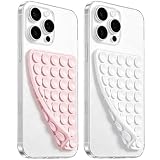
- 【PKYAA Double Sided Silicone Suction Phone Case Mount】PKYAA With Double Sided 40 Strong and Reliable individual suction cups, PKYAA provides a thicken and upgraded universal silicon suction mount for your phone.
- 【Friendly to Content Creators】If you are a content creator or an online influencer, you can create videos anywhere with this suction mount completely hands free with this silicone cell phone mount for cases.
- 【HANDS-FREE & Adhere to Mirrors】This Double Sided silicone suction phone case mount allows you to stick your phone to the mirror easily. No longer holding your phone in one hand to watch video tutorials while making up.
- 【Strong Grip on the Smooth Surface】You can easily hang your phone anywhere with a smooth surface. All you do is you clean off your phone and smooth surface. It is STURDY and it not only sticks to mirrors, it also sticks to windows, it sticks to refrigerators, tiles and other clean, flat surfaces.
- 【Press Down Firmly Every 30 Minutes】Use your palm or fingers to press the phone down firmly and check it's secure before letting go. Apply even pressure for a few seconds to allow the suction cup to adhere properly. To maintain the grip and prevent accidental falls, it's a good practice to periodically reapply pressure to the suction cup.
Plan for foreground use and historical data
Foreground collection is the reliable starting point for a demo. On Android 9 and later, background apps face restrictions on sensor event delivery for relevant reporting modes; do not assume an app can collect continuously while unattended without addressing Android’s background-execution rules. Keep sensor listeners active only as long as needed, particularly when the activity pauses.
Because Grafana’s MQTT data source does not store history or backfill earlier messages, changing the dashboard’s time range will not recover readings published before the panel was listening. If you need durable history or charts over past hours or days, add a separate persistence component that writes MQTT messages to a data store, then build historical panels from that store. The live MQTT panel remains useful for current readings, but it is not a substitute for retention.
Quick Recap
Product prices and availability are accurate as of the date/time indicated and are subject to change. Any price and availability information displayed on Amazon at the time of purchase will apply.

