
Quick wins for a faster PC:
Clear out junk files and repair common Windows errorsFree Scan →Scan for outdated or missing drivers - takes under a minuteDriver Scan →A dual-frequency Class E converter is designed to run at either of two switching frequencies, with its resonant network providing a useful operating condition at each one. Selecting a frequency can change the converter’s power state or output behavior; it is not simply a matter of doubling the switching rate. In a properly designed circuit, the transistor can turn on when its drain voltage is near zero at both frequencies, reducing switching loss.
What makes a Class E converter resonant?
A Class E converter uses a transistor as a switch, rather than operating it continuously as a linear amplifier. A shunt capacitor—often including the transistor’s output capacitance—and a resonant output network shape the switch’s drain-voltage waveform and the load current. A DC-feed inductance supplies comparatively smooth current.
The circuit is timed so the transistor turns on when the voltage across it is approximately zero. This is zero-voltage switching (ZVS). Some designs also arrange for the voltage’s slope to be near zero at turn-on, a stricter condition called zero-voltage-derivative switching (ZVDS). These conditions reduce the overlap of switch voltage and current during turn-on, which helps limit switching loss. They do not eliminate conduction, component, or other circuit losses.
How does it operate at two frequencies?
The resonant network is designed to provide a useful impedance or resonance condition at each of two selected switching frequencies. The control circuit chooses between those frequencies to select the intended operating state. For example, a frequency may correspond to a high-power state and the other to a low-power state. In another design, the two operating points may provide different output characteristics or support power and data on the same inductive link.
#1 Best Overall

- Massive Power, Precision Delivery: Utilizes advanced Digital Class D amplifier technology with over 90% efficiency. Compact and cool-running, it delivers a staggering 1000W of peak power, ensuring every watt is efficiently converted into breathtaking sound.
- Rock-Solid, Stable Performance: Stable at 1 Ohm load (subwoofer channel), providing greater current output and control. Ensures unwavering, dynamic performance even at extreme volume levels—no power fade.
- Pure Sound, Detail Restored: Features a high-performance MOSFET switching power supply and multiple protection circuits (thermal, over-voltage, short-circuit, speaker DC protection). Effectively filters engine noise and interference for signal-to-noise ratio, reproducing pure, crystal-clear musical details.
- Sleek Design, Flexible Installation: Full die-cast aluminum chassis offers robust heat dissipation and a modern look. Its slim profile allows for easy hidden installation under seats or behind panels, preserving valuable cabin space.
- Dimensions: 7 (L) x 6.5 (W) x 2 (H) (inch),weight:3.52 ibs RMS:700 watts RMS at 1-ohm load (14.4v); 380 watts RMS at 2-ohm load (14.4v); 220 watts RMS at 4-ohm load (14.4v);
Both frequencies must work with the circuit’s load, duty ratio, component values, and transistor capacitance. The design must satisfy its resonant and switching conditions at each operating point; merely changing the frequency does not guarantee ZVS or the desired output.
One switching cycle
- Switch on: The transistor conducts while the shunt capacitor is discharged or held near zero voltage. The DC-feed inductance supplies relatively smooth current.
- Switch off: The resonant network and shunt capacitance shape the drain-voltage excursion, while the output network carries the desired fundamental-frequency current.
- Energy exchange: Inductors and capacitors exchange energy at the selected operating frequency. At the second frequency, the network uses its other designed impedance or resonance condition.
- Timed turn-on: The controller waits for the drain voltage to return near zero before turning the transistor on again. In a ZVDS design, it also targets a near-zero voltage slope at that instant.
Actual waveforms depend on duty ratio, load or reflected load, resonator quality factor (Q), switch output capacitance, and the selected frequency. A change between operating states also involves control and circuit dynamics; the available examples do not establish one universal transition method or ripple level.
Rank #2

- 300W PER CHANNEL POWER: With the high-performance TPA3255 chip, the TB10D 2 channel amplifier delivers 600W of power. It can drive bookshelf speakers with 2-8 ohms effortlessly, ensuring clean, dynamic sound
- UNLOCK FLEXIBILITY: It blends flawlessly into your existing audio ecosystem. Whether you're adding warmth to a turntable with a phono preamp or delivering rumble from gaming with a bass shaker, the mini amp provides rich, immersive audio
- SOUND TAILORING: With meticulously crafted bass and treble knobs, the speaker amplifier allows you to tweak the sound to your personal preferences. The inclusion of a power switch adds convenience, making operation a breeze
- UNIVERSAL CONNECTIVITY: The RCA input and passive speaker output make it easy to connect to audio systems in most places, whether in a living room, home theater, game room, dining area, or personal studio
- COMPACT YET MIGHTY: It's compatible with a wide range of sound equipment, including phones, computers, DVDs, CD players, PCs, laptops, and TVs. Meanwhile, it's safeguarded by its built-in protection circuits, ensuring stable operation and prolonging the lifespan
Why use two frequencies?
- Select power states: A 2023 control method alternates between high- and low-power states while preserving ZVS and ZVDS in both. It describes a prototype operating over 4–8 MHz, with control-frequency operation reported up to 500 kHz; that control frequency is not the same as the converter’s MHz switching frequency.
- Shape output across load changes: A dual-band multi-resonant network can be designed for load-independent constant-current or constant-voltage output at its operating points.
- Carry power and data: A 2024 open-access study designed a dual-frequency impedance-matching network for wireless power and data transfer over an inductive link, reporting soft switching at both frequencies.
- Limit switching loss at high frequency: Class E operation uses resonant waveform shaping and soft-switching conditions to reduce switching loss at RF and MHz frequencies.
What published examples show
| Example | Frequency and reported figures | Purpose or reported result |
|---|---|---|
| Dual-band multi-resonant converter (IEEE paper; published online in 2024, in a 2025 journal issue) | 6.72 MHz and 8.1 MHz; 12 V input; 4.5–18.3 W output | Designed for constant-current or constant-voltage output; the paper reports ZVS at both operating points. |
| Two-state control method (Celentano, Pareschi, Rovatti, and Setti, IEEE Transactions on Power Electronics, 2023) | 4–8 MHz prototype operating range; control-frequency operation up to 500 kHz | Alternates high- and low-power states while preserving ZVS and ZVDS in both states. |
| Wireless power-and-data link (Results in Engineering, 2024) | 91.3% reported power-transfer efficiency for a design with an original resonant frequency of 1 MHz | Dual-frequency impedance matching for wireless power and data transfer; the study reports ZVS and ZVDS at both frequencies. |
These are results from different designs, not universal operating limits or a direct performance comparison. In particular, the 91.3% figure belongs to the reported wireless-link design; it should not be treated as a general efficiency for dual-frequency Class E converters.
What to compare when evaluating a design
- Frequency pair and separation: These determine the resonant conditions the network must support.
- Electrical operating range: Check input voltage, output power, load or reflected-load range, and duty ratio together.
- Design objective: Establish whether the frequencies select power states, provide constant-current or constant-voltage behavior, or separate power and data functions.
- Resonator behavior: Consider Q, bandwidth, and sensitivity to component tolerances, which affect how robustly each operating point can be maintained.
- Switch limits: Check device capacitance and drain-voltage stress as well as whether the design requires ZVS alone or both ZVS and ZVDS.
- Control behavior: Evaluate transition ripple and control frequency separately from the power-switching frequency.
What information is needed to design one?
The topic alone is not enough to choose inductor, capacitor, transistor, gate-drive, or timing values. A design needs, at minimum, the target frequency pair, input voltage, output power, load or reflected load, duty ratio, transistor output capacitance, allowable switch-voltage stress, and required regulation mode. Published prototypes and methods illustrate possible approaches; they do not provide a universal parts list.
Free tools Windows power users keep installed
One-click scans. No signup required.
Quick Recap
Best Value
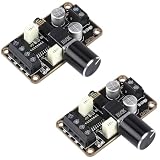
- Parameters: DROK audio amplifier board working voltage is DC 5V, output power is 5W (2Ω 5V)/3W (4Ω 5V) / 1.8W (8Ω 5V). Input method is monaural input.
- Artificial Material: this New-designed mini power amplifier is made of noble black immersion gold circuit board, imported KEMET speaker capacitor, large-capacity filter capacitor for channels. Besides, we customized black copper terminal blocks and gold-plated audio input terminal blocks for this new amplifier module.
- High Performance: the digital amplifier module is with high efficiency of over 90%, general harmonic distortion noise is less than 10%, low quiescent current and noise suppression.
- Safe Protection: the class D dual-channel amp board is designed with input reverse connection protection, short circuit protection, over heat protection; what's more, EMI is allowed to pass.
- Additional Function: it is available to connect amplifier type to choose different function (MODE: high electricity level is Type D, low electricity level is Type AB. Factory defaults high electricity level); available to add an external Shutdown (SD: the chip will be Shutdown at low electricity level, factory default high electricity level.
Rank #4

- Parameters: DROK audio amplifier board working voltage is DC 5V, output power is 5W (2Ω 5V)/3W (4Ω 5V) / 1.8W (8Ω 5V). Input method is monaural input.
- Artificial Material: this New-designed mini power amplifier is made of noble black immersion gold circuit board, imported KEMET speaker capacitor, large-capacity filter capacitor for channels. Besides, we customized black copper terminal blocks and gold-plated audio input terminal blocks for this new amplifier module.
- High Performance: the digital amplifier module is with high efficiency of over 90%, general harmonic distortion noise is less than 10%, low quiescent current and noise suppression.
- Safe Protection: the class D dual-channel amp board is designed with input reverse connection protection, short circuit protection, over heat protection; what's more, EMI is allowed to pass.
- Additional Function: it is available to connect amplifier type to choose different function (MODE: high electricity level is Type D, low electricity level is Type AB. Factory defaults high electricity level); available to add an external Shutdown (SD: the chip will be Shutdown at low electricity level, factory default high electricity level.
Rank #3

- 【RETURN OF THE CLASSIC】The A1S is a pure Class A power amplifier delivering 20W+20W (8Ω), 25W+25W (4Ω) output power. Reference classic circuit, with its characteristically British tonal signature — delicate, warm, and melodiously smooth — it offers a captivating listening experience ideal for music enthusiasts.
- 【LARGE CAPACITY MAIN FILTER ARRAY】It adopts four 18000μF/35V filter capacitors from Nippon Chemical's Black Diamond per channel, with a total filtering capacity of up to 144000μF.The charging and discharging speed is extremely fast, which can make the dynamic response of the entire machine more rapid and the penetration deeper.
- 【EQUIPPED WITH OMRON RELAY】To prevent switch on/off shocks and DC output protection, silver alloy contacts have a long service life and stable performance, providing protection for the equipment.
- 【ANSEM POWER TRANSISTOR】the left and right channels employs a pair of Ansem MJL21193/MJL21194 power transistors, frequently utilized in Swiss luxury high-end audio amplifiers. These transistors perform extremely well in terms of sound clarity, layering and detail resolution. As a set of audio-grade power transistors that enable fatigue-free listening for extended periods, they are ideally suited for AB-class and A-class amplifiers, boasting exceptional linearity.
- 【LARGE TOROIDAL TRANSFORMER】The power amplifier's strong motivation originates from the toroidal transformer, which has a strong power reserve. It is like the giant A-core uninterrupted transformer in a car's engine, providing a continuous source of energy for power amplification!
Product prices and availability are accurate as of the date/time indicated and are subject to change. Any price and availability information displayed on Amazon at the time of purchase will apply.

