
Quick wins for a faster PC:
Scan for outdated or missing drivers - takes under a minuteDriver Scan →Repair Windows errors before they cause bigger problemsFix Now →A logic-gate optocoupler transfers a digital signal across an optical isolation barrier and restores it with an integrated logic receiver. For a low-drive design, compare the LED input-current requirement as carefully as the data rate: Broadcom’s ACPL-064L-000E specifies a 1.6 mA minimum forward LED input current and a 10 MBd minimum data rate, while other candidates trade input-current detail, output behavior, speed, and noise immunity differently.
What a logic-gate optocoupler does
A logic-gate optocoupler combines an LED and a logic-compatible optical detector in one isolation component. The LED represents the input logic state as light; the receiver detects that light and amplifies it into an electrical logic output. Because the signal crosses optically rather than through a conductive connection, the two circuits can be isolated while communicating digital states.
In its application note, onsemi describes the FODM8061 as a high-speed, low-input-current LED coupled to a high-speed bipolar optical receiver. The receiver turns optical energy into electrical current and amplifies it to drive a load. The device is a 3.3 V/5 V high-speed logic-gate output optocoupler with an open-collector output, intended for isolated communications and helping prevent ground loops or hazardous-voltage conduction. onsemi FODM8061 application note
Compare representative high-speed, low-current candidates
| Part | Data rate | Input-current information | Output and notable features |
|---|---|---|---|
| Broadcom HCPL-2430 | 40 MBd typical, per Broadcom’s current product specification | Described as low input current; a numerical threshold is not stated in the cited specification summary | High common-mode transient immunity (CMR); three-state output. Broadcom describes an 820 nm AlGaAs LED coupled to a high-speed photodetector. Broadcom HCPL-2430 specification |
| Broadcom HCPL-0630 | 10 MBd typical, per Broadcom’s current product specification | 5 mA low-input-current capability | TTL/LSTTL compatible; open-collector Schottky-clamped output with enable. Broadcom HCPL-0630 specification |
| Broadcom ACPL-064L-000E | 10 MBd minimum | 1.6 mA minimum forward LED input current | 1.3 mA maximum supply current per channel; -40°C to +105°C operating range; 20 kV/µs minimum CMR at 1000 V common-mode voltage. Broadcom says the LED current can be low enough for most microprocessors to drive directly. Broadcom ACPL-064L-000E specification |
| onsemi HCPL2631 | 10 Mbit/s | 3 mA typical and 5 mA maximum input-threshold current under the datasheet test conditions | Logic-gate optocoupler. onsemi HCPL2631 datasheet |
| Vishay VOIH060A | 10 MBd | Efficient input LED; a numerical input-current threshold is not stated in the cited product information | Single-channel device with integrated high-speed logic gate and strobable output. Vishay VOIH060A datasheet |
| onsemi FODM8061 | Not stated in the cited application note | Characterized as low input current; a numerical threshold is not stated in the cited application note | 3.3 V/5 V logic-gate output and open-collector output. onsemi FODM8061 application note |
These figures are not interchangeable guarantees. In particular, a typical data rate is not a guaranteed system rate, and the stated 10 MBd minimum for the ACPL-064L-000E should not be compared as though it were the same kind of rating as a 10 MBd typical value. Check the applicable datasheet conditions for supply voltage, load, and other limits before designing around a speed figure.
#1 Best Overall
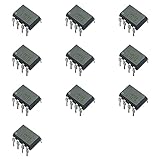
- Low input current requirements – 0.5mA
- High output current – 60mA
- High common mode noise line receiver
- High current transfer ratio – 2000% typical
- NOTE:Exposure to absolute maximum rating conditions for extended periods may affect device reliability
How to choose for a low-drive, high-speed design
Start with the current the input can actually provide
If the source is a GPIO or other constrained driver, favor a part with a clearly specified input threshold at a few milliamps or less. Among these cited examples, the ACPL-064L-000E specifies 1.6 mA minimum forward LED input current. That is a stated minimum input-current figure, not a universal guarantee that every GPIO can drive it under every condition. The HCPL2631 specifies a 3 mA typical and 5 mA maximum input-threshold current under its datasheet test conditions; the HCPL-0630 lists 5 mA low-input-current capability. For the other candidates, the cited information does not give a numerical threshold, so consult the full current datasheet before treating them as low-current fits.
Match the data-rate guarantee to the signal
Determine the actual bit rate and timing margin the isolated link requires, then compare the guaranteed data rate at the intended supply voltage and load. Do not use a typical rate as a maximum system rate. Also compare propagation delay and pulse-width distortion: a device can meet a nominal data-rate target yet still be unsuitable if its delay or distortion consumes the design’s timing margin.
Rank #2

- Photocoupler output type: phototransistor
- Number of pins: 4
- Needle distance: 2.54mm
- Package quantity: 50 pieces, packed in a durable and resealable plastic storage box.
- Application: PC817 photocoupler is widely used in computer terminals, SCR system equipment, measuring instruments, photocopiers, automatic ticketing, household appliances
Check noise immunity, isolation, and operating limits
In a noisy or high-voltage environment, compare the published CMR figures and the conditions attached to them; for example, the ACPL-064L-000E figure is a 20 kV/µs minimum at 1000 V common-mode voltage. Verify the isolation voltage and agency approvals against the equipment’s requirements, along with operating-temperature range. Use the manufacturer’s layout guidance for the chosen device rather than assuming that an isolation rating alone determines board-level performance.
Account for output topology and interface behavior
An open-collector output needs a suitable pull-up and has different loading and rise-time behavior from a three-state output. Check whether the part’s enable or strobe function is required, how its asserted state behaves, and whether the receiver can sink the pull-up current. Confirm receiver supply voltage compatibility as well: the FODM8061 is identified as a 3.3 V/5 V device, but the supply and output conditions still need to match the circuit.
Rank #3
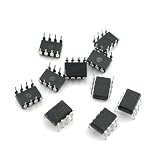
- Low input current requirement: 0.5mA
- High output current: 60mA
- High common-mode noise line receiver
- High current transfer ratio: typical value 2000per cent
- Note: Prolonged exposure to absolute maximum ratings may adversely affect the reliability of the device.
Verify the exact package and suffix
Before selecting a footprint or ordering parts, confirm package, pinout, lifecycle status, and the exact ordering suffix in the manufacturer’s current documentation. Similar part-family names do not ensure matching pinouts or output behavior.
Independent reader supportYour contribution helps us test, update, and keep practical guides available for everyone.Calculate the LED resistor and verify the receiver side
For a simple voltage-driven LED input, estimate the series resistor with R = (VGPIO – VF) / IF, where VGPIO is the driven output voltage, VF is the LED forward voltage at the operating current, and IF is the selected LED current. Use the datasheet’s forward-voltage range and account for GPIO output-voltage drop, supply tolerance, and resistor tolerance. Check both that the worst-case current reaches the required input threshold and that the best-case current stays within the LED’s permitted limits.
Quick Recap
Best Value

- ALLECIN 6N136 Optocoupler - commonly used electronic components.
- DC/Average Forward Input Current: 25mA ; Reverse Input Voltage: 5V
- Features & Advantages: Long service life, reliability and performance.
- Widely Application: 6N136 Optocoupler is widely used in various applications.
- Humanized packaging for easy storage and use. # Printed markings for easy identification.
Rank #4

- Spec: CTR=min.300-typ.1600%, Please see pic3-pic5 for detail parameters.
- Number of Pins: 8 pin(dip-8), Through Hole
- Package quantity: 10 pieces, packed in a durable and resealable plastic bag.
- Compatible with: 6N138M Optocouplers
- Choose the LED current using the datasheet’s threshold and recommended operating conditions, not just a marketing description such as “low input current.”
- Check the receiver’s supply range and decoupling recommendations in the device datasheet.
- For an open-collector output, select a pull-up compatible with the logic input and the optocoupler’s output sink-current limit; verify rise time at the actual load.
- Apply enable or strobe controls to the intended logic level and confirm their timing and default behavior.
- Recheck data rate, propagation delay, pulse-width distortion, CMR, and isolation requirements at the complete circuit’s operating conditions.
Which candidate fits which priority?
- Lowest explicitly stated LED-current figure: ACPL-064L-000E, with 1.6 mA minimum forward LED input current and 10 MBd minimum data rate.
- Highest cited typical speed: HCPL-2430, with 40 MBd typical, high CMR, and a three-state output; do not treat its typical figure as a guaranteed maximum.
- TTL/LSTTL interface with enable: HCPL-0630, with 10 MBd typical and 5 mA low-input-current capability.
- Explicit threshold-current characterization: HCPL2631, with 3 mA typical and 5 mA maximum input-threshold current under its datasheet test conditions.
- Strobable single-channel 10 MBd option: Vishay VOIH060A; confirm the required LED current in its datasheet.
- 3.3 V/5 V open-collector option: FODM8061; consult its current datasheet for numeric speed and input-current limits before relying on them.
Product prices and availability are accurate as of the date/time indicated and are subject to change. Any price and availability information displayed on Amazon at the time of purchase will apply.

