
Outdated Drivers Are Slowing You Down
One free scan finds every outdated or missing driver and matches the right update for your exact hardware.Free scan · exact hardware matchPC Slower Than It Used to Be?
A free scan shows the junk files, broken settings and background clutter dragging Windows down - then fixes them in one click.Free scan · Windows 10 & 11Current sensing measures electrical current either by reading the voltage across a series shunt resistor or by detecting the magnetic field around a conductor. For most PCB and lower-current applications, a shunt is the direct option; the first choice when selecting its amplifier is whether the amplifier’s input common-mode range includes the voltage at the shunt. High-side sensing preserves the load’s ground, while low-side sensing is simpler but shifts it.
What current sensing is used for
Current measurements can reveal battery life, trigger over-current protection, inform motor-control decisions, and profile supply current. The application determines the important constraints: bus voltage, current range, whether current can reverse, acceptable measurement error, and how the measurement output will be used.
Direct and indirect current sensing
Direct sensing with a shunt
A shunt resistor placed in series with a load produces a voltage drop proportional to current, following Ohm’s law. An amplifier measures that small differential voltage. This method is electrically connected to the circuit and dissipates power in the resistor, so shunt resistance is a trade-off: increasing it raises the measurable voltage but also increases voltage drop and heating.
Texas Instruments applications engineers Pete Semig and Collin Wells describe direct sensing as typically used for load currents below 100 A in their 2012 tutorial. That is a general application range, not a universal device limit; the shunt, amplifier, thermal design, and required accuracy determine what a particular circuit can handle.
#1 Best Overall
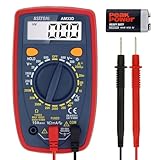
- Additional Tips - The following incorrect operations may cause the multimeter not to show results: Firstly, the plugs of test leads are not fully inserted or not inserted into the correct sockets. Secondly, the manual rotary switch is not placed in the correct position. In addition, this meter can not test all AC Current and below 100mV AC Voltage. Please check the user manual carefully before measurement.
- Versatile Digital Multimeter - Accurately measures AC/DC Voltage, DC Current, Resistance, and Diode. This Multimeter is a really useful tool for solving industrial and household electrical issues. Suitable for Household Outlets, Fuses, Batteries (including Vehicles), Automotive Circuit Troubleshooting, Charging Systems, Testing electronics in Cars etc.
- Troubleshooting with Accuracy - This Multimeter has a sampling speed of 2 times per second; Built-in a backlight LCD display with 3 ½ digits (1999 count) 0.6”, and high polarity including negative and positive readings.
- Ensures Safety - Double fuse is anti-burn and protects from overloading. The silicone cover can protect the multimeter from failing damage and prevent electric shocks. And low battery indication will be displayed when battery power is low.
- Ease of Use - Support Data Hold and Continuity Buzzer. Includes Convenient feature like LCD Backlit Screen makes it easy to use in dimly light areas. Batteries/Set of Test Leads/User Manual are Included.
Indirect sensing with a coil
Indirect sensing detects the magnetic field generated by current, using Ampere’s and Faraday’s laws. A coil such as a Rogowski coil surrounds the conductor and produces a signal without an electrical connection to it. The approach is inherently isolated, but is more expensive and generally unsuitable for ordinary PCB sensing. The same 2012 tutorial describes it as typically used for approximately 100–1000 A loads.
Choose the amplifier by its input common-mode range
Common-mode voltage is the average voltage present at an amplifier’s two inputs. It is not the small differential voltage across the shunt. The shunt drop may be only a small fraction of a volt while both inputs sit at a much higher bus voltage.
Rank #2
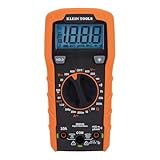
- VERSATILE FUNCTIONALITY: Measures AC/DC voltage up to 600V, 10A DC current, 2MΩ resistance; additional features include continuity, diode test and battery test
- LEAD-ALERT PROTECTION: LEDs on the meter illuminate to indicate proper test lead placement, enhancing accuracy and safety during measurements
- BACKLIT DISPLAY: LCD shows clear readings in low-light conditions for enhanced visibility
- BATTERY TEST: Battery test mode can be used for checking if batteries are working
- CONVENIENT FEATURES: Test lead holders on the back of the meter, kickstand and optional magnetic hanger (Cat. Nos. 69445 or 69417) for hands-free operation
As Semig and Wells explain in the 2012 Texas Instruments tutorial, input common-mode voltage is the key specification when selecting a direct current-sensing solution. Op amps and instrumentation amplifiers generally need their input common-mode voltage to remain within their supply rails. Difference amplifiers and dedicated current-shunt monitors may support input common-mode voltages above their own supply voltage, but only when their specifications say so. Check the common-mode range across the intended bus voltage and operating conditions before choosing a part.
High-side versus low-side sensing
| Placement | Shunt location | What it does well | Main limitation |
|---|---|---|---|
| High-side | Between the bus supply and the load | Preserves the load’s direct ground connection and can detect load shorts. | The amplifier must tolerate the bus voltage as its input common-mode voltage. |
| Low-side | Between the load and ground | Keeps input common-mode voltage near ground and can work with a single-supply, rail-to-rail op amp. | The shunt shifts the load’s ground, and this placement cannot detect load shorts. |
Use high-side placement when maintaining the load’s ground reference or detecting shorts matters, provided the selected monitor supports the bus voltage. Low-side placement can simplify the amplifier requirements when a small ground shift is acceptable and short detection is not needed.
Rank #3

- Versatile Digital Multimeter - Accurately measures AC/DC Current, AC/DC Voltage, Capacitance, Frequency, Duty Cycle, Resistance, Diode, Continuity and Temperature.
- Thoughtful Design - Support Data Hold, Large LCD Backlit Screen, Auto Shut-off and Kickstand make the process of measurements easier. Professional level is reflected in some features include Auto-Ranging capability, and True RMS for measuring both AC Current and Voltage.
- Suitable For Many Occasions - This Multimeter is a golden partner to help to troubleshoot a variety of automotive and household electrical problems safely and accurately.
- Ensure Safety - Double ceramic fuse is anti-burn and protects from overloading,and it will be more secure and reliable; F400mA/600V and F10A/600V explosion-proof ceramic fuse tubes can protect the multimeter effectively.
- Additional Tips - Please take off the cap before using the test leads. Check the manual for more usage information.
Unidirectional and bidirectional measurements
A unidirectional design measures current in one intended direction and does not need a directional reference. For a bidirectional measurement, the amplifier output uses a known reference, or pedestal, voltage. An output above that reference represents one direction; an output below it represents the opposite direction. Check that the reference and output range leave room to represent both directions.
Choose an output that fits the rest of the system
- Current output: The monitor produces an output current; an external resistor can set the gain or convert the signal to voltage.
- Voltage output: The monitor integrates gain and buffering. Gain is often fixed, so verify that the expected current range fits the output range.
- Digital output: The monitor integrates a programmable-gain amplifier and analog-to-digital converter, then reports a digital word through an interface such as I²C or SPI. This can simplify connection to a microcontroller, but resolution and conversion settings still matter.
Can you measure current with an INA219?
Yes. The Texas Instruments INA219 is a digital current-shunt and power monitor with an I²C- or SMBus-compatible interface. It measures the voltage across an external shunt and supports bus-sensing voltages from 0 to 26 V. TI specifies a 3–5.5 V supply, 12-bit conversion resolution, maximum supply current of 1 mA, and an operating temperature range of −40 °C to 125 °C. TI lists maximum accuracy over temperature of 0.5% for the INA219B; that accuracy figure is specific to the B variant.
Rank #4

- Accurately Test Full Features: Accurately measures AC/DC voltage, DC current, resistance, continuity test, diode and batteries.
- High Quality & Safety :Our multimeter is designed to safely and accurately troubleshoot a variety of automotive and household electrical problems. Overload Protection on all ranges to ensure long-term service life,Low Battery Indication, Audible continuity sensor checks that the circuit or wires conduct electricity. Double insulation with a good angled stand for hand free use.
- EASY TO USE: 2.7"Large Backlit LCD Display, Data Hold, Easy to Read Large Back-light Screen forvisibility in dimly light areas. Our mutimeter tester is widely used in Car repair, Homeuse, Schools, laboratories, Families and factories, suitable for Car Drivers, Beginners,Professional Electricians, Housewives, Students Use.
- Nice Protective Orange Shell with Stand Built: Our digital multimeter can be hand held or stood using its fold out stand. Removable thick rubber cover is made of kind of non-slip slightly soft plastic that will help with drop protection & minor bumps protection.
- 2 YEARS Quality Guarantee & Included 9V Battery: The compartment lid at the back is easy to remove. Battery/Set of Test Leads/User Manual are Included.They guarantee against faulty materials and workmanship for 2 years-giving you total peace of mind. If there is any issue within24 months of your purchase, we will replace it for vou with no doubt.
These are IC specifications, not a guarantee for every breakout board. A module’s shunt resistance, board layout, connections, and other implementation details affect the usable current range and measurement. Check the module’s shunt value, expected current, bus voltage, and layout before using it in a circuit. The TI INA219 product page provides the manufacturer’s current specifications.
Independent reader supportYour contribution helps us test, update, and keep practical guides available for everyone.How to choose a shunt resistor
There is no generally correct shunt resistance independent of the circuit. Start with the maximum expected current and the largest voltage drop the load can tolerate. For a chosen resistance, the shunt drop is current multiplied by resistance, and the shunt’s power dissipation is current squared multiplied by resistance. Confirm that the resistor’s power rating and thermal conditions are suitable, then check that the resulting signal is measurable over the full current range without exceeding the monitor’s input or output limits.
Best Value

- VERSATILE FUNCTIONALITY: Measures AC/DC voltage up to 600V, 10A AC/DC current, 50MΩ resistance; additional features include continuity, temperature, capacitance, frequency/duty cycle and diode test
- LEAD-ALERT PROTECTION: LEDs on the meter illuminate to indicate proper test lead placement, enhancing accuracy and safety during measurements
- BACKLIT DISPLAY: LCD shows clear readings in low-light conditions for enhanced visibility
- ACCURATE MEASUREMENTS: Auto-ranging and True Root Mean Squared (TRMS) technology provides precise and accurate measurements
- CONVENIENT FEATURES: Test lead holders on the back of the meter, kickstand and optional magnetic hanger (Cat. Nos. 69445 or 69417) for hands-free operation
A precision shunt resistor is an accessory, not a universal upgrade: its value depends on maximum current, allowable drop, power dissipation, and the monitor’s measurement range.
Quick Recap
What to check before building a current-sensing circuit
- Define the bus voltage, maximum current, and whether current can flow in both directions.
- Choose high-side or low-side placement based on ground integrity and whether load-short detection is required.
- Verify the amplifier’s common-mode range at the shunt’s actual voltage, not just its supply voltage.
- Choose a shunt value that produces a usable signal while keeping voltage drop and heating acceptable.
- Match the output type and interface to the receiving circuit, and confirm the required gain, resolution, and accuracy.
- For a packaged INA219 module, verify the board’s shunt resistance, expected current, bus-voltage limit, and layout rather than relying only on the IC’s specifications.
Product prices and availability are accurate as of the date/time indicated and are subject to change. Any price and availability information displayed on Amazon at the time of purchase will apply.

