
iTechGuides is reader-supported. When you buy through links on our site, we may earn an affiliate commission. As an Amazon Associate I earn from qualifying purchases. Learn more
Two 15-kilogram (about 33-pound) satellites launched on 1 October 2026 to help measure greenhouse-gas plumes over industrial sites. GHGSat-C18, named Eleanor, and GHGSat-C19, named Aidan, orbit about 500 kilometres (310 miles) above Earth. Their imaging spectrometers detect gas signatures in reflected sunlight; analysts then use observations and plume models to estimate emissions.
Which satellites launched, and when?
SFL Missions announced that Eleanor and Aidan were deployed after launching on 1 October 2026 aboard SpaceX’s Transporter-18 rideshare mission from Vandenberg Space Force Base. The spacecraft use SFL’s 15-kilogram NEMO microsatellite platform and were integrated and tested in Vaughan, Ontario, according to SFL Missions.
The figures “33 pounds” and “310 miles” are rounded conversions of the satellites’ listed 15-kilogram launch mass and approximately 500-kilometre orbital altitude. The World Meteorological Organization’s OSCAR record lists those specifications and identifies methane and carbon dioxide as the main target gases: WMO OSCAR’s GHGSat record.
Do these 3 things before closing this tab:
1Scan for outdated or missing drivers - takes under a minute2Clear out junk files and repair common Windows errors3Fix the driver behind crashes, sound loss and screen glitchesHow can a satellite detect a gas plume?
It looks for a spectral signature
GHGSat’s satellites use a wide-angle Fabry–Pérot imaging spectrometer working in short-wave infrared. The instrument observes sunlight reflected from Earth. Methane and other gases absorb light at particular wavelengths, so a plume changes the light measured over a site compared with nearby background areas. NASA describes the measurements as differences between plume and background concentrations.
#1 Best Overall

- HOBBY MODEL KIT – Unassembled model packed in an envelope with easy to follow instructions. Ideal for ages 14 and up.
- NO GLUE OR SOLDER NEEDED – Parts can be easily clipped from the metal sheets. Tweezers are the recommended tool for bending and twisting the connection tabs.
- VOYAGER – 1.5 Sheet Model with a moderate difficulty level. Assembled Size: 1.38 x 1.77 x 6.70 inches.
- FROM STEEL SHEETS TO 3D – Pop out the pieces and connect using tabs and holes. Includes illustrated instructions.
- HIGHLY DETAILED ETCHED MODEL – Display your 3D model once completed - collect and build them all.
GHGSat’s constellation is primarily designed to monitor methane, with carbon dioxide also within its mission scope. The company describes its satellite design and monitoring approach on its constellation overview.
Emission rates require interpretation
The satellite does not simply read an industrial facility’s emissions as a direct onboard measurement. Its observations show a plume’s signature; estimating how much gas is escaping involves interpreting that signal and modeling how the plume disperses. The analysis can use site information and weather data from global models or local stations. NASA explains the measurement and product context in its GHGSat data overview.
Rank #2

- Model Kit
- May Require Paints and Glues to Assemble
- Accurate Scale Model
- Detailed Instructions Provided
- Decals/Transfers Included
What does 310 miles above Earth mean for monitoring?
GHGSat reports a sun-synchronous polar low-Earth orbit at approximately 500 kilometres, or 310 miles, with a roughly 90-minute period to circle Earth. A sun-synchronous orbit is designed to keep local lighting conditions similar between passes, helping analysts compare observations over time.
The Tool Desk
Outbyte PC Repair FREERepair Windows errors before they cause bigger problemsFix Now →Outbyte Driver Updater FREEScan for outdated or missing drivers - takes under a minuteDriver Scan →NASA describes an approximate 12-by-12-kilometre field of view. GHGSat satellites typically provide spatial resolution below 30 metres, according to NASA; the earlier GHGSat-D satellite had resolution over 50 metres. Finer resolution can help connect a plume to an individual facility rather than only a broader region. GHGSat lists 100 kilograms per hour as a methane-detection capability for its current fleet, but that is a stated capability—not a guarantee that every plume will be detected in every condition.
Rank #3

- HOBBY MODEL KIT – Unassembled model packed in an envelope with easy to follow instructions. Ideal for ages 14 and up
- NO GLUE OR SOLDER NEEDED – Parts can be easily clipped from the metal sheets. Tweezers are the recommended tool for bending and twisting the connection tabs
- APOLLO CSM – 3.5 Sheet Model with a challenging difficulty level. Assembled Size: 5.07 L x 2.28 W x 3.45 H inches.
- FROM STEEL SHEETS TO 3D – Pop out the pieces and connect using tabs and holes. Includes illustrated instructions
- HIGHLY DETAILED ETCHED MODEL – Display your 3D model once completed - collect and build them all
Repeated observations add context: they can help identify activity or major changes when assessed against predetermined thresholds, and can support monitoring and mitigation checks. Detection and emission estimates still depend on conditions, repeat observations, plume behavior and weather. GHGSat says its Vanguard CO₂ measurements have 25-metre resolution; this is a company-stated capability, not a specification for every satellite in the constellation.
What do the fleet counts mean?
The figures 13 and 16 refer to different counts, not a contradiction about the operating fleet. SFL said its October 2026 launch brought the number of spacecraft it had developed for GHGSat to 13. GHGSat’s constellation page listed 16 satellites launched before Eleanor and Aidan. WMO’s record, last updated 13 July 2026, includes C16 and C17, launched on 7 July 2026. These are builder-specific and constellation-wide totals with different dates and scopes; they should not be treated as interchangeable. SFL also said 32 additional spacecraft were under development at its facility when it made its 2 October announcement.
Rank #4

- HOBBY MODEL KIT – Unassembled model packed in an envelope with easy to follow instructions. Ideal for ages 14 and up.
- NO GLUE OR SOLDER NEEDED – Parts can be easily clipped from the metal sheets. Tweezers are the recommended tool for bending and twisting the connection tabs.
- JAMES WEBB SPACE TELESCOPE - 2.75 Sheet Model with a moderate difficulty level. Assembled Size: 4.13 L x 2.75 W x 2.75 H inches. 1:221 Scale. 62 Pieces
- FROM STEEL SHEETS TO 3D – Pop out the pieces and connect using tabs and holes. Includes illustrated instructions.
- HIGHLY DETAILED ETCHED MODEL – Display your 3D model once completed - collect and build them all.
Who can use the satellite data?
This is commercial, facility-level monitoring, not automatically an open public feed. NASA says its Commercial Satellite Data Acquisition program provides access subject to authorization and applicable end-user license terms. Its GHGSat overview describes products including concentration maps and repeated monitoring of sites, with plumes resolvable from sources such as individual oil and gas wells and landfills.
Quick wins for a faster PC:
Clear out junk files and repair common Windows errorsFree Scan →Scan for outdated or missing drivers - takes under a minuteDriver Scan →How does this compare with planned missions?
ESA’s Tango Scout is a planned mission intended to monitor methane, carbon dioxide and nitrogen dioxide at large industrial sites. ESA’s 2024 announcement said the plan was to observe 150–300 facilities every four days. Those are mission plans, not evidence that Tango is currently operational. The comparison is useful because missions can differ in gases measured, target scale, coverage and revisit schedule: ESA’s Tango announcement.
Best Value
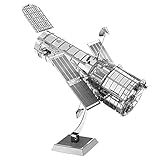
- HOBBY MODEL KIT – Unassembled model packed in an envelope with easy to follow instructions. Ideal for ages 14 and up.
- NO GLUE OR SOLDER NEEDED – Parts can be easily clipped from the metal sheets. Tweezers are the recommended tool for bending and twisting the connection tabs.
- HUBBLE TELESCOPE – 1 Sheet Model with a moderate difficulty level. Assembled Size: 3.00 x 2.00 x 2.50 inches.
- FROM STEEL SHEETS TO 3D – Pop out the pieces and connect using tabs and holes. Includes illustrated instructions.
- HIGHLY DETAILED ETCHED MODEL – Display your 3D model once completed - collect and build them all.
What is GHGSat planning next?
On 21 September 2026, GHGSat announced a second-generation satellite planned for early 2028. The company says it is targeting a 50-kilogram-per-hour onshore methane threshold, compared with 100 kilograms per hour for its first generation, and aims to double daily coverage per satellite. These are future targets announced by GHGSat, not demonstrated results from an operating system. CEO Stephane Germain characterized it as “the next step in a decade of delivery” and called GHGSat’s system “the only commercially operating, independently validated methane monitoring constellation in the world”; those descriptions are the company’s claims, not independent findings. Details are in GHGSat’s announcement.
Quick Recap
Product prices and availability are accurate as of the date/time indicated and are subject to change. Any price and availability information displayed on Amazon at the time of purchase will apply.

