
Assess dirty data by asking whether it is fit for a specific use—not whether it earns a universal quality score. Define what the dataset must support, set measurable checks for its critical fields, profile an unchanged copy, make evidence-based and documented corrections, then rerun the checks and disclose what remains uncertain.
What data quality means
Data quality is fitness for a stated purpose. A dataset may be adequate for a rough trend analysis but unsuitable for a decision that depends on current, accurate values. The UK Government’s Government Digital Service puts it plainly: “There are no universal criteria for good quality data.” Its data quality framework recommends choosing dimensions according to users’ needs. Statistics Canada likewise notes that quality assessment is complex and that not every aspect can be assessed in every context in its quality guidelines.
Start with the decision, analysis, or process the data must support. Then decide which defects could undermine it and what level of error is tolerable. A generic checklist can help surface problems, but it cannot determine fitness for use on its own.
Which data quality dimensions should you check?
Dimensions describe different kinds of quality. Frameworks group and name them differently, so treat the following as practical questions rather than a single universal standard.
The Tool Desk
Outbyte Driver Updater FREEScan for outdated or missing drivers - takes under a minuteDriver Scan →Outbyte PC Repair FREERepair Windows errors before they cause bigger problemsFix Now →#1 Best Overall

- Easy-to-use desktop hard drive — simply plug in the power adapter and USB cable.Specific uses: Business, personal
- Fast file transfers with USB 3.0
- Drag-and-drop file saving right out of the box
- Automatic recognition of Windows and Mac computers for simple setup (reformatting required for use with Time Machine)
- Enjoy peace of mind with the included limited warranty and Rescue Data Recovery Services
| Dimension | Question to ask | Example check |
|---|---|---|
| Accuracy | Does the value reflect reality? | Compare a critical value with an authoritative source or verify it with its data owner. |
| Validity | Does the value meet an agreed type, format, or range? | Check that a date parses correctly or that a measurement falls within a specified bound. |
| Completeness | Are the values or records required for this use present? | Count missing values in fields that are required, excluding legitimate inapplicability. |
| Consistency | Do related values agree within or across records or datasets? | Compare a status field with related dates or reconcile values across two sources. |
| Uniqueness | Are records duplicated under the definition relevant to this dataset? | Identify repeated records using agreed matching fields and review ambiguous matches. |
| Timeliness | Is the data current and available when the task requires it? | Compare update dates with a freshness cutoff tied to the decision. |
These checks answer different questions. A value can have a valid format but still be inaccurate; two records can agree and still both be wrong. Likewise, complete fields do not prove correctness, and an empty field may be appropriate if the value does not apply.
How to assess and clean dirty data
1. Define the use and identify critical data
Write down what the dataset will support, the relevant period, and who will rely on it. Mark the records and fields that could change the outcome. For each field, distinguish required values from optional ones and those that may legitimately be inapplicable. This makes a completeness target meaningful rather than treating every blank as a defect.
Rank #2
- Easy-to-use desktop hard drive—simply plug in the power adapter and USB cable
- Fast file transfers with USB 3.3
- Drag-and-drop file saving right out of the box
- Automatic recognition of Windows and Mac computers for simple setup (Reformatting required for use with Time Machine)
- Enjoy peace of mind with the included limited warranty and Rescue Data Recovery Services
2. Set rules before editing
For each critical field or record, specify the test, the expected result, and how exceptions will be handled. Depending on the use, rules might cover expected record counts, required-value presence, duplicate criteria, allowed types and formats, permissible ranges, cross-field consistency, or a freshness cutoff. Keep the rule, target, and rationale for exceptions together. The UK Government’s data quality action plan guidance recommends setting rules, measures, methods, and targets for critical data items, with priorities based on user needs.
3. Profile an unchanged baseline
Run the checks against an unchanged copy or a recorded version of the input before correcting anything. Count missing values, duplicates, invalid formats, range violations, apparent contradictions, and stale records. For rates, state the denominator and scope: for example, missing required values among records expected to contain them, not missing values across every row regardless of applicability.
Free tools Windows power users keep installed
One-click scans. No signup required.
Rank #3

- Slim durable design to help take your important files with you
- Vast capacities up to 6TB[1] to store your photos, videos, music, important documents and more
- Back up smarter with included device management software[2] with defense against ransomware
- Help secure your important files with password protection and hardware encryption
- 3-year limited warranty
Review distributions and suspicious values, compare related fields or sources, and distinguish formatting errors from unusual but real observations. For statistical or scientific datasets, graphical and statistical assessment can help determine whether the data suits the intended decision. The U.S. Environmental Protection Agency describes such methods in its data quality assessment guidance; the appropriate tests depend on the data and its use.
4. Choose a remedy supported by evidence
- Missing values: Establish which values are required, investigate patterns of missingness, and document known reasons. Do not fill blanks solely to improve a completeness rate.
- Invalid formats or ranges: Validate against agreed types, formats, and bounds. Correct a value only when the rule and available evidence support the correction.
- Inconsistent representations: Standardize under a documented convention, such as a consistent date format. Preserve the original value or a reversible transformation record when appropriate.
- Duplicates: Apply explicit matching criteria. Review ambiguous matches before merging or deleting records; records that look similar are not necessarily duplicates.
- Contradictory or inaccurate values: Compare against an authoritative source or investigate with the data owner. Do not choose the “right” value based only on plausibility.
- Stale values: Set a currency rule that fits the use and report the data’s reference period.
For each proposed repair, consider whether the original value can be recovered, how many critical records are affected, whether the issue is systematic, and whether the change could introduce bias or erase meaningful variation. A correction that improves consistency is not necessarily a correction to reality.
Rank #4
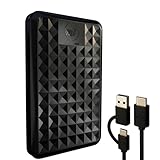
- High-capacity external hard drive with up to 2TB of storage The ModusTech Facet portable external hard drive gives you dependable HDD storage in a slim 2.5-inch design. Multiple capacities available up to 2TB — back up photos, videos, music, documents, and game libraries with room to grow. A trusted external storage solution for everyday backup, media archives, and creative work.
- USB-C and USB 3.1 connectivity with included 2-in-1 cable The Facet ships with a USB-C to USB-C cable and tethered USB-A adapter, so this external hard drive connects to modern laptops, USB-C iPhones, tablets, and older USB-A computers without buying an extra cable. USB 3.1 Gen 1 (5Gbps) interface delivers real-world transfer speeds up to 100MB/s — fast enough to back up 50GB of files in about 8 minutes.
- Plug-and-play external hard drive for PC, Mac, and laptops Preformatted in exFAT and ready to use the moment you plug it in. The Facet works out of the box with Windows PCs, macOS Macs, MacBooks, Chromebooks, and laptops — no drivers, no software, no setup required. A true plug-and-play external hard drive built for everyday use across every major operating system.
- External hard drive for PS4, Xbox One, and Smart TV gaming The Facet is compatible with PlayStation 4, Xbox One, and Smart TVs with USB support. PS4 and Xbox One games run directly from the drive — plug it in, format through the console, and add to your storage. Also works with Smart TVs that support USB recording or external media playback.
- Slim, shock-resistant portable external hard drive — 160g At 2.5 inches and just 160g, this portable external hard drive is bus-powered through a single USB-C cable — no separate power adapter, no extra cables. Slim enough for a laptop bag, jacket pocket, or camera bag, with a shockresistant casing and faceted diamond-texture top panel that resists fingerprints and everyday wear. Backed by a 1-year limited warranty from ModusTech, a consumer electronics brand specializing in external storage.
5. Recheck, monitor, and communicate
Rerun the same rules after cleaning and compare results with the baseline. Record the changes made, rule versions, exceptions, and unresolved cases. Where practical, prevent recurring defects with validation at collection or transfer points and consistent standards across the data journey. Explain relevant collection and processing limitations so users can judge whether the result is suitable for their own purpose.
Independent reader supportYour contribution helps us test, update, and keep practical guides available for everyone.How to balance quality with speed
More collection, review, and validation can improve assurance but take time. In some situations, delivering data sooner may require accepting less completeness or less review. Decide whether that trade-off is acceptable for the use, identify which dimensions are affected, and communicate the limitation alongside the data. Do not describe a faster, less-checked dataset as equivalent to one that has been fully assessed.
Recommended Free Tools
Quick Recap
Product prices and availability are accurate as of the date/time indicated and are subject to change. Any price and availability information displayed on Amazon at the time of purchase will apply.

