
Quick wins for a faster PC:
Scan for outdated or missing drivers - takes under a minuteDriver Scan →Repair Windows errors before they cause bigger problemsFix Now →iTechGuides is reader-supported. When you buy through links on our site, we may earn an affiliate commission. As an Amazon Associate I earn from qualifying purchases. Learn more
Anatomy of an AI System is a 2018 visual map and essay by Kate Crawford and Vladan Joler that traces the material resources, human labor, and data behind an Amazon Echo. Its point is not that the speaker contains all of AI, but that an apparently simple voice interaction depends on a much larger system—from extraction and manufacturing to computation, feedback, and disposal.
What is Anatomy of an AI System?
Published in 2018 by SHARE Lab/SHARE Foundation and NYU’s AI Now Institute, the work pairs a large-scale visual map with an essay in 21 parts. Its full subtitle is The Amazon Echo as an anatomical map of human labor, data and planetary resources. The project page provides digital PDF downloads of the map and an A3-format map-plus-essay publication. View the project and its downloads.
The Council of Europe calls it “a visual essay” that uses the Amazon Echo “as a case study of black box technology.” That description captures its method: start with a familiar device, then make visible the systems and dependencies a user cannot see during an ordinary interaction. Council of Europe overview.
What’s actually slowing this PC down?
Pick the symptom - the matching free tool is one click away.
Why use an Echo to explain a much larger AI system?
The Echo is the case study, not the boundary of the argument. Asking a voice assistant to perform a task can appear to be a direct exchange between a person and a speaker. Crawford and Joler instead map the chain that makes the exchange possible: physical materials and manufacturing, logistics and infrastructure, data collection and computation, and human work. The project argues that the “cloud” metaphor can obscure these material and social foundations.
#1 Best Overall

- Your favorite music and content – Play music, audiobooks, and podcasts from Amazon Music, Apple Music, Spotify and others or via Bluetooth throughout your home.
- Alexa is happy to help – Ask Alexa for weather updates and to set hands-free timers, get answers to your questions and even hear jokes. Need a few extra minutes in the morning? Just tap your Echo Dot to snooze your alarm.
- Keep your home comfortable – Control compatible smart home devices with your voice and routines triggered by built-in motion or indoor temperature sensors. Create routines to automatically turn on lights when you walk into a room, or start a fan if the inside temperature goes above your comfort zone.
- Do more with device pairing – Fill your home with music using compatible Echo devices in different rooms, or create a home theatre system with Fire TV.
- Say goodbye to drop-offs and buffering - With eero Built-in, Echo Dot doubles as a mesh wifi extender, adding up to 1,000 sq. ft. of wifi coverage to your existing eero network.
That framing is useful beyond one speaker, but it is not a universal inventory of every AI product. The map follows an Echo through specific systems and claims; applying its framework elsewhere requires checking which inputs, workers, data flows, and infrastructure actually belong to that other case.
The three connected layers in the map
Material resources
The map begins with the physical world: resources must be extracted and processed, components made, and the device transported. Its account links a compact consumer object to planetary resource use. The point is that digital services still depend on physical supply chains, even when the user encounters them through voice and software. For context on the project’s scope, see LABoral Centro de Arte’s overview.
Rank #2

- Your favorite music and content – Play music, audiobooks, and podcasts from Amazon Music, Apple Music, Spotify and others or via Bluetooth throughout your home.
- Alexa is happy to help – Ask Alexa for weather updates and to set hands-free timers, get answers to your questions and even hear jokes. Need a few extra minutes in the morning? Just tap your Echo Dot to snooze your alarm.
- Keep your home comfortable – Control compatible smart home devices with your voice and routines triggered by built-in motion or indoor temperature sensors. Create routines to automatically turn on lights when you walk into a room, or start a fan if the inside temperature goes above your comfort zone.
- Do more with device pairing – Fill your home with music using compatible Echo devices in different rooms, or create a home theatre system with Fire TV.
- Say goodbye to drop-offs and buffering - With eero Built-in, Echo Dot doubles as a mesh wifi extender, adding up to 1,000 sq. ft. of wifi coverage to your existing eero network.
Human labor
The system also depends on people’s work across production, logistics, operation, and the feedback processes surrounding the service. The authors’ map asks readers to look beyond visible product design and consider the human activity that supports a device and its interactions. These are claims and connections made by the 2018 essay, not a current audit of Amazon’s workforce or supply chain.
Data
Voice interaction creates data as well as a response. In the authors’ account, users are not only customers of the system: their commands and feedback can also function as resources and labor within it. This interpretation broadens the idea of “using” an AI service: the user’s contribution may help sustain or improve the system, even though that contribution is less visible than the speaker itself.
Rank #3
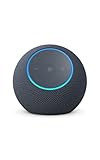
- Meet Echo Dot Max: Experience rich room-filling sound that automatically adapts to your space and fine-tunes playback. Features a built-in smart home hub and Omnisense technology for highly personalized experiences.
- Music to your ears: With nearly 3x the bass versus Echo Dot (2022 release), it fits beautifully in any space, delivering your personal sound stage with deep bass and enhanced clarity. Listen to streaming services, such as Amazon Music, Apple Music, Spotify, and SiriusXM. Encore!
- Do more with device pairing: Connect compatible Echo smart speakers and smart displays in different rooms, or pair with a second Echo Dot Max to enjoy even richer sound
- Simple smart home control: Set routines, pair and control lights, locks, and thousands of smart home devices that work with Alexa without needing a separate smart home hub. With Omnisense technology, you can activate routines via temperature or presence detection.
- Say goodbye to drop-offs and buffering - With eero Built-in, Echo Dot Max doubles as a mesh wifi extender, adding up to 1,000 sq. ft. of wifi coverage to your existing eero network.
How birth, life, and death connect the layers
The work organizes its account around a device lifecycle. “Birth” covers the material and human systems involved in bringing the object into being. “Life” follows its operation and the ongoing relationships among users, data, labor, and infrastructure. “Death” brings disposal into view, connecting a device’s end of use to the broader problem of electronic waste.
This lifecycle structure prevents a common blind spot: treating environmental or social cost as something that happens only when a device is manufactured. In the map’s framing, extraction, operation, data practices, energy, and disposal belong to the same account of the system.
Rank #4

- Your favorite music and content – Play music, audiobooks, and podcasts from Amazon Music, Apple Music, Spotify and others or via Bluetooth throughout your home.
- Alexa is happy to help – Ask Alexa for weather updates and to set hands-free timers, get answers to your questions and even hear jokes. Need a few extra minutes in the morning? Just tap your Echo Dot to snooze your alarm.
- Keep your home comfortable – Control compatible smart home devices with your voice and routines triggered by built-in motion or indoor temperature sensors. Create routines to automatically turn on lights when you walk into a room, or start a fan if the inside temperature goes above your comfort zone.
- Do more with device pairing – Fill your home with music using compatible Echo devices in different rooms, or create a home theatre system with Fire TV.
- Say goodbye to drop-offs and buffering - With eero Built-in, Echo Dot doubles as a mesh wifi extender, adding up to 1,000 sq. ft. of wifi coverage to your existing eero network.
What the work establishes—and what it cannot quantify
Anatomy of an AI System is a visual framework and critical essay, not a definitive measured footprint for every Echo or AI service. The essay describes difficulty obtaining precise figures for cloud-computing energy use and refers to criticism of AWS transparency. It does not establish a total energy figure for the Echo system. Readers should therefore treat its energy discussion as an account of opacity and dependency, not as a quantified lifecycle calculation. The authors’ project page.
Recommended Free Tools
The work also includes historical details that should stay attached to their context. For example, it cites the Consumer Technology Association’s 2014 estimate of a 4.7-year average smartphone lifespan. That number concerns smartphones, not Echo devices, and is a dated figure quoted in the essay—not a current estimate of device longevity.
Best Value

- MEET ECHO SPOT - A sleek smart alarm clock with Alexa and big vibrant sound. Ready to help you wake up, wind down, and so much more.
- CUSTOMIZABLE SMART CLOCK - See time, weather, and song titles at a glance, control smart home devices, and more. Personalize your display with your favorite clock face and fun colors.
- BIG VIBRANT SOUND - Enjoy rich sound with clear vocals and deep bass. Just ask Alexa to play music, podcasts, and audiobooks. See song titles and touch to control your music.
- EASE INTO THE DAY - Set up an Alexa routine that gently wakes you with music and gradual light. Glance at the time, check reminders, or ask Alexa for weather updates.
- KEEP YOUR HOME COMFORTABLE - Control compatible smart home devices. Just ask Alexa to turn on lights or touch the screen to dim. Create routines that use motion detection to turn down the thermostat as you head out or open the blinds when you walk into a room.
How to read it in relation to current AI
The project is anchored in a 2018 analysis of an Echo and Alexa as they were represented at that time; the essay refers to a 2017 Echo promotional video. It should not be read as a current specification sheet for today’s Echo models, a description of present Alexa policies, or a measured account of contemporary generative AI. Its lasting contribution is a set of questions to ask of any AI system:
- What materials and extraction processes make the hardware possible?
- Which paid and unpaid human work supports production and operation?
- What data is collected, processed, or supplied through user interaction?
- What infrastructure and energy are required, and how much is actually documented?
- What happens to the device and its materials at end of life?
- Which parts of the account are documented, and which are interpretations or inferences?
Crawford and Joler summarize the problem this way: “The true costs of these systems – social, environmental, economic, and political – remain hidden and may stay that way for some time.” Read as a 2018 intervention, the sentence explains why the map looks beyond the visible device: not to claim that every cost is fully known, but to show how much a simple interface can conceal.
Quick Recap
Product prices and availability are accurate as of the date/time indicated and are subject to change. Any price and availability information displayed on Amazon at the time of purchase will apply.

