
“Stop processing more rules” tells Outlook to stop checking the rules below the current rule after this rule matches. The current rule still performs its actions. The option only prevents later rules from running on that message.
This setting matters when a message could match several rules—for example, a rule that moves mail from a particular sender and another rule that deletes messages with attachments. Rule order and this checkbox together determine what happens.
What the option does
Outlook evaluates rules in their listed order. When a message meets a rule’s conditions, Outlook carries out that rule’s actions. If Stop processing more rules is selected for that rule, Outlook then ignores every rule below it for that message.
It does not:
- Cancel the rule that just matched
- Undo that rule’s actions
- Disable the remaining rules permanently
- Stop rules from processing future messages
It affects only the current message’s passage through the rule sequence. The other rules remain available and can still process messages that reach them.
Free tools Windows power users keep installed
One-click scans. No signup required.
#1 Best Overall

- 【Elegant Minimalism】: Avant-garde design concept, industrial design style makes it so attractive and decorative. The combination of industrial-inspired materials looks more texture and beauty, Add personality to any room with this unique file organizer for the desk.
- 【High-Quality Materials】: Made of Premium Metal Iron and antique wood, durable and un-pliant, easy to clean. The metal surface is frosted, making it look amazing and shiny, feels good to the touch. Paper organizer size: 7’ L x 3.3’’W x 6’’H.
- 【KEEP ORGANIZED】This mail organizer countertop has 3 slots of different heights and allows you to store instant storage for letters, paper, business cards, documents, notepads, envelopes, bills,s and more, keeping your desk tidy.
- 【READY TO USE】:Desk file organizer no assembling required, use immediately. Easy to get anything you want when retrieving folders, letters, magazines, and office essentials.
- 【PRACTICAL GIFT】Countertop rustic envelope divider is suitable for home office decoration and can also be used as a practical gift for your family, friends, and colleagues.
Example: why rule order matters
Suppose your rules are ordered like this:
| Order | Rule | Action |
|---|---|---|
| 1 | Messages from a wedding planner | Move to the Wedding folder |
| 2 | Messages with attachments | Delete the message |
A message from the wedding planner with a PDF attachment matches both rules.
- If Rule 1 has Stop processing more rules selected, Outlook moves the message to Wedding and does not run Rule 2.
- If the option is cleared, Outlook can run both rules. The message may be moved and then deleted, depending on the account and rule actions.
The first applicable rule with this option enabled therefore acts as a stopping point. If a higher rule does not match, Outlook continues down the list until it finds a match or reaches the end.
When you should enable it
Enable the option when one rule should take priority over broader rules. Common examples include:
- Send messages from your manager to a priority folder, even if a general newsletter rule also matches.
- Keep invoices in an Accounting folder instead of allowing a general “messages with attachments” rule to move or delete them.
- Route messages from a project address to a project folder before a catch-all rule archives all messages containing a keyword.
- Apply one exclusive classification to a message rather than several overlapping actions.
Leave it cleared when a message should intentionally receive multiple treatments—for example, moving a message to a folder while also flagging it or forwarding it.
Rank #2

- [Space Saving] Our mail sorter organizer features 3 compartments and no assembly needed, designed to consolidate your desktop items. This mail holder tames desk clutter, saves valuable space, and maintains a clean and orderly workspace.
- [Mesh Metal Materials] Crafted from durable metal mesh, our 3 section mail organizer countertop stands out for its quality and strength. Designed to resist damage and deformation, this letter organizer is a sturdier, more durable option compared to the typical plastic file holders on the market.
- [Elegant Design] Our envelope organizer is designed with slots at different heights to facilitate storage and access to mails or books. The metal materials looks more texture and beauty, decorating you home or office perfectly.
- [Keep Your Desktop Clean] The desktop mail holder countertop is not made of plastic or wood, the grid metal material is not only strong and durable, but also can minimize the accumulation of dust and ensure the neatness of the desktop.
- [Multifunctional Ocastion] The dimension of this mail organizer is 6.8"L x 5.43"H x 2.95"W. The desktop file organizer can store mails, letters, documents, newspapers, reduce your desk clutter down to almost zero while allowing you to store an assortment of items you'll need to easily access.
How to turn it on or off
New Outlook for Windows
- Select Settings.
- Go to Mail > Rules.
- Select Edit next to the rule.
- Select or clear Stop processing more rules.
- Select Save.
To create a rule from a message, right-click the message, hover over Rules, and select Create rule. Choose More options if you need additional conditions or actions, select the checkbox, and then select Save.
Outlook on the web and Outlook.com
- Select Settings.
- Go to Mail > Rules.
- Select Edit beside the rule.
- Select or clear Stop processing more rules.
- Select Save.
To create a rule in Outlook on the web, open Settings > Mail > Rules, select Add new rule, enter a name, choose the conditions and actions, and decide whether to leave Stop processing more rules selected. You can use Add a condition, Add an action, and Add an exception to refine it.
In Outlook.com, you can also right-click a message, select Rule > Create rule, choose More options if needed, and select the checkbox before saving.
Classic Outlook for Windows
- Select File > Manage Rules & Alerts. You can also use Move > Rules > Manage Rules and Alerts from the Ribbon.
- Select the rule you want to change.
- Select Change Rule > Edit Rule Settings.
- Proceed through the conditions with Next.
- Under What do you want to do with the message?, select or clear Stop processing more rules.
- Complete the wizard and save the rule.
Classic Outlook creates rules with stop processing enabled by default unless exceptions are created. Check the option rather than assuming its state, particularly after importing or editing older rules.
What’s actually slowing this PC down?
Pick the symptom - the matching free tool is one click away.
Rank #3

- [Efficient Partitioned Storage] This mail organization is designed with left and right partitions for efficient use of space. You can store paper, mail, letters, envelopes, bills, newspapers, and documents in the left partion. The right partition can be used to store thicker documents, books and magazines, etc
- [Ingenious Design] The 3 inner dividers on the left partition of this wood desktop mail sorter organizer are flexible and removable, adjusting the layout to your needs and organizing items of varying heights and sizes. Designed with curved panels, it is aesthetically pleasing and stylish while making it easier to hold files
- [Multiple-Scene Application] The letter organizer measures 15.83’’L x 9.25’’W x 11.1’’H. Perfect for home mail center, office mailroom, front desk reception, classroom or library, envelope organizer will be a good helper for you to organize efficiently
- [Sturdy and Stable] The high quality thickened particleboard keep the desk organizer for all your daily needs. The upper can also be used to small items such as green plants and alarm clocks
- [Easy to Assemble] This desk file organizer comes with detailed instructions and assembly tools, making assembly easy. Add an efficient storage organizer to your desk now
Do rules process messages that are already in your mailbox?
Normally, inbox rules process incoming messages. Creating a rule does not automatically reorganize every message already in the mailbox.
In new Outlook, go to Settings > Mail > Rules and select Run rule now beside the rule when you want to apply it to existing messages. Be careful with rules that delete, forward, or move mail: running one against a large folder can produce many changes at once.
“Stop processing” versus disabling a rule
These controls solve different problems:
| Setting | Effect |
|---|---|
| Stop processing more rules | Stops lower-priority rules for a message after the current rule matches. |
| Rule toggle | Temporarily disables that rule for future processing without deleting it. |
To pause a rule in new Outlook or Outlook on the web, open Settings > Mail > Rules and turn off the toggle beside the rule. This does not create a stopping point for other rules; it simply prevents the selected rule from running.
Important version limitations
The exact rule features depend on the Outlook edition and account:
Rank #4
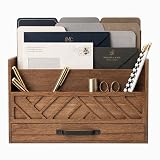
- MULTI-COMPARTMENT MAIL SORTING: Designed as a mail sorter organizer countertop, this desktop unit features six open sections for letters, bills, and paperwork, helping keep incoming and outgoing mail visible, sorted, and easy to access.
- BUILT-IN DRAWER STORAGE: Includes a spacious lower drawer for pens, stamps, and small accessories, allowing this piece to function as an outgoing mail holder while keeping everyday desk items neatly contained.
- RUSTIC WOOD DESIGN: Crafted as a wooden mail organizer with a warm brown finish and contrasting handle, this organizer adds a decorative yet practical touch to home offices, kitchens, or entryway counters.
- LETTER SIZE FILE COMPATIBILITY: Designed to hold standard letter-size folders, envelopes, and notepads, this organizer supports structured document storage without bending or overcrowding important papers.
- STURDY EVERYDAY CONSTRUCTION: Built from durable materials, this mail organizer wood structure is made for daily use, offering reliable support and long-lasting organization for busy work or household spaces.
- New Outlook, Outlook on the web, and Outlook.com support server-side inbox rules, not classic Outlook client-side rules.
- Classic Outlook for Windows supports both server-side and client-side rules. Client-side actions—such as playing a sound, displaying a desktop alert, printing, marking a message as read, or assigning a category—run only while classic Outlook is running and the relevant account is signed in.
- New Outlook does not currently support rules for third-party accounts such as Gmail, Yahoo, and iCloud. Configure those rules through the email provider instead.
- Conditions and actions can differ between versions. If a feature is missing in the newer interface, that version does not currently support it.
- In Outlook.com, a server-side rule cannot move mail to a folder that exists only on your computer. The destination folder must be stored on the server.
If a rule cannot be edited
New Outlook may show “This rule can’t be edited or viewed.” This commonly happens when a rule migrated from classic Outlook contains a client-side condition or action that the newer interface cannot handle.
The practical fix is to recreate the rule in new Outlook or Outlook on the web using supported conditions and actions. In classic Outlook, a rule marked Error is broken. Open File > Manage Rules & Alerts, select the rule, and repair the linked conditions or actions shown under Rule description.
Independent reader supportYour contribution helps us test, update, and keep practical guides available for everyone.A reliable way to troubleshoot rule results
- Open the rules list for the Outlook version you are using.
- Check the rules’ order from top to bottom.
- Inspect the conditions of every rule that could match the message.
- Check whether the first matching rule has Stop processing more rules enabled.
- Confirm that the action’s destination folder still exists and is stored in the correct mailbox.
- Check whether the rule is enabled.
- Remember that an existing message may require Run rule now.
- If the rule depends on a client-side action, test it with classic Outlook running.
There is no PowerShell command or command-line syntax for this setting. It is a checkbox in the Outlook rule editor.
For Microsoft’s version-specific instructions, see Microsoft’s explanation of “Stop processing more rules” and its guide to managing Outlook rules.
Recommended Free Tools
Best Value

- 【Space-Saving】 Our mail organizer features 3 compartments designed to consolidate your desk items. This mail sorter organizer helps declutter your workspace, saving valuable space while keeping your desk clean and organized.
- 【Elegant Design】 The mail organizer countertop is designed with slots of varying heights for easy storage and retrieval of mail or books. Made of solid wood, letter organizer adds sophistication and beauty, making it a perfect decor piece for your home or office.
- 【Versatile Functionality】 This compact envelope organizer efficiently organizes new mail, bills, receipts, documents, and office supplies. Letter holder also doubles as a stylish decorative piece, enhancing the aesthetic of your workspace.
- 【Durable & Stable】Crafted from solid wood, this desktop mail holder countertop is both stable and long-lasting. The specially coated surface ensures no worries about wear and rust. Unlike plastic or metal alternatives, which is resistant to warping.
- 【Thank You】Thank you for choosing our mail organizer! We’re dedicated to providing top-quality products and customer service. If you have any questions or issues, feel free to contact us – we’re here to help and ensure your satisfaction.
FAQ
Does “Stop processing more rules” stop the current rule?
No. Outlook completes the current rule’s configured actions. The option stops only the later rules in the list from being evaluated for that message.
Does it disable all my other Outlook rules?
No. The other rules remain enabled. They can process later messages, and they may process the same message if a preceding rule does not match or if stop processing is not selected.
What happens if I clear the checkbox?
Outlook can continue checking lower rules after the current rule matches. A message may therefore trigger several matching rules.
Why did an old email not move after I created a rule?
Inbox rules normally apply to incoming messages, not automatically to existing mail. In new Outlook, open Settings, go to Mail > Rules, and select Run rule now beside the rule.
Quick wins for a faster PC:
Repair Windows errors before they cause bigger problemsFix Now →Scan for outdated or missing drivers - takes under a minuteDriver Scan →Clear out junk files and repair common Windows errorsFree Scan →Is this setting available in every Outlook version?
The setting is available across current Outlook variants, but the rule editor differs. New Outlook, Outlook on the web, and Outlook.com use Settings > Mail > Rules; classic Outlook for Windows uses File > Manage Rules & Alerts.
Can I use new Outlook rules for Gmail or Yahoo mail?
New Outlook does not currently support rules for those third-party accounts. Create the rule in Gmail, Yahoo, iCloud, or the relevant provider instead.
The Bottom Line
In short: “Stop processing more rules” is an order-of-operations setting. Once a rule matches, Outlook performs that rule’s actions and, when the checkbox is selected, skips every rule below it for that message. Put high-priority rules first, use the option when their actions should be exclusive, and leave it cleared when multiple rules should apply.
Quick Recap
Product prices and availability are accurate as of the date/time indicated and are subject to change. Any price and availability information displayed on Amazon at the time of purchase will apply.

