
For a Microsoft Teams video meeting, Microsoft’s recommended bandwidth is 2.5 Mbps download and 4 Mbps upload per endpoint. The figures are not symmetrical: video meetings normally need more upload capacity than download capacity.
That is a planning target, not a promise that Teams will constantly use 6.5 Mbps. Teams adjusts video quality, frame rate, and other media according to available capacity. A fast internet package can still produce poor calls if the connection has packet loss, jitter, high latency, congested Wi-Fi, VPN hairpinning, or firewall problems.
How much internet speed does Teams need?
Microsoft publishes Teams bandwidth in kilobits per second (Kbps), with download and upload shown separately. These figures apply to each endpoint, not each person. An employee using Teams on a laptop and a phone at the same time has two endpoints.
| Teams activity | Minimum download/upload | Recommended download/upload | Best-performance download/upload |
|---|---|---|---|
| Audio, one-to-one | 10/10 Kbps | 58/58 Kbps | 76/76 Kbps |
| Audio, meetings | 10/10 Kbps | 58/58 Kbps | 76/76 Kbps |
| Video, one-to-one | 150/150 Kbps | 1,500/1,500 Kbps | 4,000/4,000 Kbps |
| Video, meetings | 150/200 Kbps | 2,500/4,000 Kbps | 4,000/4,000 Kbps |
| Screen sharing, one-to-one | 200/200 Kbps | 1,500/1,500 Kbps | 4,000/4,000 Kbps |
| Screen sharing, meetings | 250/250 Kbps | 2,500/2,500 Kbps | 4,000/4,000 Kbps |
For normal video meetings, the practical answer is therefore:
Quick wins for a faster PC:
Fix the driver behind crashes, sound loss and screen glitchesFind Drivers →Repair Windows errors before they cause bigger problemsFix Now →Scan for outdated or missing drivers - takes under a minuteDriver Scan →#1 Best Overall

- DUAL-BAND WIFI 6 ROUTER: Wi-Fi 6(802.11ax) technology achieves faster speeds, greater capacity and reduced network congestion compared to the previous gen. All WiFi routers require a separate modem. Dual-Band WiFi routers do not support the 6 GHz band.
- AX1800: Enjoy smoother and more stable streaming, gaming, downloading with 1.8 Gbps total bandwidth (up to 1200 Mbps on 5 GHz and up to 574 Mbps on 2.4 GHz). Performance varies by conditions, distance to devices, and obstacles such as walls.
- CONNECT MORE DEVICES: Wi-Fi 6 technology communicates more data to more devices simultaneously using revolutionary OFDMA technology
- EXTENSIVE COVERAGE: Achieve the strong, reliable WiFi coverage with Archer AX1800 as it focuses signal strength to your devices far away using Beamforming technology, 4 high-gain antennas and an advanced front-end module (FEM) chipset
- OUR CYBERSECURITY COMMITMENT: TP-Link is a signatory of the U.S. Cybersecurity and Infrastructure Security Agency’s (CISA) Secure-by-Design pledge. This device is designed, built, and maintained, with advanced security as a core requirement.
- Minimum: 150 Kbps download and 200 Kbps upload per endpoint, with heavily reduced video quality.
- Recommended: 2.5 Mbps download and 4 Mbps upload per endpoint.
- Best performance: 4 Mbps download and 4 Mbps upload per endpoint.
Microsoft also says HD video can be delivered in under 1.5 Mbps. That statement describes what Teams may achieve under suitable conditions; it is not the same as the recommended bandwidth target for a meeting.
What quality can you expect at each bandwidth level?
Bandwidth affects more than whether a call connects. Teams changes the video resolution and frame rate when capacity is limited.
| Connection condition | Typical Microsoft-supported capability |
|---|---|
| Minimum video-call bandwidth | Up to 240p video, screen sharing at an adaptive 1.875–7.5 frames per second, and Large Gallery video up to 540p. |
| Recommended bandwidth | Up to 1080p video, adaptive screen-sharing rates of 7.5–30 frames per second, and Large Gallery video up to 1080p, subject to network conditions. |
| Best performance | Intended for larger meetings, high-loss environments, and high-motion screen sharing; adaptive screen-sharing rates are 15–30 frames per second. Actual video and content quality depend on network conditions. |
“Best performance” is most useful for larger meetings, networks with higher packet loss, and screen sharing involving fast motion—for example, software demonstrations, video playback, or animated content. It is not a requirement for every Teams call.
How to calculate bandwidth for several Teams users
Start with the number of active endpoints, then allow capacity for other traffic and normal network variation.
For example, 10 employees in a meeting, each using one computer, would have a recommended meeting target of:
- Download: 10 × 2.5 Mbps = 25 Mbps
- Upload: 10 × 4 Mbps = 40 Mbps
This does not mean a 25/40 Mbps internet circuit is a safe office design. The connection may also carry file downloads, cloud backups, web traffic, security-camera feeds, updates, and other meetings. A sensible design leaves headroom instead of operating at the link’s maximum.
Count devices rather than just people. If eight people attend from computers and two of them also join on phones, the calculation uses 10 endpoints, not eight people.
Rank #2

- OneMesh Compatible Router - Form a seamless WiFi when work with TP-Link OneMesh WiFi Extenders
- Next-Gen Wi-Fi 6 Technology – The Archer AX10 leverages advanced Wi-Fi 6 features like OFDMA and 1024-QAM to deliver improved efficiency across your entire network. Perfect for high-bandwidth activities like streaming, gaming, and smart home connectivity.
- Next-gen Dual Band router - 300 Mbps on 2. 4 GHz (802. 11n) plus 1201 Mbps on 5 GHz (802. 11ax)
- Connect more devices than ever before - Wi-Fi 6 technology simultaneously communicates more data to more devices using OFDMA and MU-MIMO while reducing lag dramatically
- Powerful Dual-Core 900MHz Processor – Handles multiple data streams simultaneously for reliable performance across your devices. Ensures smooth streaming, online gaming, and video conferencing without buffering or lag.
Attendee count alone does not determine bandwidth for an individual. Consumption changes with the meeting layout, video resolution, frame rate, the number and resolution of incoming video streams, and whether the user sends camera video or screen content.
Outdated Drivers Are Slowing You Down
One free scan finds every outdated or missing driver and matches the right update for your exact hardware.Free scan · exact hardware matchWindows Errors? Fix Them Before They Spread
Repair common Windows errors and clear accumulated junk for a smoother, more stable PC - no reinstall needed.Free scan · no reinstallTeams Rooms need a different calculation
A Teams Rooms device can receive up to 18 individual video streams, send up to five outbound video streams, and handle inbound or outbound content sharing. Its downstream usage changes with the number and resolution of remote videos; upstream usage changes with the connected camera and content.
Microsoft gives these rough stream estimates:
| Teams Rooms stream | Standard download/upload | Advanced download/upload |
|---|---|---|
| Audio | 128/128 Kbps | 256/256 Kbps |
| Video | 2,000/4,000 Kbps | 8,000/4,000 Kbps |
| Screen sharing | 2,000/2,000 Kbps | 2,000/2,000 Kbps |
| Total | 4,128/6,128 Kbps | 10,256/6,256 Kbps |
Microsoft recommends at least a 1-Gbps Ethernet connection for Teams Rooms devices. It also recommends allocating 10 Mbps per Teams Rooms resource account through a meeting policy. That is a policy ceiling or allocation target, not a demand for continuous 10 Mbps traffic; typical Teams Rooms usage is commonly around 3–4 Mbps and adjusts dynamically.
Why a fast internet plan can still produce a bad Teams call
A speed test measures available throughput at one moment. Real-time media also depends on how consistently packets arrive and whether Teams can use the preferred network path.
Jitter and packet loss
Jitter means packets arrive with inconsistent timing. Packet loss means some packets never arrive. Either can make speech sound broken-up or robotic. Video may freeze, become pixelated, or disappear while Teams tries to recover.
Recommended Free Tools
High round-trip time
Excessive round-trip time (RTT) creates the walkie-talkie effect: each person waits longer before hearing the other, causing interruptions and unnatural pauses.
Wi-Fi contention and interference
A laptop may be close to a fast broadband connection but still compete with phones, televisions, nearby access points, and other users on Wi-Fi. Poor access-point placement, interference, outdated wireless drivers, and missing WMM support can affect Teams independently of the advertised ISP speed. Use wired Ethernet for fixed workstations and Teams Rooms where possible.
Rank #3

- NIGHTHAWK WIFI 6 ROUTER FOR YOUR WHOLE HOME: Delivers fast, reliable WiFi across every room of your apartment or small home for streaming, gaming, video calls, and smart home devices, all running at the same time without slowing each other down.
- WORKS WITH YOUR EXISTING INTERNET SERVICE: Pairs with your existing modem or gateway via ethernet. Compatible with most cable, fiber, DSL, and satellite providers. Some gateways and modem router combos may require bridge mode. No coax needed.
- SET UP AND MANAGE YOUR NETWORK WITH THE NIGHTHAWK APP: Download the free Nighthawk app on iOS or Android for guided setup. Manage WiFi, run speed tests, pause devices, and set up guest networks from anywhere. Active internet required.
- READY FOR THE DEVICES YOU ALREADY OWN: Your phones, laptops, and TVs work right out of the box. WiFi 6 delivers speeds up to 1.8 Gbps across 2.4 GHz and 5 GHz bands. Backward compatible with WiFi 5 and earlier.
- COVERAGE IN EVERY ROOM: Covers up to 1,500 sq. ft. for up to 20 connected devices. Walls, floors, and interference can reduce range. Larger or multi-story homes may benefit from a NETGEAR Orbi mesh WiFi system.
VPN routing
A VPN can add encryption overhead and latency. If Teams traffic travels to a corporate VPN gateway and then back out to Microsoft, the resulting hairpin route can damage call quality. Some VPN products also do not support UDP properly. Microsoft recommends split tunneling that sends Microsoft 365 and Teams traffic directly rather than through the VPN, subject to the organization’s security policy.
TCP fallback
Teams prefers UDP for real-time media. If firewall rules are incomplete, traffic may fall back to TCP. TCP retransmits delayed or lost packets, which can increase latency because old packets remain in competition for bandwidth. Review Microsoft’s required network and firewall configuration rather than assuming that web browsing proves Teams is configured correctly.
NAT port exhaustion
Large offices with many devices behind one public IP can exhaust the available NAT port pool. New connections may then fail even though the internet circuit has plenty of unused capacity.
WebSocket failure
Teams uses long-lived WebSocket connections for chat updates, call notifications, signaling, presence, and other real-time events. If the connection cannot be established, Teams can fall back to HTTP long polling, increasing bandwidth use and latency.
How Teams behaves when bandwidth is limited
Teams protects the conversation first. When bandwidth is insufficient, it prioritizes audio quality over video quality. For Teams Rooms, Microsoft’s priority order is:
- Audio
- Content sharing
- Participant video
That is why a constrained call may retain understandable audio while turning participant video blurry or stopping it altogether. Increasing bandwidth may improve the result, but it will not correct packet loss, unstable Wi-Fi, or a high-latency VPN route.
Do these 3 things before closing this tab:
1Clear out junk files and repair common Windows errors2Fix the driver behind crashes, sound loss and screen glitches3Repair Windows errors before they cause bigger problemsSet a Teams media-rate policy
Administrators can limit or allocate media bandwidth per user with the meeting policy setting called Media rate (Kbps). Microsoft documentation describes the same setting as Media bit rate (Kbps). It covers audio, video, and video-based app sharing, and the value applies independently to uplink and downlink.
Rank #4

- Next-Gen Gigabit Wi-Fi 6 Speeds: 2402 Mbps on 5 GHz and 574 Mbps on 2.4 GHz bands ensure smoother streaming and faster downloads; support VPN server and VPN client¹
- A More Responsive Experience: Enjoy smooth gaming, video streaming, and live feeds simultaneously. OFDMA makes your Wi-Fi stronger by allowing multiple clients to share one band at the same time, cutting latency and jitter.²
- Expanded Wi-Fi Coverage: 4 high-gain external antennas and Beamforming technology combine to extend strong, reliable, Wi-Fi throughout your home.
- Improved Battery Life: Target Wake Time helps your devices to communicate efficiently while consuming less power.
- Improved Cooling Design: No heat ups, no throttles. A larger heat sink and redefined case design cools the WiFi 6 system and enables your network to stay at top speeds in more versatile environments.
For example, a setting of 2,000 Kbps means 2,000 Kbps upstream and 2,000 Kbps downstream for that user. The documented minimum is 30 Kbps; the maximum depends on the meeting scenario.
To change it in the Teams admin center:
- Open Teams admin center.
- Go to Meetings → Meeting policies.
- Select an existing policy or create a new one.
- Open Audio & video.
- Set Media rate (Kbps).
- Select Save.
For meetings that require the highest-quality video experience, such as executive board meetings or Teams live events, Microsoft recommends setting the media bandwidth to 10 Mbps. This does not force every meeting to consume 10 Mbps continuously; Teams can adapt downward when conditions do not support that rate.
The media-rate policy does not affect the Teams web client.
The Tool Desk
Outbyte Driver Updater FREEScan for outdated or missing drivers - takes under a minuteDriver Scan →Outbyte PC Repair FREERepair Windows errors before they cause bigger problemsFix Now →Use Network Planner before changing your internet circuit
For an organization, Microsoft’s Network Planner is more useful than multiplying a speed-test result. You can model users, sites, WAN capacity, egress locations, and Teams workloads.
You need the Global Administrator, Teams Administrator, or Teams Communications Administrator role. The path is:
- Open Teams admin center → Planning → Network planner.
- To create a user profile, select Personas → + Custom persona → New custom persona → Save.
- To create a plan, select Network Plan → Add a network plan.
- For each site, enter the number of network users and the network details, including whether it is WAN-enabled, WAN capacity, internet egress (Local or Remote), and PSTN egress (none, local, or remote).
- To produce a report, go to Reports → Start a report → Generate report → Save.
Network Planner automatically recommends a persona distribution of 80% office workers and 20% remote workers. Replace that assumption if your actual workforce differs significantly—for example, if most users work from home or regularly use video and screen sharing.
Independent reader supportYour contribution helps us test, update, and keep practical guides available for everyone.Practical troubleshooting order
- Check upload first. A connection with 100 Mbps download but only 1 Mbps upload is below Microsoft’s recommended 4 Mbps upload target for one video-meeting endpoint.
- Test on Ethernet. If the call improves on a wired connection, investigate Wi-Fi coverage, interference, access-point load, and WMM.
- Stop competing traffic. Pause cloud backup, large uploads, game downloads, and high-bitrate streaming during the meeting.
- Check the VPN path. Test the organization’s approved split-tunnel configuration and look for hairpin routing.
- Review firewall behavior. Confirm that Teams can use UDP and that required Microsoft 365 endpoints are not being blocked or forced through a proxy.
- Inspect call-quality data. Use Teams call analytics and the Teams admin center’s call-quality monitoring to distinguish low throughput from packet loss, jitter, RTT, or device problems.
- Apply QoS consistently. QoS markings must be honored across user devices, switches, routers, and other managed network segments. Configuring only the laptop or only the edge router leaves gaps in the path.
Use Teams’ own diagnostics and call-quality reports rather than relying only on a generic speed-test website. A speed test can show adequate capacity while missing short bursts of loss or jitter that are highly noticeable in speech.
Best Value
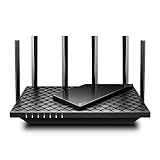
- 𝐆𝐢𝐠𝐚𝐛𝐢𝐭 𝐖𝐢𝐅𝐢 𝐟𝐨𝐫 𝟖𝐊 𝐒𝐭𝐫𝐞𝐚𝐦𝐢𝐧𝐠 – Up to 5400 Mbps WiFi for faster browsing, streaming, gaming and downloading, all at the same time. Performance varies by conditions, distance to devices, & obstacles such as walls.
- 𝐅𝐮𝐥𝐥 𝐅𝐞𝐚𝐭𝐮𝐫𝐞𝐝 𝐖𝐢𝐅𝐢 𝟔 𝐑𝐨𝐮𝐭𝐞𝐫 – Equipped with 4T4R and HE160 technologies on the 5 GHz band to enable max 4.8 Gbps ultra-fast connections.Power:12 V 2.5 A
- 𝐂𝐨𝐧𝐧𝐞𝐜𝐭 𝐌𝐨𝐫𝐞 𝐃𝐞𝐯𝐢𝐜𝐞𝐬 – Supports MU-MIMO and OFDMA to reduce congestion and 4X the average throughput
- 𝐄𝐱𝐭𝐞𝐧𝐬𝐢𝐯𝐞 𝐂𝐨𝐯𝐞𝐫𝐚𝐠𝐞 - Covers up to 2,000 sq. ft. High-Power FEM, 6× Antennas, Beamforming, and 4T4R structures combine to adapt WiFi coverage to perfectly fit your home and concentrate signal strength towards your devices.
- 𝐌𝐨𝐫𝐞 𝐕𝐞𝐧𝐭𝐬, 𝐋𝐞𝐬𝐬 𝐇𝐞𝐚𝐭 – Improved vented areas help unleash the full power of the router
FAQ
Is 1.5 Mbps enough for a Teams video call?
It may be enough for HD video under suitable conditions, and Microsoft says HD video can be delivered in under 1.5 Mbps. However, Microsoft’s recommended bandwidth for a video meeting endpoint is 2.5 Mbps download and 4 Mbps upload. Treat 1.5 Mbps as a possible operating rate, not the recommended design target.
Does Teams require the same download and upload speed?
No. Microsoft lists meeting video at 2,500 Kbps download and 4,000 Kbps upload as the recommended rate. Upload is especially important when your camera or screen is sending content to the meeting.
Does every person in a Teams meeting need 4 Mbps?
The figures apply to each endpoint, not simply each human participant. A single computer endpoint should be planned around the recommended 2.5 Mbps down/4 Mbps up for meeting video. A person using a computer and phone simultaneously represents two endpoints.
Will a 10 Mbps Teams policy make every meeting use 10 Mbps?
No. The Media rate (Kbps) setting is a per-user limit or allocation control. Teams adapts to the available conditions. Microsoft says Teams Rooms typically use around 3–4 Mbps even when a 10-Mbps policy is assigned.
Why is Teams audio robotic when my internet speed is high?
Robotic or broken-up audio is commonly caused by jitter or packet loss rather than insufficient headline speed. Wi-Fi interference, congestion, VPN routing, TCP fallback, faulty drivers, and firewall configuration are common areas to check.
Should Teams use Wi-Fi or Ethernet?
Ethernet is preferable for fixed desks and Teams Rooms because it avoids many wireless contention and interference problems. Good business Wi-Fi can work well, but it should have adequate coverage, capacity, correct access-point placement, current drivers, and WMM support.
The Bottom Line
For one Teams video-meeting endpoint, plan for 2.5 Mbps download and 4 Mbps upload. Use 4 Mbps in both directions when you need Microsoft’s best listed performance, and calculate office capacity per endpoint with room for ordinary network traffic.
Do not diagnose Teams by speed alone. Packet loss, jitter, RTT, Wi-Fi contention, VPN hairpinning, TCP fallback, NAT limits, WebSocket failures, and inconsistent QoS can all ruin a call on a fast connection. For larger deployments, model the environment in Network Planner and validate the result with Teams call-quality data.
Free tools Windows power users keep installed
One-click scans. No signup required.
Quick Recap
Product prices and availability are accurate as of the date/time indicated and are subject to change. Any price and availability information displayed on Amazon at the time of purchase will apply.

