
What’s actually slowing this PC down?
Pick the symptom - the matching free tool is one click away.
iTechGuides is reader-supported. When you buy through links on our site, we may earn an affiliate commission. As an Amazon Associate I earn from qualifying purchases. Learn more
Project memory is a short, retrievable record of what an AI agent needs to continue work; chat history is the fuller record of what happened. A useful handoff captures the current state, decisions, open issues, and next action, then points to files or other authoritative evidence. Keep the transcript for reference, but do not expect a future run to infer the project state from it.
How is project memory different from chat history?
A conversation transcript or execution trace records events: requests, replies, tool calls, and results. Durable memory is selected context that a later run can retrieve and use to guide what it does. A transcript does not become useful memory merely because it exists; the relevant lesson must be surfaced in a form the agent can load later. LangChain’s Jake Broekhuizen describes this distinction in “How To Give Your Agent Memory”.


Think of history as the audit trail and project memory as the handoff note. The note should be much smaller than the full trace, while linking to the artifacts that substantiate its claims. That makes it easier to resume without replaying every message, and easier to check whether the recorded state is still true.
The Tool Desk
Outbyte Driver Updater FREEScan for outdated or missing drivers - takes under a minuteDriver Scan →Outbyte PC Repair FREEClear out junk files and repair common Windows errorsFree Scan →Why not keep everything in the active conversation?
Context windows have limits. OpenAI’s Realtime API reference describes truncation behavior for conversations that exceed the input limit, including configurable options. A long interaction therefore cannot be assumed to remain fully available to the model indefinitely.
#1 Best Overall
Compaction is one way to continue a long interaction: summarize the conversation as it approaches the context limit and start a new context with that summary. Anthropic defines compaction as “the practice of taking a conversation nearing the context window limit, summarizing its contents, and reinitiating a new context window with the summary” in its context-engineering article. It preserves continuity, but summaries can omit details whose importance becomes apparent later. Anthropic recommends tuning for recall before removing excess detail.
An external note solves a different problem: it stores a compact project state beyond the active context, so a later run can retrieve it after a reset or across sessions. Neither a summary nor a note is a substitute for source artifacts. Keep changing facts—such as current code state—linked to the repository or other source of truth.
What should an AI agent remember between sessions?
For a coding or research task, a compact handoff can include these fields. This is a practical synthesis, not a universal vendor-prescribed schema:
- Objective: what the work is meant to accomplish.
- Status: where the task stands now, with enough context to distinguish finished work from attempted work.
- Key decisions: choices already made and the reason for each, especially decisions a later run might otherwise revisit.
- Completed work: changes or findings that have been verified.
- Open items: unresolved questions, bugs, constraints, or risks.
- Next action: the next concrete step, rather than a vague instruction to continue.
- Evidence pointers: relevant file paths, commits, test results, or source documents that let the next run verify the state.
Keep the note focused on durable, useful context. A stable preference, clarified instruction, or reusable workflow may be worth retaining. A transient observation or one-off tool result usually belongs in the trace, not permanent memory. LangChain describes conceptual memory categories as semantic (facts and preferences), episodic (past interactions, actions, and outcomes), and procedural (instructions and workflows) in its memory article.
How do I get an agent to pick up where it left off?
- At meaningful milestones, update the handoff. Record what changed, what remains uncertain, and the next useful action. Update before a planned context reset when the work is midstream.
- Link instead of duplicating volatile details. Point to the relevant files, commits, or evidence. The note gives orientation; the linked artifact holds the detailed or changing information.
- Make the next run load the note. A memory that is stored but never retrieved cannot guide behavior. Ensure the agent’s startup or task instructions direct it to the handoff location.
- Verify before acting. Have the agent check the live repository or other source artifacts against the note. If the project has changed, update the handoff rather than treating stale context as fact.
For long-running coding work, Anthropic’s November 26, 2025 article on long-running agents describes using a progress file alongside Git history, with incremental work and explicit updates to help later sessions understand repository state. It is an implementation report, not proof that one file or workflow will suit every agent.
When should you use compaction, an external note, or both?
| Approach | Best fit | Continuity and persistence | Main trade-off | How to verify state |
|---|---|---|---|---|
| Conversation compaction | Continuing a long interaction in a fresh context | Preserves a summarized thread within the ongoing interaction; it is not by itself a durable project handoff | Important nuance can be lost in the summary | Consult original messages or artifacts when a detail matters |
| External project note | Work spanning sessions, context resets, or many tool calls | Persists outside the active context if the next run retrieves it | Requires deliberate updates and protection against stale notes | Follow links to the live files, commits, or evidence |
| Progress note plus source-control history | Long-running coding tasks | Combines concise orientation with a record of repository changes | Depends on maintaining both the note and the history clearly | Compare the note with the current repository and Git history |
These approaches can work together: compact the current conversation when needed, and preserve cross-session state in a note linked to durable artifacts. The right arrangement depends on the agent harness—especially where it stores notes, how it loads them, and how it handles permissions and stale information. The cited sources do not establish a universal best note size, file format, or retention policy.
Rank #4
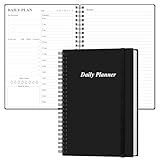
- UNDATED DAILY PLANNER - The daily planner is undated, if you miss a day or you are off of work that day you don’t need to waste a page, start use this schedule planner any time.
- Work Smarter with Daily Task Management - This daily planner undated each page includes space for 5 top priorities, 9 to do list,daily schedule from 6am-8pm, notes&ideas and water intake.Break your day into hours and help you work effective.
- A5 SIZE - This undated daily organizer size of 8.5 x 5.8 inch, perfect size to fit in your bag.1 quick reference page, contact pages, important dates page, and 75sheet (150 page) daily plan & notes,8 dotted grid pages, Undated appointment planner makes it easy for you to start the planner at any time.
- SUPERIOR QUALITY - This to do list planner with 100gsm thick paper to reduce ink leakage, erase fraying and shade issues. Sturdy and flexible PP cover to protect the inner pages well. Strong metal and lay-flat twin-wire binding, Planner with inner pocket to store loose items, like tickets, cards etc and elastic closure to protect your planner.
- PERFECT FOR - This day planner features flexible structures that allow you to keep track of goals, tasks, appointments, project, works, habbits etc. Perfect for planner, organizer or academic agenda for school, work or home or makes a great gift for your family members, relatives or friends
What should stay in history rather than memory?
Most traces should remain history. Preserve only the signal likely to change a future run’s behavior: a stable preference, an instruction clarified during the task, a reusable procedure, or a project decision still relevant to the work. LangChain’s suggested loop is to capture traces, identify repeated or meaningful signals, update durable context, and ensure later runs actually load it. Traces can also support evaluation or system fixes without being promoted to memory.
Quick Recap
Best Value

- TURN YOUR IDEAS INTO REALITY: Unleash your creativity with this unique planning notebook, consisting of 224 pages divided into 112 Project Planner sheets. Each sheet is designed to step-by-step completion and management of your project.
- EMPOWER YOUR MANAGEMENT: This professional project organizer keeps all project-related information in one place. Stay on top of multiple projects with the convenient project tracker notebook feature, ensuring no detail is missed.
- ARCHIVE YOUR PROJECT GOALS: Stay focused on your projects with dedicated sections for objectives, tasks with deadline, essential supplies and tools notes, space for ideas and sketches illustration, and notes. Experience a simple yet powerful tool to ensure completion and accomplish more with ease.
- EFFICIENT BONUS STATIONARIES: You will receive either set of a ball pen and two cute sticky notes or a set of remind stick pads (randomly). The versatile design can be used for projects at home, work, school, or business to organize, manage a team, and to delegate tasks. This planner is a simple way to make sure you finish what you start and accomplish more.
- HANDLE SINGLE PROJECT IN HAND: Designed with tearable sheets allow you taking any single sheet for more convenient. 7x10 inch sheets are printed on 70 lb premium paper. With advanced printing technology and leather cover, our planner exudes a premium feel and long lasting.
- Keep detailed exchanges and one-time tool output in the trace unless a later run needs a concise lesson from them.
- Keep decisions and next steps in the handoff, with links to their evidence.
- Refresh or correct a note when the live project state changes.
Product prices and availability are accurate as of the date/time indicated and are subject to change. Any price and availability information displayed on Amazon at the time of purchase will apply.

