
iTechGuides is reader-supported. When you buy through links on our site, we may earn an affiliate commission. As an Amazon Associate I earn from qualifying purchases. Learn more
A task in an agent plan is the right size when it produces one outcome you can check, and it is small enough that the agent knows four things: what the outcome is, which action moves it forward, what must already be true before it starts, and what observable result shows it is finished. None of the official guidance behind this article sets a universal number of steps, minutes, or tokens. The boundary is functional, not numeric.
The four tests a task must pass
Before deciding whether a task is too big or too small, check whether it is ready to execute at all. A plan item is ready when it answers these four questions:
- Outcome: What single result is this task responsible for producing?
- Action: What action or tool use advances that result, without the agent having to invent a goal or pick an approach nobody stated?
- Prerequisites: Which earlier results, inputs, or decisions must exist first?
- Completion signal: What observable result shows the task is done?
If any one of the four is missing, the task needs work, regardless of how long or short it is. A ten-word item can fail these tests, and a longer item that passes all four is usually well sized.
What’s actually slowing this PC down?
Pick the symptom - the matching free tool is one click away.
When a task should be split
Splitting is the right move when a task hides more than one piece of work, or when its result cannot be judged until something unrelated also finishes. Three triggers come up repeatedly in the guidance.
#1 Best Overall

- Confidently track and manage large jobs with ease
- Project ruling provides instant organization for notes, plans & deadlines
- Premium-weight paper is perforated to detach easily
- Snag-resistant coil and extra-strong back are perfect for notes on the go
- Gray, navy or maroon cover, 7-1/4" x 9-1/2", 84 sheets
Several independent actions in one instruction
Microsoft Learn’s guidance on writing effective instructions for declarative agents, which is aimed at people building declarative agents, advises breaking multi-action instructions into clearly separated units. The stated reason is that this “reduces ambiguity and prevents the model from merging or reinterpreting tasks.” A common example is an instruction that asks the agent to extract metrics and summarize findings in a single step. The agent may not know which half to do first, or how to tell whether the first half is complete. Two separate tasks, each with its own completion signal, avoid that.
A hidden decision that must come first
Some tasks look like execution but contain a choice. Choosing between two data sources, deciding whether a migration should preserve an old field name, or picking which library to use are decisions. Downstream work cannot be planned properly until they are made. Give the decision its own task, with its own output, so the next step can depend on it explicitly.
Rank #2

- TURN YOUR IDEAS INTO REALITY: Unleash your creativity with this unique planning notebook, consisting of 224 pages divided into 112 Project Planner sheets. Each sheet is designed to step-by-step completion and management of your project.
- EMPOWER YOUR MANAGEMENT: This professional project organizer keeps all project-related information in one place. Stay on top of multiple projects with the convenient project tracker notebook feature, ensuring no detail is missed.
- ARCHIVE YOUR PROJECT GOALS: Stay focused on your projects with dedicated sections for objectives, tasks with deadline, essential supplies and tools notes, space for ideas and sketches illustration, and notes. Experience a simple yet powerful tool to ensure completion and accomplish more with ease.
- EFFICIENT BONUS STATIONARIES: You will receive either set of a ball pen and two cute sticky notes or a set of remind stick pads (randomly). The versatile design can be used for projects at home, work, school, or business to organize, manage a team, and to delegate tasks. This planner is a simple way to make sure you finish what you start and accomplish more.
- HANDLE SINGLE PROJECT IN HAND: Designed with tearable sheets allow you taking any single sheet for more convenient. 7x10 inch sheets are printed on 70 lb premium paper. With advanced printing technology and leather cover, our planner exudes a premium feel and long lasting.
An outcome that cannot be checked yet
If a task can only be verified after unrelated work completes, failures become hard to locate. When a check fails, you cannot tell which part caused it. Snowflake’s planning article, which is a vendor publication rather than official guidance, describes planning as decomposing a goal into dependent subtasks and tracking intermediate state. Splitting along those dependencies lets each piece be checked as it finishes.
When work should stay together
Over-splitting is a common failure. Keep actions in one task when they serve a single outcome, share the same context, and can be checked as one unit. Splitting them would force the agent to rebuild the same setup several times and would lose the shared context that makes the work coherent. The aim is work that can be executed and verified, not the largest possible number of plan items.
Rank #3

- 𝑼𝑳𝑻𝑰𝑴𝑨𝑻𝑬 𝑻𝑨𝑺𝑲 𝑷𝑳𝑨𝑵𝑵𝑬𝑹 - Introducing the BestSelf Project Action Pad – the ultimate task planner and to-do list notepad for effectively managing projects. This one-page tool breaks down multi-tasks goals into a clear plan of action and doubles as a to-do list notepad.
- 𝑮𝑬𝑻 𝑶𝑹𝑮𝑨𝑵𝑰𝒁𝑬𝑫 - Never miss a beat with this to-do list notebook for work, school, or life. Perfect for managing your large projects effectively or just jotting down quick notes and keeping yourself on track.
- 𝑻𝑹𝑨𝑪𝑲 𝑷𝑹𝑰𝑶𝑹𝑰𝑻𝑰𝑬𝑺 - Prioritize your daily tasks with this sleek and modern undated daily planner. This pad features a master to-do list with a start date, due date, budget, and completed date. This professional quality pad is 11.75” x 7 with 52 total project spreads, spiral-bound with perforated pages to tear off once complete.
- 𝑫𝑨𝑰𝑳𝒀 𝑻𝑨𝑺𝑲 𝑷𝑳𝑨𝑵𝑵𝑬𝑹 - Elevate your workspace aesthetic with these stylish and functional shopping list notepads, a must-have planner for men or planner for women. This daily task planner will help you stay organized, prioritize your goals, and meet your deadlines. It is the perfect choice for anyone looking to track and complete their daily to-do list.
- 𝑷𝑹𝑶𝑱𝑬𝑪𝑻 𝑴𝑨𝑵𝑨𝑮𝑬𝑴𝑬𝑵𝑻 𝑻𝑶𝑶𝑳 - Plan ahead with confidence using this planner for your next project, the academic year, or simply for the week. Great for party planning, home renovations, writers, launching a business, and more. Helps maintain work-life balance and optimizes your time. Perfect for students, teachers, and anyone in need of a work, home, or school planner.
Sizing coding tasks against the actual project
For implementation work, the plan has to be anchored in the codebase. Visual Studio Code’s guidance on planning work with agents, on a page dated 30 September 2026, puts it directly: “Your actual plan should identify the files and code patterns in your project, not just list generic tasks.” The same guidance recommends reviewing whether a plan covers the requested scope, fits the project, surfaces decisions, and includes verification.
Illustrative example, not a benchmark:
| Version | Task text | Why it works or fails |
|---|---|---|
| Too broad | Add export support. | No outcome format, no affected files, no completion test. |
| Right-sized | Add a CSV export action to the reports controller, reusing the existing row-formatting code. Verify header order, an empty result set, and an invalid date range. | One outcome, named location, and checks that map to the behavior requested. |
Verification checks should match the change. Typical coding checks include tests for valid and invalid inputs, handling of empty results, and confirmation that existing behavior still works. The exact list depends on the requested change, so the check belongs in the task, not in a general closing step.
Rank #4

- Half Meeting Half Note: 1.MEETING PLANNING: Date, Location, Topic & Attendees 2.MEETING MINUTES: Agenda, Quick Notes & Other 3.NOTES AREA: Lined Page 4.ACTION ITEMS: Action Steps, Person, Due Date & Check Box 5.NEXT MEETING: Date, Time & Location 6.INDEX PAGE: Date, Title, Page Number, which will help create more effective meetings and good results.
- Premium Quality Notebook for Work: Golden spiral binding is sturdy and flexible, with easy-to-turn pages. Hot-stamped cover is water-resistant and not easy to bend. Bonus Bookmark and Pockets. Perfectly hold up well to frequent transfers in and out of backpacks, briefcases, and cars.
- Fight Ink-bleeding & Great Size: The high-end 100gsm paper could prevent ink bleeding through or feathering, handle double-sided writing and most daily use pens pretty well. The office/business work notebook measures 7.5"x 10"(similar to B5 size), Generous size provides ample space to jot down your meeting notes.
- Each 160 Pages Per Book: Provide ample space for note taking & planning and with the date section at the top for tracking them. With 160 pages for meeting minutes, the manager notebook will cover more than half a year, even in daily use. Also provides index pages for organizing this office planner.
- Better Tool Drives Better Meetings: The hassle of organizing the chaotic meeting notes VS this professional meeting notebook. Definitely a step up! Everything is neatly zoned on each page makes it a breeze to fill them out and ensure all you need are accounted for.
When decomposition needs more layers
Some work is too open-ended for a flat list. Google Cloud’s Architecture Center describes a hierarchical task-decomposition pattern for ambiguous problems that involve research, planning, and synthesis. In that pattern, a higher-level agent breaks the goal into sub-problems and delegates them.
The extra layer has real costs, and the Google Cloud guidance names them: more model calls, higher latency, greater operational expense, and more architectural complexity. In practice, the layer is worth adding when:
Best Value
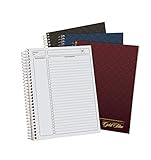
- 9-1/2 x 7-1/4
- Assorted Covers in Navy, Gray, Maroon
- Planner Ruled
- Designer Gold Fibre Series Planner Notebook. 84 Pages.
- INCLUDES 3 NOTEBOOKS: Each pack includes 3 notebooks that can be any combination of the three colors we offer: Navy, Gray, or Maroon; Your order may include 3 of the same color
- the number of sub-problems is not known until the work begins;
- the sub-results must be synthesized into a single answer;
- the work is too large for one agent context to hold coherently.
For a well-defined task, such as the CSV export above, a flat plan is usually the better choice.
Should an agent plan stay fixed once generated?
No. A plan is an initial hypothesis about how to reach the goal. GOV.UK’s “AI Insights: Agentic Workflow” describes agent workflows as iterative, with monitoring and feedback allowing the system to adapt its plan. Snowflake describes the same loop: inspect the result of each step and revise later steps when observations change the path forward.
Plans should be revised when intermediate results reveal a new dependency, when an assumption turns out to be false, or when conditions change. Checkpoints after each meaningful outcome limit how far an agent can travel on a wrong assumption.
Quick wins for a faster PC:
Clear out junk files and repair common Windows errorsFree Scan →Scan for outdated or missing drivers - takes under a minuteDriver Scan →Snowflake’s article cites a May 2026 LongDS-Bench benchmark in which the best-performing model reached 48.45% average accuracy, and performance dropped by nearly 47 points from early to late turns. This is a single benchmark result from a vendor article, and it does not define a task-size threshold. It does suggest that long, unbroken stretches of multi-turn work deserve more checkpoints than short ones. Snowflake’s evaluation question is useful for those checkpoints: “Did it use the right tools in the right order?” That is a check on the sequence of work, not only on the final output.
A decision table for borderline cases
When you cannot decide whether to split or combine a candidate task, test it against the seven axes below. These are a practical synthesis of the guidance above, not a published scoring system or a numeric standard.
Quick Recap
| Axis | Question to ask | Lean toward splitting when | Lean toward keeping together when |
|---|---|---|---|
| Outcome clarity | Is there one understandable result? | The task would produce several distinct results. | One result is clear. |
| Actionability | Can the agent act without inventing goals? | A hidden choice must be made first. | The approach is already determined. |
| Dependency structure | Does it rely on a prior result? | Parallel actions should stay distinct. | Steps depend on each other tightly. |
| Verifiability | Can completion be checked on its own? | Checking needs unrelated work to finish. | One check covers the whole unit. |
| Context reuse | Would splitting repeat setup? | Each part needs little shared context. | Splitting would repeat setup or lose context. |
| Replanning cost | How costly is a wrong assumption? | The work is uncertain and checkpoints would catch errors early. | The work is predictable and low-risk. |
| Coordination overhead | Would extra layers add cost without control? | The work is ambiguous and open-ended. | Extra hierarchy would add calls, latency, and cost without better control. |
Product prices and availability are accurate as of the date/time indicated and are subject to change. Any price and availability information displayed on Amazon at the time of purchase will apply.

