
Two Ethernet ports give a motherboard two wired network interfaces. Depending on the model, they may offer different speeds, connect to separate networks, support configured teaming or failover, or provide a specialized server-management connection. Simply plugging both into a router does not automatically make your internet faster.
Why would a motherboard have two Ethernet ports?
The reason depends on the board’s design and the network setup it is intended to support. Check the motherboard’s specifications or manual to identify each port’s speed, controller, and intended role; two jacks do not necessarily have identical capabilities. Intel’s motherboard buying guide notes that some boards offer dual ports, including models with dual 10-Gigabit Ethernet.
Different speeds or capabilities
A board may pair network ports with different speeds or capabilities. The specifications for the exact motherboard model are the reliable way to tell what each jack supports.
Separate network connections
Two interfaces can connect a computer to separate networks or services, if the operating system and network configuration support that use. Unless configured otherwise, the interfaces remain independent; having two does not itself combine them.
#1 Best Overall
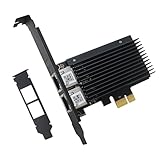
- PCI Express 3.1 :5GT/s Support for x1 width (Lane).The original I225-v has been discontinued, and the new generation I226-v will replace it. The two models have identical functionality. Compared to the I225, the I226 has improved error rates, offering better data packet stability over longer cable lengths and providing a more stable network connection. It also enhances the accuracy and stability of data transmission. In the end, the new generation I226 reduced active power consumption, making it more energy-efficient
- Network Interfaces:Integrated MAC + BASE-T PHY. MDI (Copper) standard IEEE 802.3 Ethernet interface for 2500BASE-T, 1000BASE-T, 100BASE-TX, and 10BASE-TE applications (802.3, 802.3u, 802.3bz, and 802.3ab)
- This 2.5GB Dual-Port NIC RJ45 Ethernet Network Card supports a motherboard with an X1/X4/X8/X16 slot and a PCIe gold-plated pin with nice electrical conductivity and high oxidation resistance.In addition, this Dual port network adapter gigabit network card comes with low profile bracket, suitable for desktop/server/workstation and other computer cases
- Support Win10/11,Linux Kernel 5.8/5.16.18,RHEL 8.1/8.3/8.6,Ubuntu* 22.04 LTS,FreeBBSD 13.0,VMware ESXi7.0/8.0,DPDK 20.05/22.07,OPENWRT/UNRAID/PVE.Support PXE function
- Worry free warranty and friendly customer service. If you have any questions, we will help you solve the problem when you need it. If it cannot be solved, we will provide a refund without the need for a return
Optional teaming, aggregation, or failover
Some supported adapters can be configured as a team. Depending on the mode, teaming may provide a backup connection if an adapter, cable, or link partner fails, or distribute traffic across interfaces. The available modes and their behavior depend on the network adapter, driver, operating system, and network equipment. Intel’s guide to Intel Advanced Network Services teaming describes these dependencies.
Server management
On certain Intel server boards, a host-interface BMC LAN channel lets the host operating system access the baseboard management controller through an internal channel. This is a specialized server feature, not a safe assumption about the second jack on a consumer motherboard. Intel explains the setting in its HI BMC LAN configuration article, last reviewed July 13, 2022.
Rank #2
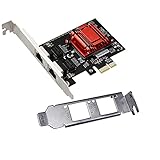
- Supports Windows 7/8/2000/XP/Vista/Windows Server 2003/2008/2012; Novell Netware 5.x/6.x; Linux; FreeBSD 7.x or later; DOS; SCO Open Server; UnixWare / OpenUnix 8; Sun Solaris x86; OS Independent Vmware ESX (Does not support VMware ESXi 7.0 or above)
- PCI Express 2.1. 2.5 GT/s x1 Lane. Compatible with x1, x2,x4, x8, x16 standard and low-profile PCI Express slots.
- Compatible with IPMI pass-through (SMBus or NC-SI), iSCSI boot, WoL, PXE remote boot, VLAN filtering
- Support Network Management Protocol (SNMP) and Remote Network Monitoring (RMON).
- Imported alloy heat sink , can effectively remove excess heat , keep the network card at normal operating temperature and double stable operation
Do two Ethernet cables make the connection faster?
No—not just by plugging both ports into a router. Two links only work together when the adapters, drivers or software, and network equipment support a compatible teaming or aggregation configuration and it is set up correctly.
For example, ASRock’s B650D4U-2L2TBCM manual says the connected switch or router must support IEEE 802.3ad for its teaming procedure. That requirement is specific to the procedure described in that manual; check the documentation for your own motherboard and network equipment.
The Tool Desk
Outbyte Driver Updater FREEFix the driver behind crashes, sound loss and screen glitchesFind Drivers →Outbyte PC Repair FREEClear out junk files and repair common Windows errorsFree Scan →Rank #3

- 𝟏-𝐭𝐨-𝟐 𝐄𝐭𝐡𝐞𝐫𝐧𝐞𝐭 𝐒𝐩𝐥𝐢𝐭𝐭𝐞𝐫- This powered RJ45 Ethernet splitter expands one Gigabit Ethernet port into two active Ethernet ports, allowing two devices to connect simultaneously. Ideal for environments with limited Ethernet ports, it reduces the need for additional wiring while supporting cascading for easy network expansion and stable, uninterrupted data transmission.
- 𝟏𝟎𝟎𝟎𝐌𝐛𝐩𝐬 𝐆𝐢𝐠𝐚𝐛𝐢𝐭 𝐇𝐢𝐠𝐡-𝐒𝐩𝐞𝐞𝐝 𝐓𝐫𝐚𝐧𝐬𝐦𝐢𝐬𝐬𝐢𝐨𝐧- Supports up to 1000Mbps total bandwidth with smooth, stable data transmission and no signal crosstalk. Backward compatible with 100Mbps / 10Mbps networks, helping you work more efficiently and enjoy a smoother online experience. Note: When two devices are connected, bandwidth is shared; actual speed depends on the network environment and connected equipment.**
- 𝐖𝐢𝐝𝐞 𝐂𝐨𝐦𝐩𝐚𝐭𝐢𝐛𝐢𝐥𝐢𝐭𝐲- Compatible with Cat8/Cat7/Cat6/Cat5e/Cat5 Ethernet cables. Works seamlessly with routers, switches, hubs, computers, and other Ethernet-enabled devices.
- 𝐏𝐥𝐮𝐠 𝐚𝐧𝐝 𝐏𝐥𝐚𝐲- No drivers or software required. Simply connect the power and network cables to start enjoying high-speed Gigabit connectivity. * Supports simultaneous Internet access for two devices, ensuring stable and reliable network performance.
- 𝐎𝐮𝐫 𝐂𝐲𝐛𝐞𝐫𝐬𝐞𝐜𝐮𝐫𝐢𝐭𝐲 𝐂𝐨𝐦𝐦𝐢𝐭𝐦𝐞𝐧𝐭 - TP-Link is a signatory of the U.S. Cybersecurity and Infrastructure Security Agency’s (CISA) Secure-by-Design pledge. This device is designed, built, and maintained, with advanced security as a core requirement.
Even with link aggregation configured, increased bandwidth is not a guarantee that one download, game, or internet connection will run twice as fast. Intel notes that aggregation’s bandwidth increase is available across multiple destination addresses. A fault-tolerance mode may instead keep one adapter as a backup until the active link fails. The outcome depends on the chosen mode and traffic pattern.
Independent reader supportYour contribution helps us test, update, and keep practical guides available for everyone.How to tell what your two ports are for
- Find the exact motherboard model. Use the model name printed on the board or shown in system information.
- Check its specifications and manual. Look for each LAN port’s speed, controller, and any stated teaming or management features.
- Decide what you want the second connection to do. Separate networks, failover, and aggregation are different purposes and may require different configurations.
- For teaming or aggregation, verify every part of the setup. Confirm support in the adapter, driver, operating system, and router or switch, then follow the board and network-equipment documentation for the selected mode.
If the goal is to combine links, verify switch or router support for the required standard rather than assuming that two ports on the PC are enough. If the goal is ordinary home internet access, one connected port is generally all that is needed; the second is an additional interface, not an automatic speed boost.
Quick Recap
Best Value

- AMD AM4 Socket and PCIe 4.0: The perfect pairing for 3rd Gen AMD Ryzen CPUs
- Connectivity: Dual M.2, PCIe 4.0, WIFI 5, 1 Gb Ethernet, rear USB 3.2 Gen 2 Type-A and Type-C, front USB 3.2 Gen 1 Type-A and Type-C
- Comprehensive Cooling: VRM heatsink, PCH heatsink, hybrid fan headers and Fan Xpert 2 utility
- 5X Protection III: all-round protection with LANGuard, DRAM overcurrent protection, overvoltage protection, SafeSlot Core safeguards and stainless-steel back I/O
- Boosted Memory Performance: ASUS OptiMem proprietary trace layout allows memory kits to operate at higher frequencies with lower voltages to maximize system performance.
Rank #4

- Motherboards
- SV1-19026P Industrial control motherboard dual gigabit Ethernet ports
Product prices and availability are accurate as of the date/time indicated and are subject to change. Any price and availability information displayed on Amazon at the time of purchase will apply.

