
Free tools Windows power users keep installed
One-click scans. No signup required.
There is no single reliable wattage or annual electricity cost for every gaming computer. A PC’s draw changes with the game, graphics settings, hardware, and whether it is gaming, idle, asleep, or off. To estimate your own cost, measure the energy used by the whole setup in kilowatt-hours (kWh) and multiply by the electricity rate on your bill.
What determines a gaming PC’s power use?
Power use varies with workload and configuration. A demanding game can draw more than browsing or sitting at the desktop; sleep and shutdown use different amounts again. The display and accessories also affect the total if you are calculating the cost of the complete setup rather than the tower alone.
GPU specifications are not whole-computer measurements. For example, NVIDIA reported that its GeForce RTX 4080 averaged 251 W of GPU power across its tests of 22 games at 4K, 1440p, and 1080p. The card’s stated 320 W total graphics power (TGP) is a separate specification. In NVIDIA’s five-game table, GPU power ranged from 117 W to 297 W depending on the game and resolution. These are manufacturer test results for the GPU, not a universal gaming-PC average or a wall-meter reading. NVIDIA’s RTX 4080 power testing explains why TGP alone cannot describe total consumption: “But TGP or the peak power draw is only one part of the story when measuring power. For a more complete view of power consumption, more measurements are needed.”
PSU wattage is not the same as electricity drawn from the outlet
A power supply unit’s wattage rating describes its maximum continuous DC output capacity; it does not mean the computer constantly draws that many watts from the wall. Actual wall draw depends on system load and PSU efficiency. NVIDIA’s example illustrates the distinction: an 800 W PSU at 70% load and 85% efficiency delivers 560 W to the system while drawing about 644 W from the outlet. That is a worked example, not an expected reading for every gaming PC. NVIDIA’s explanation of PSU power and efficiency gives further context.
The Tool Desk
Outbyte PC Repair FREEClear out junk files and repair common Windows errorsFree Scan →Outbyte Driver Updater FREEScan for outdated or missing drivers - takes under a minuteDriver Scan →#1 Best Overall

- 80 PLUS GOLD CERTIFIED
- 10-year limited warranty, guaranteeing long term reliable operation
- Fully modular design
- ATX 3.1 & PCIE 5.1
An older measurement reinforces why ratings should not be treated as consumption. Lawrence Berkeley National Laboratory’s 2016 study measured a gaming system at 414 W in its gaming benchmark, while the tested configuration had an 810 W nameplate rating. The study’s hardware is dated, so this is an illustration of the difference between rated capacity and observed load—not a forecast for a current build. The Berkeley Lab paper, “Taming the Energy Use of Gaming Computers”, describes the test.
How to calculate your electricity cost
Use accumulated energy in kWh when you can; it captures use over time better than a brief wattage reading. Multiply the measured kWh by the price per kWh on your electricity bill. If you only have an average wattage for a steady operating state, estimate energy with this formula:
Rank #2

- 80 PLUS GOLD CERTIFIED
- 10-year limited warranty, guaranteeing long term reliable operation
- Fully modular design
- ATX 3.1 & PCIE 5.1
kWh = watts × hours ÷ 1,000
Then calculate:
Cost = kWh × your electricity rate per kWh
For example, if your measured setup uses 2 kWh during a session and your bill’s rate is 25 cents per kWh, that session costs 50 cents. This is an arithmetic example, not a claim about a typical PC or electricity rate. Your bill may include other charges, so use the rate that best represents the cost you want to estimate.
For longer estimates, separate gaming, idle, sleep, and other states if they account for meaningful time. Estimate each state’s energy, add the kWh figures, then apply your rate. Avoid annualizing a short or unrepresentative session as though it reflected every day.
Rank #3
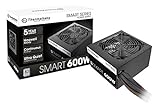
- Delivers 600W Continuous output at plus 40℃. Compliance with Intel ATX 12V 2. 31 and EPS 12V 2. 92 standards
- 80 PLUS Certified – 80% efficiency under typical load. Power good signal is 100-500 millisecond
- Supports (2) PCI-E 6 plus 2pin Connectors. Active (PFC) Power Factor Correction, MTBF: 100, 000 hours
- Industry Grade Protections: (OPP) Over Power Protection, (OVP) Over Voltage Protection, (SCP) Short Circuit Protection
- Hold up time is 16 millisecond minimum within 60 percent load. Input frequency range 50 - 60 in Hz
How to measure your own gaming setup
- Use a plug-in wall energy meter or a smart plug that explicitly measures energy use. Check that the device is rated for your region’s electrical system and the load you intend to measure.
- Connect the tower to the meter and, if you want whole-setup consumption, include the monitor and relevant accessories. A tower-only reading does not include a separately powered display or peripherals.
- Reset or note the meter’s accumulated kWh, then use the PC in a representative session: the games, settings, and duration you want to understand.
- Record both accumulated kWh and, if useful, watts during play. A momentary peak is not a substitute for energy accumulated over the session.
- Multiply the measured kWh by the electricity rate on your bill. Repeat for other states, such as idle or sleep, if you want a broader estimate.
A GPU software sensor can help explain what the graphics card is doing, but it does not measure the complete system’s wall draw. To compare two computers fairly, keep the game, resolution, graphics settings, frame-rate cap, session length, and included peripherals the same; compare both wall watts under load and accumulated kWh over the session.
Independent reader supportYour contribution helps us test, update, and keep practical guides available for everyone.Why published annual estimates need context
Annual figures depend on the computer, display boundary, and assumed hours of use. Lawrence Berkeley National Laboratory’s 2016 modeled estimate was 1,394 kWh per year for an average gaming computer plus display, based on a representative 2014-era build and U.S. population-level use assumptions that included 4.4 gaming hours per day. The same study estimated 1,300 kWh per year for its “Avid” profile (3.6 gaming hours per day) and 1,890 kWh per year for its “Extreme” profile (7.2 gaming hours per day). These are historical model estimates, not measurements of today’s typical gaming PC. The study’s methods and assumptions are essential to interpreting them.
Rank #4

- Fully Modular PSU: Reliable and efficient, low-noise power supply with fully modular cabling, so you only have to connect the cables your system build needs.
- Intel ATX 3.1 Certified: Compliant with the ATX 3.1 power standard, supporting PCIe 5.1 platform withstands 2x transient power excursions from the GPU.
- Keeps Quiet: A 120mm rifle bearing fan with a specially calculated fan curve keeps fan noise down, even when operating at full load.
- 105°C-Rated Capacitors: Delivers steady, reliable power and dependable electrical performance.
- Modern Standby Compatible: Extremely fast wake-from-sleep times and better low-load efficiency.
No recent representative estimate establishes one annual kWh figure for today’s gaming-PC population. Your current system’s measured kWh and your local bill rate are more useful for a personal cost estimate than applying an older population model without its assumptions.
Quick Recap
Best Value

- 80 PLUS GOLD CERTIFIED: Delivering gold-level performance with 92% efficiency, ensuring effective power transmission to your components.
- Fully Modular Design: Unique dragon-pattern fully modular cables cut redundant wiring to tidy your chassis, improve airflow and optimize system heat dissipation. With dimensions of 150×150×86mm (5.91×5.91×3.39in), the PSU fits most mainstream ATX cases.
- Support ATX 3.1 & PCIe 5.1: Compliant with the ATX 3.1 standard to fuel high-performance PC components with stability, efficiency, and power spike resistance. Meanwhile, supporting PCIe 5.1 platform withstands 2x transient power excursions from the GPU.
- Dual-Colour 16-Pin Cable: The Dual-color dragon-pattern 12V-2x6 PCI-E 5.1 cable for modern high-end graphics cards. With yellow connector can easily show you whether the cable has been plugged in properly.
- RGB Silent Fan & RGB Lighting Model: This 140mm low-noise fan comes with a silent mode, it outperforms standard 120mm fans in terms of quietness, heat dissipation capability and durability. What's more, the psu features ARGB lighting model, allowing you to adjust the lights style according to your needs.
Product prices and availability are accurate as of the date/time indicated and are subject to change. Any price and availability information displayed on Amazon at the time of purchase will apply.

