
MP3 and MP4 are not two competing audio formats: MP3 is an audio encoding, while MP4 is a container that can package video, audio, or both. For audio-only playback, MP3 is a familiar option with broad adoption; AAC in an MP4-family audio file such as M4A can offer better quality at the same data rate when your device supports it. For video with sound, MP4 is the relevant choice of the two. The best option depends on what the file contains and what your player can decode.
What is the difference between MP3 and MP4?
The key difference is that MP3 describes how audio is encoded, while MP4 describes a container—a file structure that packages media streams and related information. The National Archives explains that a digital audio or video file is a container holding data processed through a codec. A codec encodes and decodes audio or video; a container holds the encoded stream or streams. The National Archives’ overview of digitizing records describes this distinction.
MP3 stands for MPEG Layer III audio encoding, defined in MPEG-1 and MPEG-2. The customary filename extension is .mp3. MP3 uses perceptual coding: it reduces precision in sound components considered less audible to make files smaller. The Library of Congress format description outlines the format and its uses.
MP4 means MPEG-4 Part 14. It is a container derived from the ISO Base Media File Format and can hold video, audio, or video and audio together. An MP4 file does not specify one particular audio or video codec. AAC is a common audio codec in MP4-family files; audio-only MPEG-4 files often use the .m4a extension. The Library of Congress MP4 description explains the container, and its AAC description covers that audio encoding.
Free tools Windows power users keep installed
One-click scans. No signup required.
#1 Best Overall
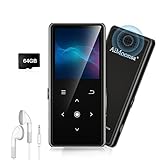
- ★【64GB Large Storage & HIFI Lossless Sound】 Each MP3 Player is equipped with a 64GB large-capacity TF card, which allows you to download thousands of your favorite music. And through the powerful DSP audio decoder chip, the most original sound is presented to you. It can ensure the high sound quality of HIFI.(Supports TF cards up to 256GB.)
- ★【Upgraded Bluetooth 5.2 & Support Multiple Formats】 Latest Version Bluetooth 5.2 means that faster transmission speed, longer connection distance and stronger anti-interference ability.Reduced power consumption for more power savings. And support APE / FLAC / WMA / MP3 / ACELP and other lossless formats.
- ★【Built-in HD Speaker & Easy to Carry】 The MP3 player has built-in HD speakers, which can play music without earphones, and no longer need to feel the pain of wearing earphones. MP3 player length is 3.6", width is 1.7" and thickness is 0.35". The body is made of hard and light zinc alloy and weighs only 70 grams. Lightweight and easy to carry.
- ★【Multifunctional MP3 Player for Many Occasions】 Multiple functions in one, music play, FM radio (need to insert a wired headphones), voice recorder, e-book, Alarm clock. Touch buttons with backlight to solve the problem of button noise. Perfect for Sport, Sleeping, Reading, Leaning, Meeting etc.
- ★【Great Gift】Each package contains an MP3 player, wired earphones, a 64GB TF card, a card reader, and a Type-C data cable. It makes an ideal gift for your children, partner, parents, or family on birthdays, Christmas, Thanksgiving, and other special occasions. If you have any questions, feel free to contact us anytime.
So “MP4 sounds better than MP3” is not a precise comparison: an MP4 might contain AAC, another audio encoding, or no audio at all. To compare audio quality, identify the audio codec and its settings—not just the filename extension.
Which should you choose?
| Your use | Good starting choice | What to consider |
|---|---|---|
| Music or spoken audio, especially on older or varied devices | MP3 | MP3 is widely adopted for online distribution and playback on specialized devices, but support still depends on the device and the particular file. The Library of Congress format description discusses its adoption. |
| Audio where efficient quality at a given data rate matters | AAC in an MP4-family audio file, often M4A | The Library of Congress reports that AAC-MPEG-4 quality surpasses MP3 at a given data rate. That does not mean every AAC file sounds better: bitrate, encoder, source audio, and playback conditions also matter. Confirm that your player supports the file. See the Library of Congress AAC description. |
| Video with sound | MP4 container | Check that the intended player supports the file’s video and audio codecs; the MP4 extension alone does not guarantee it can decode them. The Library of Congress MP4 description covers the container. |
| Long-term preservation or future editing | A suitable lossless or uncompressed master | Retain a high-quality source instead of relying on an MP3 or AAC copy as your master. The National Archives recommends uncompressed, lossless WAV-PCM in its federal recording and digitization context; that is archival guidance, not a requirement for ordinary consumer listening. See National Archives digitization guidance. |
How do quality and file size compare?
Common MP3 and AAC encodings are both lossy: they reduce file size by discarding some signal information. More aggressive compression discards more data and can produce audible artifacts. Quality depends on the codec, bitrate, encoder, original source, and playback—not on whether the filename ends in .mp3 or .mp4. The National Archives explains how codecs and containers relate in its digital audio and video guidance.
As a specific illustration, the Library of Congress says a 128 kbit/s MP3 is about one-eleventh the size of uncompressed LPCM audio at CD-level settings (44.1 kHz, 16-bit). This is an approximate comparison for those stated settings, not a general ratio for every bitrate or codec. The Library of Congress MP3 description gives the figure.
Rank #2

- 【64GB BUILT-IN LARGE STORAGE CAPACITY】Different from other large memory MP3 players on the market, the AGPTEK M3 boasts an impressive 64GB of internal storage, can expandable 128GB memory card (total up to 192G). [Other brands have no built-in memory and can only be used with TF card.]【Tip: The file size of a single transfer should not exceed 3GB to ensure the transfer speed and stability.】
- 【Bluetooth 5.3 & Automatic Reconnection】AGPTEK M3 MP3 music player adopts Bluetooth 5.3 technology, more stable connection, better compatibility, and lower consumption. You can pair the Bluetooth MP3 Player with wireless headphones or a Bluetooth speaker, automatically connects to the last Bluetooth device it was connected to, as soon as it is activated.
- 【HiFi Lossless Sound & Sports Partner】 With a professional audio decoding chip and smart noise reduction chip, AGPTEK MP3 player brings you original lossless music. With breakpoint resume function, perfect for doing sports, Yoga, exercise, running, travel, etc. Supports music formats like MP3/APE/FLAC/WMA/WAV/AAC [Note It does not directly support Audible, Apple music and iTunes.]
- 【Multi-function & Long battery life】 M3 MP3 player with Music Play, Video, Recording, Radio, Pictures, e-Books, Pedometer, A-B repeat, etc. Built-in 500mAh battery, it only takes 2.5 hours to fully charge and enjoy long hours of music. Perfect solution to replace mobile phone music, save mobile phone power. (To save power, the player will automatically power off after 5 minute of inactivity. You can turn it off in the settings.)
- 【 2.4'' SCREEN & LINE-IN FUNCTION】Features a 2.4-inch TFT color screen, bringing a clear and beautiful display. Metal middle frame with ABS plastic back shell,the size is approximately 4.4 inches × 2.06 inches × 0.39 inches, Weight: approximately 3.6 oz. And it supports Line-in recording and playback capabilities. Use a LINE IN cable to record from two MP3 players or connect with other devices for recording or play music.
Converting a lossy file—such as an MP3—to another lossy codec can introduce additional quality loss. If you expect to edit, convert, or preserve audio, keep the original lossless or uncompressed source where possible rather than repeatedly converting a compressed copy. The National Archives’ WAV-PCM recommendation applies to its federal-record context, not every personal music library. See its digitization guidance.
Do these 3 things before closing this tab:
1Fix the driver behind crashes, sound loss and screen glitches2Repair Windows errors before they cause bigger problems3Scan for outdated or missing drivers - takes under a minuteHow can you check whether a file will play?
Check the target device or app’s supported containers and codecs, then identify the codecs actually used in the file. An .mp4 may be recognized as a container but still fail to play if the device cannot decode its specific video or audio stream. Similarly, broad MP3 adoption does not prove that every device supports every MP3 file. The National Archives’ format guidance explains the container-and-codec distinction; the Library of Congress describes the MP4 container and AAC audio encoding.
Quick Recap
- For audio-only files, check the audio codec and the player’s support for it; MPEG-4 audio-only files commonly use
.m4a. - For video, check both the video and audio codecs, along with the container.
- When choosing between audio encodings, compare codec, bitrate, encoder and source quality, file size, and playback support. For video files, also consider resolution and the target player’s codec support.
Product prices and availability are accurate as of the date/time indicated and are subject to change. Any price and availability information displayed on Amazon at the time of purchase will apply.

