
What’s actually slowing this PC down?
Pick the symptom - the matching free tool is one click away.
Clustered Systems’ 100 kW rack was a high-density blade-server system cooled with pumped refrigerant and cold plates—not a single server or an ordinary cooling accessory. A 2011 report described the design as a target; in 2013, the company said it had installed a 105 kW configuration at SLAC. Those are historical claims, not evidence that the system is currently available or that its performance was independently validated.
What the 100 kW claim referred to
The figures describe rack-scale high-performance computing (HPC): many blade servers sharing a rack and its cooling and power infrastructure. Data Center Knowledge reported on December 12, 2011, that Clustered Systems was developing a blade-server chassis intended to support 80–100 kW per rack. The planned system was to receive its first test at SLAC.

The 2011 report described five 8U chassis, each holding 16 blades and providing 20 kW of capacity. Each blade used two cold plates. These were details of the planned configuration, not a report of an already installed five-chassis rack. Data Center Knowledge’s 2011 report.
What Clustered Systems said it installed at SLAC
In a May 8, 2013 press release, Clustered Systems said its first system had been installed at SLAC. The company described an 800 mm-wide, 48U rack with four installed chassis and 128 servers. It reported 105 kW of rack power and cooling capacity, with an n+2 redundant power supply. Each 8U chassis was described as capable of cooling up to 20 kW of servers.
#1 Best Overall

- Liquid cooling radiators: Support up to 360mm
- M/B size: EATX/ATX/MicroATX/Mini-ITX
- Drive Bays: 2*3.5 (internal)
- Expansion Slots: 8xslots PCI/PCIE full height
- Sliding rail: Not support, suggest to use rack shelf
The 2013 configuration did not simply fill the rack with a fifth chassis: the space that could have held one was allocated to a high-performance network switch. These are specifications and installation details reported by the company, not independent measurements. SLAC’s Amedeo Perazzo, quoted in the release, called the computing density unprecedented; that favorable comment is not a technical validation. Clustered Systems’ 2013 announcement.
How the cold-plate cooling system worked
The 2011 description called the design fanless. Cold plates attached to the blades carried heat into tubing filled with pumped liquid refrigerant. A pump and heat exchanger linked that refrigerant circuit to a water loop: the refrigerant collected heat at the servers, then transferred it to the water circuit.
Rank #2
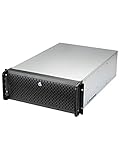
- Spacious Chassis: This huge 4U server case comes with 15 internal 3.5" HDD bays.
- Expandable & E-ATX Compatible: 7 PCI expansion slots and E-ATX compatibility gives you growth options for all of your needs.
- Exceptional Cooling: 8 pre-installed cooling fans provide excellent airflow and heat protection. 3 front 120mm PWM fans, 3 middle 120mm fans and 2 rear 80mm fans ensure your drives and chassis avoid overheating.
- Desired Features: Front panel LED indicators for power, HDD, and LAN status monitoring allow quick, easy visual assessment. Additional utility with 2 USB 3.0 port and built-in front panel lock.
Clustered Systems’ CEO and founder, Phil Hughes, told Data Center Knowledge that testing had continued with water temperatures as high as 78 degrees, allowing operation without a chiller in the setup he described. The 2011 report said the anticipated initial SLAC cooling source was tower water or return water from upstream equipment.
That does not mean every deployment could dispense with a chiller. The company’s 2013 release said a chiller was used during tests at varying water temperatures. Whether a facility can cool a rack without one depends on its available water source and operating conditions; the historical reports do not establish a universal chiller-free design.
Rank #3

- Customizable Depth Design: Enjoy flexible configuration with 4-post 27U Network rack pen frame featuring 4 vertical rails and adjustable 22"-35" depth range. Offers ample clearance for AV systems, network gear, and cable management while providing multi-angle access to ports and equipment
- Strong Load Capacity: 27U Network Rack is constructed from durable cold rolled steel for better weldability performancedesigned for ventilation with 27U mounting height and 1200lbs (550kg) weight capacity
- Enterprise-Grade Compatibility: Full 27U height (43.5"H) accommodates standard 19" rack-mount equipment. Features pre-installed square holes with included M6 screws/cage nuts. Universal depth adjustment (21"W x 22"-35"D) works seamlessly with switches, patch panels, and UPS systems.
- Quick-Lock Assembly System: Assembly is required, but it's simple. With all the included hardware & witty instructions, you'll have your server rack ready for servers & networking gear in under 20 minutes.
- Multi-Environment Ready: Enterprise-grade solution for server rooms, data centers, broadcast studios, and commercial spaces. Ideal for consolidating IT infrastructure in offices, schools, retail stores, or home lab setups with space-saving vertical organization
Power delivery and system overhead
The 2011 article described a power path that converted 480 V AC to 380 V DC at the rack, then distributed power to the blades, with conversion to 12 V DC at chassis level. It also identified PCI Express as the system interconnect. These details describe the system reported at the time, not a current specification for an available product.
The 2013 release noted that power-conversion losses, pumps, and heat-dissipation components add infrastructure overhead. A rack’s IT power rating alone therefore does not describe all electricity used by the cooling and power-delivery system.
Rank #4

- SPECIFICATIONS - The NavePoint 18U 4-post open frame rack ensures versatility with its adjustable depth from 22.5" to 40.7", fitting a wide range of server sizes. This rack, crafted from Cold Rolled Steel with a black powder coat, stands at 37.21"H x 20.67"W x 22.5-40.7"L and supports up to 1322 lbs, providing a durable and stable platform for mounting heavy-duty 19" rack equipment.
- DESIGN & VENTILATION - This 4-post network rack's open frame design supports unobstructed airflow, critical for maintaining equipment at optimal temperatures. It's ideal for setups where quick access to hardware and efficient cooling are priorities, supporting effective thermal management and easy maintenance.
- MOBILITY & ASSEMBLY - The rack's mobility is enhanced with casters, allowing for smooth relocation and adjustment in the workspace. Although assembly is required, it's facilitated by a self-squaring design and numbered, square-hole mounting positions. The rack arrives flat-packed with all necessary hardware included, making assembly straightforward.
- CABLE MANAGEMENT - Cable management is simplified with the inclusion of cable hooks, which aid in keeping cables organized and accessible. This feature contributes to a cleaner and more organized installation, which is essential for system reliability and ease of service.
- SAFETY & COMPLIANCE - All NavePoint products are built to industry standards.
What the reported PUE does—and does not—show
Clustered Systems’ 2013 release said initial testing indicated an average power usage effectiveness (PUE) of 1.07 could be expected. This was a company-reported expectation, not an independently confirmed benchmark in the cited announcement. PUE compares total facility energy with energy delivered to IT equipment, so the measurement boundary matters; the release noted that fan power is usually counted as IT load. The figure should not be treated as directly comparable with another system unless measurement methods and boundaries match.
Why the system was installed at SLAC
The company said the SLAC installation would support computational methods for tailoring catalysts and simulations involving interactions of X-rays with matter. The project was part of a broader effort to fit substantial computing capacity into limited space: the 2011 report said development received $3 million in grants from the U.S. Department of Energy and the California Energy Commission.
The Tool Desk
Outbyte PC Repair FREEClear out junk files and repair common Windows errorsFree Scan →Outbyte Driver Updater FREEFix the driver behind crashes, sound loss and screen glitchesFind Drivers →How it relates to today’s 100 kW liquid-cooling equipment
Vertiv’s CoolChip products are present-day comparison points, not continuations of the Clustered Systems rack. Vertiv describes the CoolChip CDU 100 as a 100 kW in-rack, liquid-to-liquid coolant distribution unit for direct-to-chip cooling. Its listed features include a 4U design, filtration, redundant components, monitoring, and temperature control. A CDU distributes coolant; it is not itself the historical blade-server rack.
Vertiv’s catalog separately describes the CoolChip CDU 121 as supporting 100 kW-plus single-rack direct-to-chip applications. The model names and stated capacity should not be conflated: confirm the specific model, regional product page, datasheet, and site requirements before making a procurement decision. Vertiv CoolChip CDU 100 and Vertiv CoolChip CDU 121.
What to compare when evaluating a 100 kW rack
A capacity figure is only one part of a liquid-cooling design. For a meaningful comparison, check:
- Cooling capacity per rack and per coolant distribution unit.
- Whether the design is direct-to-chip, rear-door, or another architecture.
- How primary and secondary fluid loops are arranged and separated.
- Required facility water temperatures and compatibility with the site’s cooling loop.
- Equipment footprint, rack space, and access for service.
- Redundancy, leak detection, monitoring, and control features.
- Electrical conversion losses and the full system’s power demand.
- Vendor support and regional availability.
The available figures do not establish comparable independent measurements for Clustered Systems’ historical rack and current CDU products, so they cannot support a performance ranking.
Do these 3 things before closing this tab:
1Fix the driver behind crashes, sound loss and screen glitches2Repair Windows errors before they cause bigger problems3Scan for outdated or missing drivers - takes under a minuteQuick Recap
Product prices and availability are accurate as of the date/time indicated and are subject to change. Any price and availability information displayed on Amazon at the time of purchase will apply.

