
Researchers test self-driving cars by running their driving software through virtual scenarios that can be repeated, changed and made unusually challenging without staging every event on a real road. They use those results to find and study problems—not to prove a vehicle safe on their own. Simulation is one stage in a broader process that also includes software checks, closed-course tests and public-road testing.
What “self-driving” testing means
In this article, “self-driving” refers to automated-driving systems intended to perform the driving task in defined conditions, rather than ordinary driver-assistance features that still rely on a human driver. The U.S. National Highway Traffic Safety Administration (NHTSA) generally uses the term “automated driving systems” for systems in which a traditional driver would no longer be needed. NHTSA cautions that “self-driving” can describe a vehicle’s operating state without clearly identifying its capabilities. The distinction matters: a test result applies to the system and conditions being tested, not automatically to every automated feature or situation.

NHTSA’s U.S. safety information says companies test the vehicles they build, must comply with Federal Motor Vehicle Safety Standards and certify that their vehicles are free of safety risks. These statements describe the U.S. framework; requirements and public-road testing arrangements vary by jurisdiction. NHTSA’s Automated Vehicle Safety page also references a 2025 USDOT automated-vehicle framework update, so current regulatory details should be checked against the agency’s latest information.
How a simulation test is built and run
-
Set the system’s intended operating conditions
Researchers first define the system under test and the conditions in which it is meant to operate. NHTSA’s preliminary testing framework considers an automated vehicle’s operational design domain (ODD)—the conditions in which it is designed to function—and the driving competencies it needs. Its framework describes work across modeling, simulation, track testing and open-road testing; simulation is not a standalone approval step. See NHTSA’s published reports and documents on automated-vehicle safety.
Special offer. See more information about Outbyte and uninstall instructions. Please review EULA and Privacy policy. -
Create or select a scenario
A scenario might start with recorded real-world driving data, which researchers replay and modify, or it might be constructed entirely in a virtual environment. Teams can also generate adversarial cases—deliberately difficult variations intended to expose weaknesses. NVIDIA researchers describe methods for generating and characterizing safety-testing scenarios, including evaluating possible safe trajectories and ranking cases by how difficult accident avoidance may be (published July 11, 2021).
-
Control and vary the conditions
In a simulator, researchers can specify the route, road layout, other traffic, sensors, weather and lighting, then repeat a run after changing selected conditions. The 2017 CARLA research paper describes configurable sensors, traffic, routes, weather, time of day and scenarios of increasing difficulty. Its urban-driving examples include intersections, construction, pedestrians and interactions between road users. This lets researchers isolate a factor or combine several to investigate how the system behaves (CARLA: An Open Urban Driving Simulator).
-
Run the driving software and inspect what happens
In a closed-loop simulation, the virtual environment supplies inputs to the driving software, and the software’s actions affect what happens next. Researchers can examine how the system perceives its surroundings, chooses a response and controls the vehicle. They may assess whether it stays within safe bounds or handles the scenario as intended. NVIDIA’s scenario-characterization work illustrates one way to analyze cases: compare possible safe trajectories and estimate how challenging accident avoidance would be.
-
Repeat, investigate and move to physical testing
If a run reveals a problem, researchers can adjust the software or scenario and repeat the test under controlled conditions. A simulation result can guide further software checks and physical tests, but it does not remove the need to validate behavior outside the virtual environment. NHTSA’s framework includes track and open-road work as well as modeling and simulation; Waymo likewise describes simulation, closed-course scenarios and public-road testing in its Waymo Driver testing overview.
What’s actually slowing this PC down?
Pick the symptom - the matching free tool is one click away.
Special offer. See more information about Outbyte and uninstall instructions. Please review EULA and Privacy policy.
What researchers test in the virtual world
Simulation is useful for exploring how a system responds to combinations of conditions that are difficult, risky or impractical to stage repeatedly on public roads. The CARLA paper and scenario-generation research illustrate several kinds of test dimensions:
- Roads and routes: intersections, complex routes, construction zones and changes in road layout.
- Other road users: vehicles, pedestrians and interactions where another participant’s behavior affects the vehicle’s choices.
- Environment: weather, lighting and time of day.
- Vehicle inputs: configurable sensor suites and the information those sensors provide to the driving software.
- Rare or demanding events: constructed and adversarial variations designed to probe possible failure modes.
Not every test needs to be a dramatic near-crash. Researchers can change one condition at a time to see whether a system’s response changes, or combine conditions to examine a more complicated interaction. Starting from real-world data can help ground a scenario in recorded driving, while generated variations can explore cases not captured by that original trip.
Rank #3
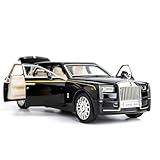
- Product size: 6.69*2.36*1.97 inches Weight: 0.7 pounds Outer packaging: exquisite color translucent packaging box
- Material: Die-cast car model, made of zinc alloy, with plastic parts, rubber tires, detailed interior and exterior decoration.
- Function: Press the two wheels of the front car to trigger the sound of the engine and the lights, with upright car logos,the angel logo is stored in the hood. The details of the body interior are realistic. Place the car on a flat ground, press the body and pull it back, the car will drive forward. (With pull back function)
- This Rolls-Royce Phantom 1/32 car model pull back car is very suitable for children to play with. The paint is exquisite and feels good, and it is heavy to hold. It is also very suitable for car model enthusiasts as a decoration.
- Accessories and collections: This product is very suitable for static accessories and can be used as an accessory next to a computer. For those who are passionate about collecting model car models, this is a great art collection.
How simulation compares with track and road testing
Each method offers a different kind of evidence. Simulation is repeatable and highly controllable; physical tests expose the system to real vehicles, infrastructure, sensors and variation that a model may not capture. NHTSA’s framework and Waymo’s description place simulation alongside physical testing rather than treating the methods as interchangeable.
| Method | Repeatability and control | Rare hazards | Real-world variability | Evidence it contributes |
|---|---|---|---|---|
| Simulation | High: researchers can reproduce a scenario and systematically change its conditions. | Can explore unusual or hazardous events without staging them on a road. | Limited by how accurately the virtual environment represents real conditions. | How the software behaves in specified, repeatable virtual scenarios. |
| Closed-course testing | Researchers can set up controlled physical scenarios, though reproducing every detail may be harder than in simulation. | Can stage selected scenarios in a controlled physical environment. | More physical realism than simulation, but not the full range of public-road conditions. | How the vehicle behaves in physical tests under arranged conditions. |
| Public-road testing | Less controlled: conditions and other road users vary. | Not a safe way to deliberately stage every hazardous event. | Direct exposure to real-world conditions and interactions. | How the system performs during testing on actual roads; it complements, rather than replaces, controlled testing. |
The distinctions are practical, not a ranking. Simulation can cover more controlled variations; a track can test the physical vehicle in arranged situations; and road testing can reveal behavior amid real-world variability. The agencies and company sources cited here do not establish that any one method, or a particular amount of simulated driving, can prove safety by itself.
What simulation can—and cannot—prove
Simulation helps researchers expand and structure the evidence they collect. It can make a test repeatable, support systematic comparisons and let teams investigate unusual scenarios without staging each one in traffic. But those strengths depend on the scenarios selected and the fidelity of the virtual environment. The sources do not establish that a simulator perfectly represents reality, or that a mileage total alone demonstrates that a system is safe.
Waymo says it has accumulated “more than 20 billion miles in simulation” on its company testing page. That is Waymo’s own cumulative figure, reported on an undated page accessed in 2026; it is not an independently verified measurement or a general safety threshold. A simulated mile is evidence of running software in virtual conditions, not a direct substitute for a mile driven on a public road.
The meaningful question is therefore not just how much simulation a team reports, but what was tested, how scenarios were selected and varied, what behaviors were evaluated, and how results were followed up in software and physical tests. The sources cited here do not describe a universal threshold that authorizes public-road deployment.
How oversight and public-road testing fit in
In the United States, NHTSA says limited public-street testing is permitted by states, while the agency monitors research and pilot programs through its Standing General Order. NHTSA also states that “Vehicles are tested by the companies that build them.” These are agency descriptions of the U.S. context, not a statement of rules that applies worldwide. They do not mean NHTSA certifies each simulated test or that passing a particular simulation automatically grants permission to test on roads.
Recommended Free Tools
For a broader view of how a company describes its testing stages, Waymo’s Waymo Driver overview discusses simulation, closed-course scenarios and public-road testing. Company descriptions explain that company’s approach; they should not be read as a universal testing standard.
Quick Recap
Product prices and availability are accurate as of the date/time indicated and are subject to change. Any price and availability information displayed on Amazon at the time of purchase will apply.

