
Free tools Windows power users keep installed
One-click scans. No signup required.
Choose DDR4 RAM by matching the exact motherboard and CPU models—not by relying on the kit’s advertised speed alone. Confirm both components support DDR4, then check the board manual and memory QVL and the processor specifications for module type, capacity, slot population, data rate, and ECC requirements. A kit’s XMP speed may require a BIOS setting and may exceed the system’s standard supported memory rate.
Start with the exact motherboard and CPU models
Write down the full model number of your motherboard, including its revision if the manufacturer lists one, and the exact CPU model. Compatibility depends on both: the processor’s memory controller and the board’s design and population rules can limit the usable memory configuration.
First verify that the motherboard is specifically a DDR4 model. DDR4 and DDR5 are physically keyed and electrically distinct, so a DDR4 module cannot be used in a DDR5 motherboard. Similarly, a motherboard family may include separate DDR4 and DDR5 variants; the family name alone is not enough.
Check what the CPU and motherboard support
CPU specifications
Look up the exact processor on its manufacturer’s specification page. For Intel processors, the specifications include supported memory type, maximum capacity, channels, and memory rates. Use the values for your particular CPU rather than assuming every processor in a product family has the same limits. Intel’s guidance is to check the processor specifications and the motherboard documentation for a particular system: Intel: How to Find Max Memory Size, Max Speed, and Max Number of Channels Supported by Intel Processors.
The Tool Desk
Outbyte PC Repair FREEClear out junk files and repair common Windows errorsFree Scan →Outbyte Driver Updater FREEFix the driver behind crashes, sound loss and screen glitchesFind Drivers →#1 Best Overall

- Disclaimer: Maximum Speed requires overclocking/PC BIOS adjustments. Maximum speed and performance depend on system components, including motherboard and CPU
- Hand-sorted memory chips ensure high performance with generous overclocking headroom
- VENGEANCE LPX is optimized for wide compatibility with the latest Intel and AMD DDR4 motherboards
- A low-profile height of just 34mm ensures that VENGEANCE LPX even fits in most small-form-factor builds
- A solid aluminum heatspreader efficiently dissipates heat from each module so that they consistently run at high clock speeds
Motherboard manual and QVL
Use the manual for your exact motherboard model and revision to confirm the supported memory type, DIMM form factor, slot count, maximum capacity, and recommended slots for each population. Then check the manufacturer’s memory QVL (Qualified Vendor List) for the kit’s exact part number and the number of modules you plan to install. A QVL entry indicates that the manufacturer tested that configuration; an absent entry does not, by itself, establish that a kit is incompatible.
Intel likewise recommends checking the board manual or contacting its manufacturer to verify a particular memory brand and model: Intel’s motherboard and memory compatibility guidance.
Rank #2

- Requires overclocking/BIOS adjustments. Maximum speed and performance depends on system components, including motherboard and CPU.
- G.SKILL RipjawsV Series DDR4 U-DIMM Memory Kit, Model: F4-3200C16D-16GVKB
- Non-ECC, DDR4 U-DIMM, 288-pin, for Desktop PC & Gaming
- Includes JEDEC default profile, and Intel XMP memory overclock profile
- Do not mix memory kits. Memory kits are sold in matched kits that are designed to run together as a set. Mixing memory kits will result in stability issues or system failure.
Match module type and configuration
Before choosing capacity or speed, make sure the modules’ electrical and physical type matches the platform. Confirm whether the kit is desktop UDIMM or another form, whether it is ECC or non-ECC, and whether it is buffered or unbuffered. Do not mix module types such as registered and unbuffered DIMMs. ECC works only when the processor and motherboard both support the relevant ECC configuration; check both manufacturers’ specifications if error-correcting memory is required.
Capacity and speed can also depend on how the modules are populated. Follow the board manual’s recommended slots for one, two, or more DIMMs, and account for the number of DIMMs per channel and module ranks. A configuration that works at a particular rate with fewer modules may have a lower supported rate when more slots are populated.
Rank #3
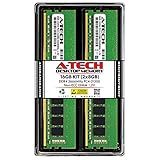
- Compatible with select DDR4 Desktop computers + Easy to install at home, no expertise required
- Maximize your system's performance, boost loading speeds and multitask with ease
- Backed by A-Tech's Lifetime Warranty + Friendly tech support team available to help before and after your purchase
- 16GB RAM Kit ( 2 x 8GB Modules ) | DDR4 DIMM 288-Pin | Speeds up to 2666MHz (2667MHz), PC4-21300 / PC4-2666V
- NON-ECC Unbuffered | 1Rx8 or 2Rx8 - Single or Dual Rank | JEDEC DDR4 standard 1.2V
Understand advertised speed and XMP
Compare a kit’s advertised data rate with the standard memory rates supported by both the processor and motherboard for your planned module configuration. The box speed is not a guarantee that every CPU, board, and slot population will run at that rate.
Many DDR4 kits use Intel XMP profiles to load preset memory settings. XMP is a profile that must be supported by the motherboard and may need to be enabled in BIOS or a vendor tuning utility; it is not the same as the system’s default memory setting. Intel describes XMP as memory overclocking, so use it only if the board supports the profile and the resulting system is stable. Intel also notes that overclocking can have warranty implications: Intel Extreme Memory Profile (XMP).
Rank #4

- Boosts System Performance:16GB DDR4 laptop memory RAM kit (2x8GB) that operates at 3200MHz to improve multitasking and system responsiveness for smoother performance
- Easy Installation: Upgrade your laptop RAM with ease—no computer skills required Follow step-by-step how-to guides available at Crucial for a smooth, worry-free installation
- Compatibility Guaranteed: Ensure seamless compatibility with your laptop by using the Crucial System Scanner or Crucial Upgrade Selector—get accurate recommendations for your specific device
- Trusted Micron Quality: Backed by 42 years of memory expertise, this DDR4 RAM is rigorously tested at both component and module levels, ensuring top performance and reliability
- ECC Type = Non-ECC, Form Factor = SODIMM, Pin Count = 260-pin, PC Speed = PC4-25600, Voltage = 1.2V, Rank and Configuration = 1Rx16, 1Rx8 or 2Rx8
A practical compatibility checklist
- Identify the exact motherboard model and revision, plus the exact CPU model.
- Confirm that the motherboard is a DDR4 variant and that the CPU supports DDR4.
- Check the CPU specifications for memory capacity, channels, and supported rates.
- Read the motherboard manual for DIMM type, slot population, capacity limits, and recommended slots.
- Search the board’s current QVL for the kit’s exact part number and intended number of modules.
- Verify UDIMM or other form factor, ECC status, and buffered or unbuffered type; do not mix incompatible module types.
- Choose capacity and module count within the board’s population guidance, then check the expected rate for that configuration.
- If you intend to use XMP, verify board support and be prepared to enable the profile and confirm stability.
How to compare compatible kits
Once a kit meets the basic requirements, compare the factors that affect your actual system rather than choosing by headline speed alone:
- Exact part number and QVL status: Prefer a kit listed for your board and intended slot configuration when available.
- Total capacity: Keep within both CPU and motherboard limits and consider whether the board’s supported slot arrangement accommodates it.
- Module count and placement: Follow the manual’s recommended slots and account for any rate limits tied to DIMMs per channel or ranks.
- Standard supported rate: Check the rate for your particular CPU, board, and population before treating an advertised rate as attainable.
- XMP profile: If the desired rate relies on XMP, confirm the profile and motherboard support and consider the stability trade-off.
There is no single best DDR4 kit or speed without the exact CPU and motherboard models. QVLs and BIOS support can change, so verify the latest documentation for the board revision before buying.
Quick Recap
Product prices and availability are accurate as of the date/time indicated and are subject to change. Any price and availability information displayed on Amazon at the time of purchase will apply.

