
Not as a proven, practical standalone system for ordinary household electricity. Thermoelectric generators (TEGs) convert heat into electricity and can recover some power from a sustained heat source, but the available evidence supports specialized waste-heat recovery and small loads—not verified whole-home supply. A module’s rated or laboratory output is not the same as net electricity from an installed system.
How a thermoelectric generator makes electricity
A TEG produces electricity when heat flows across it from a hotter side to a cooler side. It needs both a sustained temperature difference across the module and a way to transfer heat to the hot side and carry it away from the cold side. A hot object alone is not enough: if the module’s two sides approach the same temperature, its useful output falls.
That makes the complete thermal path important. Heat exchangers, thermal interfaces, airflow or coolant, and the surrounding environment influence how much of a source’s heat actually crosses the module. Material performance matters, but it does not determine system output on its own. A field-deployment study describes material properties, device boundary conditions, and environmental thermal resistance as interacting influences on performance. Kishore and colleagues’ 2020 study
Why lab efficiency does not predict home output
The 2020 field-deployment study summarizes laboratory reports of thermal-to-electrical efficiency as high as 11%, but says real-environment TEG efficiency is no more than a few percent. Those figures describe different conditions: a laboratory result is not a forecast for a residential installation. The study also reports up to 28% more power and 162% more power per unit mass than the commercial low-grade-waste-heat module used as its comparison. These are relative results for the study’s device and comparison, not typical household output.
Recommended Free Tools
#1 Best Overall

- Please identify the "diymore" store.
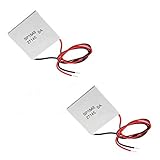
- Model: TEC1-12706.
- Size: 40mm x 40mm x 3.6mm.
- Refrigeration power: Qcmax 50-60W.
- Operation Temperature: -30°C-70°C(-86℉-158℉)
System losses can further reduce the electricity available to use. Pumps or fans may consume a significant share of generated power, and some loads require DC-to-AC conversion. The U.S. Department of Energy’s industrial scoping study identifies the temperature difference and heat transfer on both sides, as well as material performance, as important factors. It also says a 100°C reduction in temperature difference can cause more than 20% performance loss for a ZT≈2 module. That is a study-specific performance observation, not a universal household calculation. DOE industrial TEG scoping study
What the residential and building projects show
DOE residential burner project
The U.S. Department of Energy’s Advanced Burner Thermoelectric Generator project set out to develop an integrated, fuel-flexible system for residential and commercial buildings. Led by the Gas Technology Institute with Oak Ridge National Laboratory and Sheetak Inc. as partners, it aimed to demonstrate technical and economic feasibility. Its listed project term ran from April 15, 2019, to July 31, 2022. The project page describes a development objective; it does not establish that a consumer product is now available or that a completed system supplied a home’s ordinary electrical loads.
The DOE page also notes that earlier work on self-powered appliances had not produced commercially successful products, citing low energy savings and customized designs that prevented drop-in installation. DOE residential heating-system project
California boiler and heater project
The California Energy Commission’s 2024 Advanced Thermo-Electric Generator System (ATEGS) project integrated and tested lead telluride (PbTe) and bismuth telluride (BiTe) modules in an available boiler/heater. The report page gives efficiency above 5% for the tested high-temperature PbTe modules, with a 6.27-year payback, and a 4.77-year payback for the low-temperature BiTe module. It also reports 1.00- and 0.56-year payback figures for combined heat-and-power cases. These are project-specific application and economic results, not general household payback estimates or evidence of whole-home electrical supply. California Energy Commission ATEGS project
The Tool Desk
Outbyte Driver Updater FREEFix the driver behind crashes, sound loss and screen glitchesFind Drivers →Outbyte PC Repair FREEClear out junk files and repair common Windows errorsFree Scan →Rank #3

- Peltier Module Model: 5 PCS TEC1-12706
- Size: 40mm x 40mm x 3.6mm
- Working Current: 4.3-4.6 A (rated 12 v), Imax: 4.5A
- Rated voltage: DC12V (Vmax: 15 v starting current 5.8 A)
- Refrigeration Power: Qcmax 50-60W
What small demonstrations can—and cannot—prove
TEGs can produce measurable electricity for modest loads. In a different approach, researchers demonstrated a device that harvested energy through radiative cooling to the night sky. DOE reported 0.025 watts per square meter measured on a clear night at a Stanford rooftop; the researchers estimated up to 0.5 watts per square meter with higher-quality components. The demonstration powered a small LED. Its conditions and niche mechanism make it an example of small-scale generation, not a representative home-power system. DOE: “Generating Light from Darkness”
It is useful to distinguish three claims: a device generates some electricity; a system offsets a small auxiliary load; or an installation supplies a home’s ordinary electrical loads over time. The cited demonstrations support the first two kinds of claim. The reviewed residential and building evidence does not establish the third.
Rank #4

- 【Easy to install】An excellent DIY kit for electronic enthusiasts in semiconductor refrigeration applications,Completely assembled,you have no need to use your hands,save time. Positive red and negative black,Easy To install.
- 【High quality and Durable】The complete sealing structure isolates the moisture in the air,Using high-quality aluminum + TEC1-12706 semiconductor cooling plate(The gravity of the upgraded heat sink is increased by 20%, which makes the heat dissipation stronger and smaller.)durable.
- 【High cooling efficiency】 equipped with cool fan, The upgraded version of S-type thickened heat dissipation is faster,easily cooling down within a few minutes. no noise, no vibration, no refrigerant required.Power Supply: DC 12V.Max Power:72W.
- 【 Best assistant for small space cooling】Suitable for computer heatsink ,small splace cooling. Also used for pet bed cooling,plate cooling,test bench,cardboard box, Pantry,wine cellar,ect
- 【Mini and Portable】Easy to install,Save space, can be installed anywhere,compact size (100 * 95 * 95mm / 3.93 * 3.74 * 3.74inch) DIY Peltier Kit include TEC1-12706 semiconductor cooler and other accessories.
What to check before treating a TEG as a home-energy solution
Ask for system-level evidence rather than a module’s headline rating. A meaningful estimate needs a defined heat source, operating conditions, and accounting for the energy required to run the rest of the system.
- Heat source: What is its temperature, how much usable heat is available, and for how many hours does it operate?
- Temperature difference: What hot-to-cold difference is maintained across the module during actual operation, rather than at a test point?
- Thermal design: How do the heat exchanger and cold-side arrangement sustain heat flow and reject heat under the intended conditions?
- Net output: Is the quoted figure module output or system power after pumps, fans, controls, and electrical conversion?
- Operating pattern: Is the figure continuous, intermittent, or a laboratory maximum?
- Purpose and economics: Is the goal a sensor or light, auxiliary power for a heating appliance, or whole-home electricity? What installed cost and payback assumptions apply to that specific use?
Without those details, a wattage claim cannot be translated reliably into household power. The available sources do not provide a general home-scale output figure.
Best Value

- HIGH HEAT TOLERANCE: Features graphite thermal transfer layer, withstands up to 227°C/440°F. Ideal for fireplace applications with efficient heat transfer. Maintains structural integrity through extended use with consistent performance
- REPAIR SOLUTION: Specifically engineered for fireplace fan repair, extends equipment lifespan. Simple replacement process requiring basic tools. Compatible with numerous fireplace fan types, offering versatile application. Addresses common generator wear issues
- UNIVERSAL CONNECTION: Standardized power generator interface ensures secure mounting. Stable electrical link maintains consistent current dance. Secure connection minimizes loosening risks while simplifying maintenance procedures for professionals
- EFFICIENT THERMAL TRANSFER: Graphite construction delivers superior heat conduction. Promotes even temperature distribution, preventing hot spots. Enhances thermoelectric generator output while maintaining safe operating temperatures.
- FUNCTIONAL RESTORATION: Revives fireplace fan's temperature difference generator capability. Restores equipment's power generation function. Essential for residential fireplace maintenance and technician repairs, solving frequent failure issues
Can you build a home-power system from a TEG module?
A thermoelectric generator module is a component for experiments or specialized heat recovery, not a complete home generator. Depending on the design, a build may also need a heat exchanger, heat sink, thermal interface, temperature control, and DC/DC or DC/AC electronics. The necessary arrangement depends on the heat source and intended load; the available evidence does not establish one recommended kit or compatible parts list.
The DOE industrial scoping study gives historical market context, estimating commercial TEGs at roughly 3% efficiency and about $30 per watt, with about $5 per watt identified as a competitiveness target. These are figures from the report, whose publication date is not stated on the retrieved page—not current product prices or a quote for a residential installation. DOE industrial TEG scoping study
Quick Recap
Product prices and availability are accurate as of the date/time indicated and are subject to change. Any price and availability information displayed on Amazon at the time of purchase will apply.

