
PC Slower Than It Used to Be?
A free scan shows the junk files, broken settings and background clutter dragging Windows down - then fixes them in one click.Free scan · Windows 10 & 11Outdated Drivers Are Slowing You Down
One free scan finds every outdated or missing driver and matches the right update for your exact hardware.Free scan · exact hardware matchChoose a thermoelectric generator (TEG) for the temperatures the module will actually experience and the net electricity your system needs—not the waste stream’s headline temperature or a module’s catalog wattage. Measure the hot and cold sides through real operating cycles, estimate available heat flow, then select and evaluate the module together with its heat exchangers, mounting, power electronics, and cooling. A module cannot deliver its rated output if the system cannot maintain its test conditions or reject heat from its cold side.
Start with the electrical job the TEG must do
Write down what the recovered electricity is for before comparing modules. A TEG intended to charge a battery for intermittent sensing has different electrical and availability needs from one intended to supply a steady industrial load.
- Specify the load’s required voltage and current, average and peak power, and whether it can tolerate interruptions.
- Decide whether energy storage is required, and identify the expected storage and conversion path.
- Set acceptable downtime and determine whether fans or pumps are acceptable, since their consumption reduces net output.
- Record physical access, installation constraints, and any process limits on pressure drop or heat extraction.
Use the required net power at the load as the target. The module’s gross electrical output is not the same as electricity left over after conversion, wiring, storage, controls, and any active cooling.
Measure both sides of the module, not just the heat source
The useful temperature difference is the one maintained between the module’s hot and cold faces under operating conditions. The waste stream’s temperature alone does not establish that difference: heat-exchanger losses, contact resistance, and the cold-side sink all affect the interface temperatures. Measure hot-side and cold-side conditions over a representative operating cycle, including starts, stops, and changes in load.
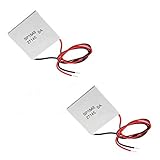
#1 Best Overall

- Please identify the "diymore" store.
- Model: TEC1-12706.
- Size: 40mm x 40mm x 3.6mm.
- Refrigeration power: Qcmax 50-60W.
- Operation Temperature: -30°C-70°C(-86℉-158℉)
Estimate heat flow and its variability as well as temperature. For process streams, note relevant flow, pressure-drop limits, fouling, corrosive constituents, and access for exchanger installation or maintenance. Establish allowable module-face temperatures and likely thermal excursions before shortlisting products.
The U.S. Department of Energy’s 2007 industrial waste-heat scoping study emphasizes heat transfer on both sides of a TEG. In its modeled module with a thermoelectric figure of merit ZT≈2, reducing the temperature differential by 100°C could cause a performance loss of more than 20%. This is a result for that modeled case, not a universal output rule. A source that is too cool, intermittent, or difficult to exchange heat with may not justify a TEG system; the unused heat still needs a path out through the cold side.
Shortlist modules by actual interface conditions
Use measured or credibly estimated hot-face and cold-face temperatures to identify suitable module families. Check that the module’s operating range covers normal conditions and expected excursions; do not assume a catalog rating applies at different temperatures or with a different exchanger.
Material labels alone do not determine project economics. In its 2024 summary of the Advanced Thermo-Electric Generator System (ATEGS) demonstration, the California Energy Commission reported that the tested high-temperature PbTe modules exceeded 5% efficiency and had a 6.27-year payback, while the low-temperature BiTe configuration had a 4.77-year payback. Those are outcomes for the demonstration and its assumptions, not transferable performance or payback guarantees.
What’s actually slowing this PC down?
Pick the symptom - the matching free tool is one click away.
Catalog ratings are also conditional. For example, Interm lists a 40 × 40 mm PGL-1-1-150 power-generation module at 2.8 W with a 150°C hot side and 50°C cold side. That rating is not a prediction for other face temperatures, heat exchangers, or electrical loads. Compare candidates only when their test conditions and load conditions are comparable.
Request the data needed to compare candidates
Ask manufacturers or suppliers for a current, complete datasheet and the information needed to verify fit:
Rank #3

- Peltier Module Model: 5 PCS TEC1-12706
- Size: 40mm x 40mm x 3.6mm
- Working Current: 4.3-4.6 A (rated 12 v), Imax: 4.5A
- Rated voltage: DC12V (Vmax: 15 v starting current 5.8 A)
- Refrigeration Power: Qcmax 50-60W
- Output-versus-temperature and load curves, open-circuit voltage, and internal electrical resistance.
- Allowable hot- and cold-side temperatures, thermal resistance, and specified contact or clamping requirements.
- Thermal-cycle limits, environmental or sealing rating, and applicable warranty terms.
- Whether the module is designed for generation at your temperatures, rather than merely for cooling.
Construction matters at elevated temperatures. Analog Devices notes that some modules intended for power generation use higher-temperature solder to permit higher operating temperatures and output. Do not infer a generator’s temperature capability from a cooling module’s appearance or dimensions.
Design heat capture, mounting, and heat rejection together
The TEG is only one part of the thermal system. Estimate the hot-side exchanger’s area and thermal resistance, the cold-side heat-rejection capacity, and losses at interfaces. Include surface flatness, contact pressure, thermal interface material, clamping, insulation, and differential thermal expansion in the mechanical design. For process heat, account for exchanger fouling and pressure drop as well as access for cleaning and service.
Do these 3 things before closing this tab:
1Clear out junk files and repair common Windows errors2Fix the driver behind crashes, sound loss and screen glitches3Repair Windows errors before they cause bigger problemsA larger module is not automatically a better choice. It may require a larger cold-side heat sink to preserve the temperature difference, and forced cooling can consume electricity that would otherwise reach the load. Analog Devices calls out this heatsinking trade-off in energy-harvesting systems; Ferrotec likewise identifies cold-side heat rejection as a potentially challenging part of generator design.
Rank #4

- 【Easy to install】An excellent DIY kit for electronic enthusiasts in semiconductor refrigeration applications,Completely assembled,you have no need to use your hands,save time. Positive red and negative black,Easy To install.
- 【High quality and Durable】The complete sealing structure isolates the moisture in the air,Using high-quality aluminum + TEC1-12706 semiconductor cooling plate(The gravity of the upgraded heat sink is increased by 20%, which makes the heat dissipation stronger and smaller.)durable.
- 【High cooling efficiency】 equipped with cool fan, The upgraded version of S-type thickened heat dissipation is faster,easily cooling down within a few minutes. no noise, no vibration, no refrigerant required.Power Supply: DC 12V.Max Power:72W.
- 【 Best assistant for small space cooling】Suitable for computer heatsink ,small splace cooling. Also used for pet bed cooling,plate cooling,test bench,cardboard box, Pantry,wine cellar,ect
- 【Mini and Portable】Easy to install,Save space, can be installed anywhere,compact size (100 * 95 * 95mm / 3.93 * 3.74 * 3.74inch) DIY Peltier Kit include TEC1-12706 semiconductor cooler and other accessories.
NETL’s methane-mitigation TEG project illustrates why integration needs to be considered as one design: its engineers addressed the burner and TEG arrangement, heat exchangers, module stack, controls, pressure drop, interface temperatures, thermal cycling, and a compliant mounting structure to accommodate expansion. The details of that project are not a universal design prescription, but they show the kinds of interactions that can determine field performance.
Match the module’s electrical output to the converter and load
Use the module’s electrical curves and internal resistance to choose series or parallel wiring and a DC/DC converter or energy-harvesting controller. Check startup voltage and cold-start behavior, expected load transients, converter efficiency at the power levels you expect, wire losses, and storage behavior. A converter that works at peak output may perform differently at the lower output the system sees for much of its operating cycle.
Ferrotec states that maximum generator efficiency occurs when generator resistance matches load resistance. Treat that as a matching principle to apply with the module’s actual electrical data, not as a reason to select wiring or a converter without checking operating conditions. In NETL’s project, engineers identified high current as a source of battery-storage losses and changed the module configuration to raise voltage and reduce current. That was a project-specific adjustment, not a general rule that every TEG should be wired for higher voltage.
The Tool Desk
Outbyte PC Repair FREERepair Windows errors before they cause bigger problemsFix Now →Outbyte Driver Updater FREEScan for outdated or missing drivers - takes under a minuteDriver Scan →Best Value

- HIGH HEAT TOLERANCE: Features graphite thermal transfer layer, withstands up to 227°C/440°F. Ideal for fireplace applications with efficient heat transfer. Maintains structural integrity through extended use with consistent performance
- REPAIR SOLUTION: Specifically engineered for fireplace fan repair, extends equipment lifespan. Simple replacement process requiring basic tools. Compatible with numerous fireplace fan types, offering versatile application. Addresses common generator wear issues
- UNIVERSAL CONNECTION: Standardized power generator interface ensures secure mounting. Stable electrical link maintains consistent current dance. Secure connection minimizes loosening risks while simplifying maintenance procedures for professionals
- EFFICIENT THERMAL TRANSFER: Graphite construction delivers superior heat conduction. Promotes even temperature distribution, preventing hot spots. Enhances thermoelectric generator output while maintaining safe operating temperatures.
- FUNCTIONAL RESTORATION: Revives fireplace fan's temperature difference generator capability. Restores equipment's power generation function. Essential for residential fireplace maintenance and technician repairs, solving frequent failure issues
Compare installed systems on net output, durability, and economics
Compare shortlisted options on the same operating assumptions, not on headline watts or conversion efficiency alone. Include the installed thermal and electrical system, expected operating time, service needs, and net energy delivered after system parasitics.
| Comparison area | What to compare |
|---|---|
| Thermal fit | Hot- and cold-side operating windows, actual interface temperatures, heat flow, and performance through transients. |
| Heat-exchanger integration | Exchanger and sink requirements, pressure drop, fouling, contact design, and any fan or pump power. |
| Electrical delivery | Output at project conditions, voltage, current, resistance, converter match, and storage or wiring losses. |
| Field durability | Evidence for thermal cycling and vibration, plus protection against oxidation, corrosion, moisture, contact degradation, and mechanical stress. |
| Project economics | Module and installation costs, exchanger fabrication, process disruption, annual net generation, maintenance, downtime, avoided energy cost, and payback. |
Ask for thermal-cycle and vibration evidence relevant to the intended environment. In one NETL project test, a prototype module lost 3.7% of its power after 100 heat-up/cool-down cycles at 20–30°C per minute. That is a result for that module and protocol, not a general degradation rate for TEGs.
Include integration costs and service life in the economic comparison. The CEC demonstration’s PbTe configuration exceeded 5% efficiency yet had a longer reported payback than its BiTe configuration; that example shows why efficiency by itself does not settle project value. A 2020 study of high-performance TEGs reported up to 28% higher power and 162% higher power per unit mass than a commercial low-grade-waste-heat module studied for comparison. Those figures describe that study’s devices and comparison, not an expected improvement for a project’s selected module.
Use a project-specific selection workflow
- Define the load. Document the useful voltage, average and peak power, storage needs, allowed downtime, and tolerance for active cooling.
- Characterize the thermal cycle. Measure hot- and cold-side conditions, estimate heat flow, and record variability and process constraints.
- Set module limits. Establish acceptable face temperatures and excursions, then shortlist modules whose documented operating windows cover them.
- Model the complete thermal path. Evaluate hot-side capture, interface losses, mounting, cold-side rejection, and any parasitic cooling.
- Check electrical compatibility. Use output curves and resistance to assess wiring, conversion, startup, storage, and net power to the load.
- Compare field and financial cases. Put durability, maintenance, installation, downtime, annual net generation, and payback on a common basis.
- Validate before procurement at scale. Confirm heat-transfer performance, material limits, electrical output, and safety at intended operating conditions.
A specific module cannot be selected responsibly without the project’s measured interface temperatures, heat flow and transients, target net load, electrical and storage architecture, environment, exchanger constraints, installation budget, and maintenance requirements. Where those inputs are not yet available, a scoping study can establish whether recoverable heat and expected parasitic loads make the project worth developing before modules are purchased.
Free tools Windows power users keep installed
One-click scans. No signup required.
Quick Recap
Product prices and availability are accurate as of the date/time indicated and are subject to change. Any price and availability information displayed on Amazon at the time of purchase will apply.

