
Recommended Free Tools
Gaming laptop display specs describe three different things: refresh rate (how often the screen updates), resolution (how many pixels form the image), and response time (how quickly pixels change color). The best combination depends on the games you play and whether the laptop’s CPU and GPU can produce enough frames at your chosen resolution to make use of the screen.
What refresh rate means on a gaming laptop
Refresh rate, measured in hertz (Hz), is the number of times a display updates each second. A higher rate can make motion look smoother, especially when a game is producing enough frames to take advantage of it. Intel explains that the CPU, GPU, and display work together: a 144 Hz panel receiving 30 frames per second cannot use its full refresh capability. Intel’s guide to refresh rate explains the relationship.
ASUS ROG’s 2025 buying guide likewise says, “Refresh rate dictates the number of times a screen refreshes each second — higher numbers mean smoother motion.” That is useful guidance, but it does not mean the highest listed Hz is automatically the best choice for every game or laptop. ASUS ROG’s gaming laptop buying guide
Is 144 Hz good for gaming?
A 144 Hz display can provide smoother motion than a lower-refresh display when the game and laptop deliver a sufficiently high frame rate. If a demanding game runs at a much lower frame rate, the display will not be receiving enough frames to show the full benefit of its 144 Hz capability. Consider the games and graphics settings you actually use, not just the panel’s maximum rating.
#1 Best Overall

- CURVED FOR ENHANCED ENGAGEMENT: An immersive viewing experience with a curved monitor that wraps more closely around your field of vision; It creates a wider view, enhancing depth perception and minimizing peripheral distraction
- SMOOTH PERFORMANCE FOR SEAMLESS CONTENT: Stay in the action when playing games, watching videos, or working on creative projects; The 100Hz refresh rate reduces lag and motion blur so you don't miss a thing in fast-paced moments¹
- MORE GAMING POWER: Gain the edge with optimizable game settings; Color and image contrast can be adjusted to see scenes more vividly and spot enemies hiding in the dark; Game Mode adjusts any game to fill the screen so you can view every detail²
- KEEP IT EASY ON THE EYES: Care for your eyes and stay comfortable, even during long sessions; Advanced eye comfort technology certified by TÜV reduces eye strain by minimizing blue light and reducing irritating screen flicker²
- INCREASED VERSATILITY: Connect to more; Plug devices straight into your monitor for increased flexibility, making your computing environment even more convenient
What resolution means—and why it affects frame rate
Resolution is the image’s pixel width and height. Common gaming display resolutions include FHD (1,920 × 1,080), QHD (2,560 × 1,440), and UHD/4K (3,840 × 2,160). A 2,560 × 1,440 image contains 3,686,400 pixels. These figures are listed by Intel’s gaming monitor guide.
More pixels can show more image detail, but they also increase the work required of the GPU. Intel notes that 4K has four times as many pixels as standard 1080p, and ASUS explains that a higher resolution generally reduces the maximum frame rate a system can sustain at a given graphics capability. The trade-off matters because a higher-resolution screen may look sharper while making it harder for the laptop to sustain the frame rate needed to benefit from a high refresh rate. Intel’s gaming laptop guide
Rank #2

- 【INTEGRATED SPEAKERS】Whether you're at work or in the midst of an intense gaming session, our built-in speakers provide rich and seamless audio, all while keeping your desk clutter-free.
- 【EASY ON THE EYES】 Protect your eyes and enhance your comfort with Blue-Light Shift technology. This feature reduces harmful blue light emissions from your screen, helping to alleviate eye strain during long hours of use and promoting healthier viewing habits.
- 【WIDEN YOUR PERSPECTIVE】Our sleek minimal bezel design ensures undivided attention. The nearly bezel-free display seamlessly connects in a dual monitor arrangement, delivering an unobstructed view that lets you focus on more at once, completely distraction-free.
1080p vs. 1440p on a gaming laptop
FHD 1080p asks the GPU to render fewer pixels than QHD 1440p, while QHD can provide more detail. Which is preferable depends on the balance you want between image detail and the frame rate your laptop can sustain in your games. Compare expected performance at the resolution and graphics settings you intend to use; a resolution label alone cannot tell you what frame rate a particular laptop will achieve.
What response time measures
Response time describes how quickly display pixels change color. It is different from refresh rate: Hz counts display updates, while response time concerns pixel transitions. When pixels change too slowly for the content, moving objects can leave blur trails. ASUS ROG notes that response time is an important consideration, particularly for high-refresh displays. ASUS ROG’s 2025 buying guide
Rank #3

- 1800R curve monitor the curved display delivers a revolutionary visual experience with a leading 1800R screen curvature as the images appear to wrap around you for an in depth, immersive experience
- Hdmi, VGA & PC audio in ports
- High refresh rate 75Hz.Brightness (cd/m²):250 cd/m2
- Vesa wall mount ready; Lamp Life: 30,000+ Hours
- Windows 10 Sceptre Monitors are fully compatible with Windows 10, the most recent operating System available on PCs.Brightness: 220 cd/M2
Treat a manufacturer’s response-time figure as a specification for that product, not as a directly comparable score unless the measurement method and conditions are known. A number by itself does not establish how two different panels will perform relative to each other.
How the three specs work together
Think of the display and laptop as a system. Resolution affects the GPU workload; the game and CPU/GPU determine how many frames can be produced; refresh rate sets how often the screen can update; and response time describes how quickly pixels can transition. Intel recommends matching CPU and GPU capability to the resolution and consistent frame rate you want. Intel’s laptop selection guide
Rank #4
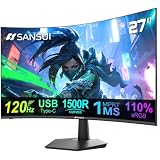
- ⭐27 inch curved monitor with speakers built in for gaming, work or business.
- Screen Feature: 120hz Refresh Rate丨1ms(MPRT) Fast Response Time丨Adaptive Sync
- Display Color: 110% sRGB丨 4000:1 Contrast Ratio丨300Nits Brightness丨16.7M display colors
- Ports and Speakers:1*USB Type-C 丨1*HDMI 1.4 丨2*2W Built-in Speakers for Daily Use.
- Ergonomic Design: -5°~15°Tilt丨178°Wide Viewing Angle丨Ultra-thin Bezel丨100 x 100mm VESA Mount
- Prioritize refresh rate when smooth motion is important and your laptop can produce enough frames in your target games.
- Prioritize resolution when additional image detail matters, while accounting for the extra GPU workload.
- Check response time as a separate pixel-transition specification, and be cautious about comparing manufacturer figures with unspecified methods.
What to check in a laptop’s display listing
Do not rely on a single headline number. Check the exact laptop configuration and the conditions attached to its maximum display specification. For example, ASUS ROG’s US-market specifications for the ROG Strix G16 (2026) list a 2,560 × 1,600 display with a maximum refresh rate of 300 Hz and a 3 ms response time. ASUS specifies that 300 Hz requires Ultimate GPU mode; Standard, Eco, and Optimized GPU modes default to 240 Hz. These are manufacturer specifications, not independent test results, and configurations may differ by region and SKU. ASUS ROG Strix G16 (2026) specifications
- Look up the resolution, refresh rate, and response time for the exact model and SKU you are considering.
- Check whether the advertised maximum refresh rate requires a particular GPU mode or configuration, and whether that mode is enabled by default.
- Match the panel to the games, graphics settings, resolution, and frame rate you expect to use.
- Consider an external monitor only if it suits your setup; its resolution and refresh rate still require enough laptop CPU and GPU performance.
How to choose a practical combination
- Start with your games. Decide which titles and graphics settings matter most, and what frame rate you hope to sustain.
- Choose a resolution with the GPU workload in mind. Higher pixel counts can improve detail but may reduce the frame rate the system can sustain.
- Choose a refresh rate that fits expected frame rates. A faster panel is most useful when the laptop can deliver enough frames in the games you play.
- Review response-time claims separately. Check the manufacturer’s stated figure, but do not assume figures from different products are directly comparable without measurement details.
- Verify mode-dependent limits. Confirm whether the listed maximum requires a specific GPU mode and whether that mode is the default for the exact configuration.
The central question is not which spec is largest, but whether the whole combination—game, resolution, graphics settings, CPU/GPU, refresh rate, and pixel response—fits how you plan to play.
Quick Recap
Best Value

- Incredible Images: The Acer KB272 G0bi 27" monitor with 1920 x 1080 Full HD resolution in a 16:9 aspect ratio presents stunning, high-quality images with excellent detail.
- Adaptive-Sync Support: Get fast refresh rates thanks to the Adaptive-Sync Support (FreeSync Compatible) product that matches the refresh rate of your monitor with your graphics card. The result is a smooth, tear-free experience in gaming and video playback applications.
- Responsive!!: Fast response time of 1ms enhances the experience. No matter the fast-moving action or any dramatic transitions will be all rendered smoothly without the annoying effects of smearing or ghosting. A 120Hz refresh rate speeds up the frames per second to deliver smooth 2D motion scenes in gaming and video.
- 27" Full HD (1920 x 1080) Widescreen IPS Monitor | Adaptive-Sync Support (FreeSync Compatible)
- Refresh Rate: Up to 120Hz | Response Time: 1ms VRB | Brightness: 250 nits | Pixel Pitch: 0.311mm
Product prices and availability are accurate as of the date/time indicated and are subject to change. Any price and availability information displayed on Amazon at the time of purchase will apply.

