
Quick wins for a faster PC:
Scan for outdated or missing drivers - takes under a minuteDriver Scan →Repair Windows errors before they cause bigger problemsFix Now →Superconductivity experiments can disagree because researchers may be testing samples that differ in composition or structure, exposing them to different conditions, or using different methods and criteria to define a transition. A resistance drop is an important observation, but it does not by itself prove superconductivity. To compare results, first ask what was measured, in which sample, under what conditions, and how the reported value was defined.
What does it mean when experiments conflict?
“The same material” can mean the same nominal composition, not the same specimen. Two groups may report different transition temperatures, critical fields, or critical currents because their samples and measurement conditions are not equivalent. They may also observe different parts of a broad or gradual transition, or interpret a signal differently.
It helps to separate three questions: whether an experiment produced a repeatable signal on its own setup, whether independent experiments reproduce it, and whether the signal supports the interpretation being claimed. Repeatability does not guarantee correctness, and a failure to reproduce a result does not by itself identify why it failed.
Why can two experiments on the same nominal material differ?
The samples may not be equivalent
A material label or synthesis recipe does not guarantee identical phase content, composition, defects, stress, or microscopic uniformity. Superconductivity may occur in only part of a specimen, so the measured response can depend on which regions dominate. A review of superconducting critical-field measurements identifies stress and nonuniformity as sources of uncertainty (Standards for Measurement of the Critical Fields of Superconductors, 1984). In high-pressure hydride work, the very small size and heterogeneity of samples make interpretation especially challenging (National Science Review, July 2024).
#1 Best Overall

- The Economy Superconductivity Kit includes all the materials needed (except liquid nitrogen) to demonstrate the Meissner Effect.
- Our kit features a large disc formulated from the oxides of Yttrium, Barium, and Copper in the famous 1-2-3 chemical combination, and has a critical temperature of 92 degrees Kelvin. Show high-temperature superconductivity as the disc levitates.
- Chill the disc to 77 degrees Kelvin with liquid nitrogen and it produces a striking Meissner Effect (magnetic levitation) when the neodymium magnet is introduced.
- Included: One super conductive disc (7/8” x 1/8”), one neodymium magnet (1/8" dia. x 1/8"), one petri dish cover, one low temperature plastic forceps, and instructions and safety precautions.
- Please Note: Liquid Nitrogen is not included. We recommend you source this from a local distributor.
These are possible explanations to investigate, not proof that a particular sample difference caused a particular disagreement. That conclusion requires measurements of the samples themselves.
Conditions at the sample may differ from instrument settings
The temperature displayed by an instrument or the pressure applied to a cell may not perfectly represent conditions throughout the specimen. Temperature gradients, local heating or cooling, and uneven stress can shift or broaden an observed transition. NIST’s 2013 discussion of variable-temperature critical-current measurements notes that a thermometer may not capture the effective temperature of the relevant sample region; a measurement can be repeatable and still be wrong if the represented temperature is not the sample’s actual temperature (NIST-associated publication, 2013).
Rank #2

- The Complete Superconductivity Kit includes all the materials needed (except liquid nitrogen) to demonstrate the Meissner Effect.
- Our kit features a large superconductive disc formulated from the oxides of Yttrium, Barium, and Copper in the famous 1-2-3 chemical combination. The disc has a critical temperature of 92 degrees Kelvin.
- Chill the disc to 77 degrees Kelvin with liquid nitrogen and it produces a striking Meissner Effect (magnetic levitation) when the neodymium magnet is introduced.
- Included: One super conductive disc (7/8” x 1/8”), one neodymium magnet (1/8" dia. x 1/8"), one petri dish cover, one low temperature plastic forceps, gloves and googles, and instructions and safety precautions. Please Note: Liquid Nitrogen is not included. We recommend you source this from a local distributor.
Pressure is part of the experimental environment, not merely a number to report. In a particular cuprate study described by APS Physics, crystals were suspended in neon to reduce effects associated with compression inhomogeneity (APS Physics, 2023). That is a specific example, not a universal pressure-cell solution.
Measurement methods and transition criteria can change the reported value
A transition is not always a sharp boundary that every instrument reads identically. Resistance, magnetic response, heat capacity, and other probes detect different aspects of a sample’s behavior. Even within one method, the reported value can depend on measuring current, field conditions, and the chosen criterion. The 1984 critical-field standards review says different methods may give different values for the same sample, and that the same method can vary with parameters such as measuring current.
Rank #3

- ✔ 66 ACTION-PACKED SCIENCE EXPERIMENTS – Includes 26 step-by-step guided activities and 40 bonus DIY ideas using household items. Explore fizzy explosions, color changes, bubbling potions, and more.
- ✔ REAL SCIENCE, SERIOUS FUN – Learn chemistry concepts like acid-base reactions, states of matter, pH indicators, and gas expansion—all through hands-on, kid-friendly experiments.
- ✔ VOLCANOES, GLOW LAVA & SLIME – Make your own volcano with plaster and paint, create glowing potions and blue lava, blow up gas balloons, and mix gooey self-siphoning slime.
- ✔ INCLUDES TOOLS & INGREDIENTS – Comes with test tubes, food coloring, volcano mold, citric acid, slime mix, popping crystals and more to start a home science lab performing exciting experiments.
- ✔ STEM LEARNING FOR AGES 8+ – Perfect for future scientists and curious kids. Encourages critical thinking, creativity, and scientific exploration with clear instructions and adult supervision.
When comparing reported values, check the authors’ operational definition. For a resistance transition, that might be the onset of a drop, its midpoint, zero resistance, or a specified fraction of the normal-state resistance. Field and current measurements likewise depend on their stated criteria. Some critical-field values also require extrapolation when the field needed to observe the transition directly is unavailable, adding another source of method dependence.
The method itself matters beyond superconductivity. A 1990 NIST paper on high-temperature conductors warned that applying practices developed for low-temperature superconductors could produce inconsistent, ambiguous, or invalid critical-current measurements. Its point is practical: procedures and reporting conventions must fit the material and measurement context (NIST, 1990).
Rank #4
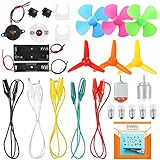
- COMPLETE CIRCUIT KIT: Comes with one instructions, 5 x crocodile clip leads, 5 x bulbs, 2 x motors, 2 x motor holder, 2 x rocker switches, 3 x propeller with 3 Vanes, 3 x propeller with 4 Vanes, 1 x buzzer sounder, 1 x bulb holders, AA size battery holder (1 x 1.5V), AA size battery holder (2 x 1.5V), packaged with enough circuit accessories for you do science project easily
- SCIENCE EXPERIMENT KIT: This popular and interesting electronic science experiment STEM toys can well inspire and encourage kids learning about science. This Montessori learning toy is good for curious kids, turning your own new ideas and inventions into reality. Also perfect for Children's school science STEM engineering projects, Ideal back to school gift for curious minds
- WIDE APPLICATIONS: The circuit motor kit can well catch kids attention and let the them try to build, experiment and explore basic electrical simple circuits. It can also be used in school in science, STEM, technology and design courses, easy to meet your project needs, properly educating some circuit knowledge would be a good interaction time with your kids together
- NOTICE: It is recommended that the voltage be 1.5V-3V. If the voltage is 3V, please control the time. The use time should not be too long, and the time should be controlled within 3 minutes. After 5-10 minutes, the circuit will generate heat and a short circuit.
- WARNING: Suitable for 8+ years. CHOKING HAZARD—Small parts, not for children under 3 years. Be careful of scald caused by short circuit. Do not mix old and new batteries. Do not mix alkaline, standard (carbon-zinc), or rechargeable batteries, the kids must use under the supervision of adults
Why isn’t a resistance drop enough to prove superconductivity?
A resistance decrease is evidence of a change in electrical behavior, but it is not uniquely diagnostic of superconductivity. In tiny samples under extreme pressure, sample heterogeneity and alternative electrical explanations can complicate interpretation. Magnetic measurements can also be difficult to interpret when the sample signal is small relative to backgrounds from the surrounding apparatus.
These issues are particularly prominent in high-pressure hydride experiments, where diamond-anvil assemblies contain components that can contribute background signals. A 2022 Science report on the retraction of a room-temperature superconductivity study describes these measurement challenges and notes that resistance alone is not considered sufficient evidence. It identifies magnetic-field expulsion when a material crosses its critical temperature as an important independent signature (Science, 2022).
Crashes, No Sound, or Screen Glitches?
Random freezes, missing sound and display glitches usually trace back to one bad driver. Find and replace yours safely.Free scan · under a minuteWindows Errors? Fix Them Before They Spread
Repair common Windows errors and clear accumulated junk for a smoother, more stable PC - no reinstall needed.Free scan · no reinstallBest Value

- Learn basic Electricity and Magnetism experiments through full-color manuals, understand the basic principles, and help Students learn, think and explore.
- The basic Electricity and Magnetism experiments kit includes everything that you need to get started,provides a hands-on opportunity for students in grades 9-11 to build simple electrical and magnetic models
- Includes 56 items for Electricity,21 items for Magnetism,2 pcs repair tool,Color page manual,All in the storage bag.(Notice:Batteries Not Included.Need 3 AA Batteries to work.)
- This Electricity and Magnetism Experiment STEM kit can build many projects::Series Circuits,Parallel Circuits,Fruit Battery,Measure unknown resistor with Ohm's law,Oersted Experiment,Electromagnet,Amper's Force Investigation,Electric Bell Making and Hand Crank Generator
- Please feel free to contact us if you have new ideas for EUDAX Product, we will provide Best After-sales service
The appropriate conclusion depends on the full body of evidence. A disputed signal is not automatically false; it may be real but have another cause, or it may be one part of a case that needs corroboration. Nor should challenges in diamond-anvil measurements be generalized to every superconductivity experiment.
Independent reader supportYour contribution helps us test, update, and keep practical guides available for everyone.What should you compare when reading conflicting results?
| What to compare | Why it matters | What to look for |
|---|---|---|
| Sample identity | Nominally identical materials can differ in phase content or uniformity. | Composition, preparation, phase characterization, defects, dimensions, and evidence of spatial variation. |
| Mechanical and pressure conditions | Stress and uneven compression can shift or broaden a measured transition. | Applied pressure, pressure medium, loading method, and how pressure at the sample was determined. |
| Temperature and magnetic-field conditions | The sample’s actual conditions may differ from instrument settings. | Calibration and thermometer location, field magnitude and orientation, and cooling or warming path. |
| Measurement method | Different probes detect different signatures and have different potential biases. | Electrical, magnetic, heat-capacity, or other measurements; contact geometry; and measuring current. |
| Transition definition and data handling | Different criteria can yield different reported numbers from related data. | Onset, midpoint, zero resistance, field or current criterion, background subtraction, and any extrapolation. |
| Corroboration and reporting | Independent assessment is difficult without enough detail to evaluate the result. | Controls, uncertainty, apparatus background, raw data, analysis choices, and independent replication. |
How does reporting affect reproducibility?
A replication can differ because the original result was incorrect, because the samples or conditions were different, because a crucial procedural detail was omitted, or because the measured effect is fragile. Without adequate reporting, readers may not be able to distinguish among these explanations.
A useful paper gives enough detail to evaluate or repeat the work: sample preparation and characterization, instrument configuration and calibration, experimental sequence, transition criteria, uncertainty, data exclusions, and background treatment. Access to primary data and analysis also helps others assess reproducibility, as emphasized in the 2026 Report on Reproducibility in Condensed Matter Physics (NIST / Physical Review B, 2026).
Quick Recap
How to judge a disagreement fairly
- Compare the samples and conditions before comparing the headline values.
- Check exactly how each group defined the transition or critical value.
- Ask whether the signal has plausible alternative explanations or apparatus backgrounds.
- Look for independent signatures and sufficient data to evaluate the analysis.
- Keep separate the evidence for superconductivity, the measured transition or critical values, and any proposed mechanism; confidence in one does not automatically establish the others.
Product prices and availability are accurate as of the date/time indicated and are subject to change. Any price and availability information displayed on Amazon at the time of purchase will apply.
Recommended Free Tools

