
If your USB-C hub’s HDMI port shows no picture, first confirm that the computer’s exact USB-C port supports video output. USB-C describes the connector, not what it can do: a hub that converts DisplayPort video from USB-C to HDMI cannot create a signal if the host port is data-only or charging-only. Then check the hub connection, cable, monitor input, and display settings in that order.
Why a USB-C hub’s HDMI port may not work
The most important compatibility check is the computer’s USB-C port. Many hubs receive video through DisplayPort Alternate Mode (Alt Mode) or a compatible Thunderbolt connection, then convert that signal to HDMI. If the host port does not support the display mode required by the hub, its HDMI socket cannot output video—even if the port charges the computer or the hub’s USB ports work.
Look up the specifications for your exact computer model and port. A symbol beside the connector, such as a lightning bolt or DisplayPort icon, can be a clue, but the manufacturer’s specifications are stronger confirmation. Microsoft advises checking that the PC, display, and cable support a compatible display mode and connecting the device directly; HP likewise requires DisplayPort Alt Mode for its Universal USB-C Multiport Hub. Microsoft’s USB-C troubleshooting guidance and HP’s hub requirements explain these compatibility checks.
Other common causes include an intermediate dock or adapter, a USB-C cable that does not carry video, a monitor set to the wrong HDMI input, a bad HDMI cable, or a resolution and refresh rate beyond the hub’s limits. The right diagnosis depends on the exact computer, hub, cables, display, and operating system.
#1 Best Overall

- 5 in 1 Connectivity: The USB C Multiport Adapter is equipped with a 4K HDMI port, a 100W USB C PD port, a 5 Gbps USB A data port, and two 480 Mbps USB A ports
How to troubleshoot the HDMI connection
- Verify the host port’s video support. Search the computer maker’s specifications for the exact model and confirm that the port supports the mode required by the hub, such as DisplayPort Alt Mode or a compatible Thunderbolt/USB4 display path. Do not infer video support from the USB-C shape, charging, or other hub functions. If the specifications are unclear, ask the computer maker.
- Connect the hub directly. For troubleshooting, plug it into the computer rather than routing it through another hub, dock, extension, or adapter. This removes intermediate devices from the signal path.
- Use the hub’s supplied host cable. Some USB-C cables support charging or basic data but not the video signal the hub needs. Begin with the cable included with the hub and follow its manual for any replacement cable requirements; matching connector shapes alone is not enough.
- Check the monitor’s power and input. Turn the display on and select the HDMI input used by the cable, such as HDMI 1 or HDMI 2. Monitors do not always switch to a newly connected input automatically.
- Simplify the HDMI connection. Connect the hub to the monitor with one direct HDMI cable. Remove splitters, converters, or adapters while testing. If possible, try a known-good HDMI cable or another display to distinguish a display-side problem from a host or hub issue.
- Check resolution, refresh rate, and display count. If the setup is near the hub’s supported limits—especially with multiple displays—try a lower resolution or refresh rate. Check the specifications for your exact hub model and revision, as well as the computer’s supported display configuration. For example, Plugable lists the original USBC-7IN1 at up to 3840 × 2160 at 30 Hz; its revised version can reach 60 Hz with a compatible DisplayPort 1.4 Alt Mode host. Those figures apply to that product, not USB-C hubs generally. See Plugable’s USBC-7IN1 specifications and revision notes.
- Power-cycle the display path. Disconnect the hub from the computer and, if it has a power supply, disconnect that too. Follow the hub’s own reset instructions before reconnecting. For its UD-CA1A, Plugable specifies waiting 30 seconds before reconnecting power and the host cable; that timing is model-specific. See Plugable’s HDMI troubleshooting steps.
- Check operating-system display settings. On a Mac, open System Settings > Displays to see whether the monitor is detected and adjust supported resolution or refresh rate. The number of external displays a Mac supports depends on its exact model and the connected displays’ settings; check Apple’s guidance for connecting a display to a Mac. On Windows, use the steps for the specific USB-C or display error and device. A chipset-driver step may be relevant to certain device-specific problems, but a driver cannot add a video mode the computer’s port does not support. ASUS provides model-specific USB-C troubleshooting guidance.
- Isolate a possible hardware fault. If possible, test the same hub, host cable, HDMI cable, and display with a computer known to support the hub’s video mode. If the setup works there but not on the original computer, investigate that computer’s port or configuration. If the hub’s video fails across compatible computers and displays, the hub or its power source may be at fault. Contact the relevant manufacturer if the checks do not identify the cause.
What to check before replacing the hub
Try the simple swaps first: confirm host compatibility, connect directly, use the supplied host cable, select the correct monitor input, and test a known-good HDMI cable or display. A USB-C-to-HDMI adapter is an alternative connection for a compatible computer, not a workaround for a port that lacks video output. Apple notes that its USB-C/Thunderbolt display adapters must comply with DisplayPort Alt Mode or supported Thunderbolt standards; check the adapter and computer requirements before choosing one. Apple’s adapter guidance describes the supported connection path.
If you do replace a hub or adapter, compare the required host video mode, supported resolution and refresh rate for your computer and number of displays, whether external power or software is needed, and the included cable and manufacturer support. Port count by itself does not establish video compatibility.
Quick Recap
Best Value

- Sleek 7-in-1 USB-C Hub: Features an HDMI port, two USB-A 3.0 ports, and a USB-C data port, each providing 5Gbps transfer speeds. It also includes a USB-C PD input port for charging up to 100W and dual SD and TF card slots, all in a compact design.
- Flawless 4K@60Hz Video with HDMI: Delivers exceptional clarity and smoothness with its 4K@60Hz HDMI port, making it ideal for high-definition presentations and entertainment. (Note: Only the HDMI port supports video projection; the USB-C port is for data transfer only.)
- Double Up on Efficiency: The two USB-A 3.0 ports and a USB-C port support a fast 5Gbps data rate, significantly boosting your transfer speeds and improving productivity.
- Fast and Reliable 85W Charging: Offers high-capacity, speedy charging for laptops up to 85W, so you spend less time tethered to an outlet and more time being productive.
- What You Get: Anker USB-C Hub (7-in-1), welcome guide, 18-month warranty, and our friendly customer service.
Rank #4
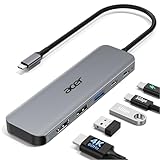
- 【5-in-1 Ultimate Productivity HUB】Expand your USB-C port into a high-performance workstation. This usb c hub multiport adapter integrates 4K@60Hz HDMI, 100W PD, USB-C 3.0 (5Gbps), USB-A 3.0/2.0. Perfect for keeping your desk organized and eliminating clutter from multiple dongles.
- 【True 4K@60Hz Visual Feast】Stop settling for blurry 30Hz displays. This USB-C to HDMI adapter supports 4K@60Hz, delivering 2X the smoothness of standard hubs. Ideal for pro video editing, high-stakes presentations, or immersive 4K streaming without motion blur.
- 【100W Pass-Through Fast Charging】Equipped with a high-speed PD 3.0 chip, this usb c to usb adapter supports up to 100W input and provides a stable 90W output to your laptop. Stay powered up during intensive tasks like 3D rendering or long meetings—say goodbye to low-battery anxiety once and for all. 📌Note: For optimal 90W charging, a 100W power adapter and cable are recommended (not included).
- 【Hyper-Speed 5Gbps Data Transfers】Move massive files in seconds! Featuring both USB-C and USB-A 3.0 ports (5Gbps), this usb c hub for laptop is 10X faster than USB 2.0. The additional USB 2.0 port is optimized for wireless mice and keyboards, ensuring a stable connection with zero interference.
- 【Superior Cooling & Ultra-Portable Design】Built with a durable aluminum shell, this docking station improves heat dissipation for reliable use. Its ultra-slim, lightweight design slips easily into your bag—perfect for travel, office, or remote work essentials.
Rank #3

- 5-in-1 Connectivity: Equipped with a 4K HDMI port, a 5 Gbps USB-C data port, two 5 Gbps USB-A ports, and a USB C 100W PD-IN port. Note: The USB C 100W PD-IN port supports only charging and does not support data transfer devices such as headphones or speakers.
- Powerful Pass-Through Charging: Supports up to 85W pass-through charging so you can power up your laptop while you use the hub. Note: Pass-through charging requires a charger (not included). Note: To achieve full power for iPad, we recommend using a 45W wall charger.
- Transfer Files in Seconds: Move files to and from your laptop at speeds of up to 5 Gbps via the USB-C and USB-A data ports. Note: The USB C 5Gbps Data port does not support video output.
- HD Display: Connect to the HDMI port to stream or mirror content to an external monitor in resolutions of up to 4K@30Hz. Note: The USB-C ports do not support video output.
- What You Get: Anker 332 USB-C Hub (5-in-1), welcome guide, our worry-free 18-month warranty, and friendly customer service.
Rank #2

- 7-in-1 USB C Hub: USB C to HDMI Adapter equipped with 1*4K@60Hz HDMI port, 2*USB 3.0 ports, 1*USB C Data port, 1*100W PD, microSD/SD card reader slot, Works well with most USB-C devices, like MacBook Pro, MacBook Air, MacBook M1, M2, iMac, iPad Pro, iPhone 15 Pro/Pro Max, Dell XPS Surface, HP and other USB-C port devices
- Enjoy Crystal-Clear 4K@60Hz Video: MacBook Pro Adapter mirrors or extend your screen with USB C hub’s HDMI port and directly stream 4K UHD @60Hz video to HDTV, monitor or projector to see all in sharp and glorious detail, perfect for photographer and video editor
- Super Speed USB 3.0 Ports: USB C Hub Multiport Adapters allow you to connect keyboard, mouse, hard drive, etc to MacBook Pro, up to 5Gbps data transmission speed, down compatible with USB A 2.0 and below. Because HDD/SSD needs more power, so it only allows connect 1 HDD/SSD and this adapter won't support Apple USB super drive
- USB C Data & 100W PD: Mac HDMI Adapter comes with 2*USB C port which easily fulfills your multiple needs, the USB C data port enables you to connect multiple USB C devices to your devices and quickly transfer files, such as hard drives, flash drives, mice, etc. Another PD port supports 100W power in; Power out (charging) is limited to 87W for safety, continuously charging your laptop while using
- Convenient microSD/SD Card Reader: USB C Adapter for MacBook only needs a few seconds to complete the reading speed, super fast to upload and download your data; Convenient USB-C adapter to access files from microSD/SD card reader and perfect for photographer or designer, etc
Product prices and availability are accurate as of the date/time indicated and are subject to change. Any price and availability information displayed on Amazon at the time of purchase will apply.
Independent reader supportYour contribution helps us test, update, and keep practical guides available for everyone.
