
Recommended Free Tools
Bringing back an extinct species could harm living wildlife or disrupt ecosystems, but damage is not inevitable. The risks depend on the organism, the release site and whether the animal is a close ecological match for the extinct species. A de-extinction candidate is generally a proxy—an organism designed to resemble an extinct species—not an exact restoration of it. IUCN guidance treats any environmental release as a conservation translocation that needs a clear expected benefit, advance risk assessment, community involvement, monitoring and a plan to stop or reverse the release if necessary.
What “bringing back” an extinct species means
In conservation, de-extinction usually means creating a proxy organism that resembles an extinct species. A proxy may differ from its historical counterpart in its behavior, reproduction and ecological interactions. Its genetic and epigenetic traits, rearing conditions and responses to the living environment can all affect how it behaves after release. IUCN’s 2016 guiding principles for creating proxies of extinct species recommend assessing those uncertainties rather than assuming the proxy will perform the same ecological role as the original.
Releasing a proxy is not just a laboratory achievement: it is a conservation translocation, intended to establish a population in suitable habitat for an ecosystem benefit. That intention does not guarantee a benefit. The IUCN guidelines for reintroductions and other conservation translocations provide a framework for evaluating the rationale, risks, design and implementation of such releases.
What ecological risks could a release create?
Unexpected effects on wildlife and ecosystem functions
A proxy could affect other species or ecosystem functions in ways decision-makers did not predict. Interactions are especially hard to forecast in ecosystems that have changed since the extinction. An extant ecological substitute may be more predictable because its biology and effects are better understood.
Outdated Drivers Are Slowing You Down
One free scan finds every outdated or missing driver and matches the right update for your exact hardware.Free scan · exact hardware matchPC Slower Than It Used to Be?
A free scan shows the junk files, broken settings and background clutter dragging Windows down - then fixes them in one click.Free scan · Windows 10 & 11#1 Best Overall

- Resin Cast Replica
- 5.5 inches
Invasive or pest behavior
A released population might establish, spread or cause damage. Whether that happens depends on the species and release conditions; it is a risk to assess, not an automatic outcome of de-extinction. Candidate assessments should consider the potential for spread, possible damage, whether the population could be controlled and whether the release could be reversed if its effects become unacceptable.
Invasive species are a broad conservation concern, but general figures should not be mistaken for predictions about de-extinction. IUCN reports that biological invasions cost a minimum of USD 1.288 trillion worldwide over 1970–2017, attributing that figure to Diagne et al. (2021). It also reported in 2022 that invasive alien species threaten 1 in 10 species on the IUCN Red List. Neither figure estimates the likelihood or cost of a de-extinction release becoming invasive. See IUCN’s overview of invasive alien species.
Rank #2
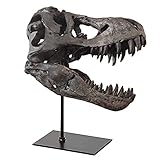
- 【Home Office Desktop Shelf Decor 】Dinosaur head sculptures skull model is hand cast from high-quality solid resin. The surface is made of antique craftsmanship, and the convincing colours and details make it look very realistic and eye-catching. Add some aesthetic to your room
- 【Supplement Your Collection】T-Rex is one of the most popular dinosaurs in the world. For dinosaur lovers or palaeontology lovers, the tyrannosaurus rex skull is a fantastic replica. It will also be a fun teaching tool for any child or teen
- 【Home Decor and Conversation Starter】A lifelike dinosaur skeleton decor. This impressive sculpture looks great on a table or bookshelf. It will be a great conversation starter and conversation piece for any family
- 【Suitable for Many Occasions】This Tyrannosaurus Rex skull replica comes with a metal base. There are 4 non-slip pads on the bottom of the stand to protect the surface of your furniture. It can be placed on various occasions such as office, hallway, TV cabinet, wine rack, living room, etc
- 【Perfect Christmas/Birthday Gift】10.2x 5.9x 11.8 inches.It only takes 2 minutes to complete the installation.Give it as a gift to children, adults, husbands, and friends, no one will refuse it
Disease and biosecurity
No translocated organism should be assumed to be entirely free of microorganisms or parasites. Disease planning should consider both the likelihood that a pathogen is present and the severity of its possible consequences. This assessment should begin before release planning is complete, not only after a problem appears.
Hybridization with living relatives
A proxy might breed with a closely related living species or subspecies. The resulting gene flow could affect fitness, genetic integrity or ecological traits. How serious that possibility is depends on the proxy’s relationships to living populations and on the conditions at the proposed release site.
Rank #3

- Utahraptor was a large theropod dinosaur that lived during the Early Cretaceous period, known for its sharp claws and hunting abilities
- This replica is based on a real Utahraptor fossil discovered in Utah, accurately capturing the shape and detail of the original claw
- The Utahraptor’s curved claw was used for gripping and slashing, making it a key tool for hunting prey
- Cast in durable resin, this 5.5-inch replica offers museum-quality detail and texture
- Made in the USA, this fossil reproduction is perfect for collectors, educators, and dinosaur enthusiasts
Habitat mismatch and environmental change
A candidate may lack suitable food, habitat or ecological partners at a proposed site. For species extinct long ago, present-day conditions may differ substantially from those in which the extinct species lived. Assessments should account for long-term change, including climate change, rather than relying only on a site’s current suitability.
Release failure and re-extinction
A new population could die out because of habitat mismatch, unfamiliar pathogens, unexpected interactions with other species, conflict with people, missing or abnormal behavior, or physiological impairments. In that case, substantial intervention may still end with the proxy population disappearing.
Rank #4

- IT FROM XUQCAH MATERIAL AND FOIMOJSK PAR ENT AND Thurder LOVER
- Museum Quality Replica
- Please thoroughly read discription
Impacts on people that undermine conservation
Ecological effects can have direct consequences for people, including disease, livestock predation, crop damage, effects on harvested species, changes to ecosystem services and harm to cultural values. These impacts can generate conflict or opposition that makes a release harder to sustain. IUCN’s 2021 rewilding risks brief emphasizes community impacts, engagement, adaptive management and monitoring.
Independent reader supportYour contribution helps us test, update, and keep practical guides available for everyone.How to judge a proposed release
IUCN’s starting point is that creating and releasing a proxy is not conservation-neutral: even an ideal scenario carries costs and risks. Its 2016 principles call for an advance justification based on an expected positive conservation benefit, such as increased ecosystem stability or resilience, or reduced losses in other species. The principles state: “There should be a priori positive justification for engaging in proxy species creation based on the expectation of a positive conservation benefit, i.e. increasing ecosystem stability and resilience, and/or reducing losses in other species.”
That expected benefit should be tested against realistic alternatives, including a living ecological substitute and no release. A substitute may achieve the conservation goal more easily, quickly, predictably or with less cost and risk. The proxy should be justified by its expected ecological contribution, not by the fact that it resembles an extinct animal.
| Decision question | What to evaluate |
|---|---|
| Would it help conservation? | Expected effects on biodiversity, ecosystem stability or resilience, and losses in other species. |
| Would it fit this ecosystem? | Habitat suitability, ecological role, likely behavior and uncertainty about interactions. |
| Could harm be contained? | Disease, invasion and hybridization risks; whether the population can be controlled or the release reversed. |
| Is it preferable to alternatives? | Whether a living substitute could achieve the goal sooner or with less cost, uncertainty or risk. |
| Can people and institutions support it? | Potential conflict and livelihood or cultural effects, consent, and the capacity to monitor and respond. |
What responsible preparation should include
- Define the conservation goal. State the expected benefit in advance and compare the proxy with a living ecological substitute and with no release.
- Assess the candidate and the site. Evaluate predicted population performance, behavior, ecological role, habitat needs, invasive potential, generation time, human-wildlife conflict and the feasibility of controlling or reversing a release. Consider long-term environmental change, including climate change.
- Investigate uncertainty before release. Use captive populations where they can provide useful information about behavior, performance and potential impacts. Conduct an in-depth risk assessment that considers both the likelihood and consequences of harm.
- Involve affected people early. IUCN calls for prior informed consent from local communities and particular effort to obtain prior approvals from Indigenous peoples. Their concerns, livelihoods and cultural values should inform the decision, not be addressed only after a release is proposed.
- Set up monitoring and a response plan. Decide what outcomes to monitor, how to detect unacceptable effects and what actions—including stopping or reversing the release—would follow. Monitoring needs to continue after release so managers can respond to actual outcomes.
IUCN’s principles offer guidance, not a substitute for the laws and permits that apply at a specific release site.
Quick Recap
Product prices and availability are accurate as of the date/time indicated and are subject to change. Any price and availability information displayed on Amazon at the time of purchase will apply.

