
The Tool Desk
Outbyte PC Repair FREEClear out junk files and repair common Windows errorsFree Scan →Outbyte Driver Updater FREEScan for outdated or missing drivers - takes under a minuteDriver Scan →Marvell announced OCTEON 10 on June 28, 2021, as a DPU family for networking, security and storage workloads. Its key architectural change was integrating Arm Neoverse N2 CPU cores with programmable packet processing and hardware acceleration—not dropping the OCTEON name. “Ditching Cavium” is therefore an imprecise shorthand for the shift in CPU architecture, not the end of the product family.
What Marvell announced
Marvell positioned OCTEON 10 for 5G, cloud, carrier and enterprise infrastructure, where a processor may handle networking and security tasks alongside general-purpose compute. The company highlighted a TSMC 5nm process, Neoverse N2 cores, inline AI/ML acceleration, an integrated 1-terabit switch and vector packet processing (VPP) accelerators.



The name needs a little care: OCTEON 10 is the product family; Neoverse N2 is the CPU core architecture it uses. Marvell’s launch announcement describes that combination. It does not say that the OCTEON product name was abandoned, nor does it identify “Cavium” as a CPU architecture being replaced.
How the architecture fits together
The OCTEON 10 design pairs Arm CPU cores with specialized blocks intended to offload infrastructure work. That can let a system handle packet processing, encryption, switching or data movement in hardware rather than relying only on general-purpose software execution. The exact interfaces and acceleration capacity depend on the selected model.
#1 Best Overall
CPU, memory and I/O
Marvell’s product brief lists 64-bit Neoverse N2 cores, with family configurations ranging from 8 to 24 cores and clock rates up to 2.7 GHz. It specifies up to 24 MB of L2 cache and 48 MB of L3 cache, and DDR5 support of up to six channels at 5600 MT/s. These are family-level maximums, not a promise that every SKU has the maximum configuration.
The same brief lists PCIe 5.0 and up to 56G SerDes lanes across the family, but interface capability varies by model; for example, it lists PCIe 3.0 for CN102XX and PCIe 5.0 for CN103XX and the listed CN106 variants. Check the exact SKU when evaluating compatibility, lane counts or system bandwidth.
Rank #2
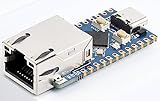
- 【RP2040-ETH Module】 Based On RP2040, Onboard Ethernet Port,Dual-core Arm Cortex M0+ processor, flexible clock running up to 133 MHz 264KB of SRAM, and 4MB of onboard Flash memory.
- Onboard CH9120 with integrated TCP/IP protocol stack. 14 × multi-function GPIO pins, compatible with some Pico HATs.
- Castellated module allows soldering direct to carrier boards. Drag-and-drop programming using mass storage over USB. 8 × Programmable I/O (PIO) state machines for custom peripheral support. Controllable via network.
- Support multiple communication modes: Supports TCP Server / TCP Client / UDP Server / UDP
- Support C/C++, MicroPython, Arduino: Comprehensive SDK, Dev Resources, Tutorials To Help You Easily Get Started
Acceleration and software
Marvell lists an AI/ML engine, VPP accelerator, integrated switch, inline cryptography, programmable packet processors, PCIe DMA acceleration and secure boot. Its launch announcement also describes support for networking, security and storage software stacks, DPDK/VPP extensions, virtualization and containers. The product brief lists SDK support for standard toolchains, DPDK, VPP and SPDK. These capabilities describe the platform; they do not establish that all models expose identical resources.
What the performance numbers do—and do not—show
Marvell’s 2021 launch claim was “3x performance and 50 percent lower power” versus previous OCTEON generations. The product brief identifies the compute comparison as SPECint per core per GHz. These are Marvell’s comparative claims, not independent measurements of every application or deployed system.
Free tools Windows power users keep installed
One-click scans. No signup required.
In its December 2023 CN102/CN103 announcement, Marvell reported a SPECint 2017 score of 36.5 and nearly 1.5 SPECint points per watt, attributing the benchmark result to Marvell testing. Marvell’s product brief also claims 100x performance gains over software processing for its hardware-based ML engine and up to 5x packet-processing-rate improvement for VPP accelerators. The latter figures are vendor claims with the comparisons described by Marvell; the brief excerpt does not establish them as universal results across workloads.
Which OCTEON 10 model fits which job?
The model names indicate meaningful differences in core count, I/O and power. Marvell’s product brief provides the following family specifications; its figures are not substitutes for checking the complete specification of the exact part number being designed into a system.
| Model family | Core and interface details | Typical power in Marvell’s product brief | Fit and dated availability statement |
|---|---|---|---|
| CN102XX | Up to 8 Neoverse N2 cores; PCIe 3.0 in the brief. Marvell’s December 2023 announcement describes CN102 with 10G SerDes for entry-level equipment. | 10–20 W, as listed in Marvell’s product brief. | Marvell named routers, firewalls, 5G small cells, SD-WAN appliances, top-of-rack switch control planes and line-card controllers as target uses. In December 2023 it said CN102 was sampling, with production quantities planned for Q4 2023. |
| CN103XX | Up to 8 Neoverse N2 cores; PCIe 5.0 in the brief. Marvell’s December 2023 announcement describes CN103 with 56G SerDes for higher throughput. | 10–25 W, as listed in Marvell’s product brief. | Marvell listed the same router, firewall, small-cell, SD-WAN, switch-control-plane and line-card uses. In December 2023 it said CN103 was sampling, with production quantities planned for Q1 2024. |
| CN106XX | Up to 24 Neoverse N2 cores; PCIe 5.0 in the brief. | 40 W, as listed in Marvell’s product brief. | Marvell positions the CN106 family for cloud, enterprise and 5G wireless baseband workloads. |
| CN106XXS | Up to 24 Neoverse N2 cores; PCIe 5.0 in the brief. | 50 W, as listed in Marvell’s product brief. | Part of the CN106 family positioned for cloud, enterprise and 5G wireless baseband workloads. |
The December 2023 sampling and production-quantity dates are historical plans, not confirmation of current stock or lead times. The announcements identify design and pilot-production activity with OEMs; they do not establish a retail channel for these processors.
OCTEON 10 Fusion for radio access networks
OCTEON 10 Fusion is a related branch aimed at 5G baseband and radio-access processing. Marvell describes it as adding programmable DSP cores and Layer 1 acceleration for integrated or virtualized RAN. Its February 2023 announcement named distributed-unit and radio-unit applications, massive MIMO beamforming, conventional and virtualized RAN, and Open RAN; Marvell said Fusion was then in production.
Availability, partners and buying context
Availability statements should be read in their original time context. Marvell said in June 2021 that OCTEON 10 would be available in the second half of that year. Its December 2023 release gave later sampling and planned production-quantity timing for CN102 and CN103. Marvell’s DPU product page continues to describe the OCTEON family and application areas, but the cited materials do not verify current inventory, delivery dates or the status of every variant.
Marvell’s February 2023 Fusion announcement described work with Samsung, Dell, Red Hat, Wind River and VMware around 5G RAN, accelerator hardware, cloud orchestration and platform software. It specifically cited validation of Red Hat OpenShift on an OCTEON 10 Fusion Open RAN accelerator, Dell’s 5G Open RAN accelerator card, Wind River Studio and VMware Telco Cloud Platform RAN. These are Marvell’s ecosystem statements; they do not mean every product from those partners contains OCTEON silicon.
OCTEON 10 is specialized infrastructure silicon for OEM design, not a standard consumer processor or retail add-in card established by the available product materials. A buyer typically needs to evaluate it as part of a router, firewall, server or RAN system, and verify the processor configuration in the specific system rather than assume a partner product uses a particular OCTEON part.
Quick Recap
What to check before an infrastructure design
- Workload: Match the model to packet-processing, security, storage, cloud or RAN requirements rather than choosing by core count alone.
- Interfaces: Verify the precise Ethernet/SerDes and PCIe configuration, including generation and available lanes, for the SKU and system board.
- Memory: Confirm the model’s DDR5 channel and speed configuration; the family maximum is not necessarily present in each variant.
- Power and thermals: Treat the brief’s typical-power figures as model specifications and check the system’s power and cooling design.
- Evidence: Treat performance figures as vendor-published comparisons unless independent results are available for the workload and system under consideration.
- Availability: Ask the OEM or Marvell for current supply and lifecycle information; dated sampling and production plans do not establish today’s lead time.
Product prices and availability are accurate as of the date/time indicated and are subject to change. Any price and availability information displayed on Amazon at the time of purchase will apply.
Quick wins for a faster PC:
Scan for outdated or missing drivers - takes under a minuteDriver Scan →Clear out junk files and repair common Windows errorsFree Scan →Fix the driver behind crashes, sound loss and screen glitchesFind Drivers →
