
AI-ready data centers are not just buildings with newer servers. They need cooling that can handle denser workloads, dependable power, construction that can adapt, and plans for water use and community impact. Nancy Novak and Amy Marks of Compass Datacenters, and Helen Munro of Pulsant Data Centers, describe three parts of that challenge: adapting cooling, expanding capacity beyond London, and making facilities easier to build and change.
What makes a data center AI-ready?
AI workloads can concentrate more heat in each rack than conventional air-cooling designs were built to handle. Nancy Novak, chief innovation officer at Compass Datacenters, said that GPU clusters can exceed 50 kW per rack in many environments and that traditional air cooling is insufficient for the thermal density of these systems. Those are her observations, not universal thresholds: whether a cooling design works depends on the facility, equipment, and workload.
Readiness also reaches beyond the server room. Operators must plan for power availability and utility relationships, cooling water, construction schedules, site location, and local effects. The Data Center Knowledge feature presents these as connected design and operating decisions, rather than a single technology upgrade. Data Center Knowledge profiled the leaders on March 9, 2026; Compass Datacenters published its own account two days later.
How can existing facilities move toward liquid cooling?
Nancy Novak: add liquid cooling in stages
Novak describes a hybrid platform developed with Vertiv, combining existing air systems with options such as direct-to-chip cold plates or row-level liquid distribution. A customer can add liquid cooling as AI workloads grow without removing all existing infrastructure at once. In her words, “It allows a customer to plug into liquid cooling when their AI workloads scale, without ripping out existing infrastructure.”
Do these 3 things before closing this tab:
1Scan for outdated or missing drivers - takes under a minute2Repair Windows errors before they cause bigger problems3Fix the driver behind crashes, sound loss and screen glitches#1 Best Overall

- Condition: 100% Brand New and in Perfect package to ensure you receive a perfect product
- Model: DV4600-492
- Bearing Type: Ball; Fan Diameter: 120mm; Maximum Fan Speed: 2650/3100 RPM; Material: Plastic; Type: Axial cooling fan
- Packaging: Carton; Power Connection: 2-Pin; Voltage: 115VAC
- Fan size: 120*120*38MM
This staged approach can help a facility support mixed workloads and limit the disruption of a wholesale conversion. It is not a universal retrofit recipe: the site still needs engineering for the specific equipment, piping, controls, maintenance access, and operational procedures. The feature notes added complexity, serviceability needs, and staff training as considerations.
What closed-loop cooling can—and cannot—tell you about water
Novak also describes a closed-loop approach intended to avoid water consumption for IT cooling in normal operations. That claim concerns IT cooling in the described design, not every use of water across a data center. It should not be read as proof that every closed-loop installation uses no water, or as a site-wide water result independently measured by the feature.
Rank #2

- APPLICATION: USB computer fans cool off gaming systems, routers, amplifiers, and receivers. 120mm case fan keep entertainment centers' stereos and cables cool and help with air flow in various spaces
- PLAY AND PLUG: Just plug this server fan into any USB source—like a charger, power bank, phone adapter, game console, or USB outlet. It's a breeze to use
- PACKAGE INCLUDING: This usb cooling fan set comes with two USB fans, one USB cable to control two fans (high speed medium speed low speed), and a metal shield to protect your hands. Easy to use, safe and reliable
- Variable Speed Fan: It has a variable-speed controller so you can adjust the pc fan for the best mix of quiet operation and airflow
- Specification: 120 x 120x 25 mm ( 4.72 x 4.72 x 0.98 in. ) | Rated Voltage : 5V | Rated Current: 0.25A | Airflow: 77 x 2 CFM | Noise: 32dBA | Speed: 2000 RPM (MAX)
Why is Pulsant expanding high-density capacity outside London?
Helen Munro: build for regional demand
Helen Munro, head of environment and sustainability at Pulsant Data Centers, points to the Milton Keynes (Linford Wood) expansion as an example of high-density capacity intended for AI, machine learning, and accelerated computing. She says the investment is aimed at key UK technology regions and demand for high-performance infrastructure outside London. The feature also notes that existing UK digital infrastructure can be adapted to meet a significant portion of AI demand.
Locating capacity outside a major hub may support regional technology ecosystems and make use of available grid capacity, but those benefits depend on the particular project. Operators must account for latency requirements, grid connections, planning permission, and whether local communities accept the development. The feature says Pulsant is deploying closed-loop cooling at Linford Wood, but does not give site-level water or other performance metrics; Munro said detailed metrics would appear in later sustainability reporting.
Recommended Free Tools
Rank #3

- An ultra-quiet UL-certified fan system designed for cooling cabinets that requires minimal noise.
- Features a multi-speed controller to set the fan’s speed to optimal noise and airflow levels.
- Contains a CNC machined aluminum frame with a modern brushed black finish.
- Powered by wall outlet or USB port, included Turbo Adapter increases performance by 25%.
- Dimensions: 8.5 x 4.4 x 1.3 in. | Total Airflow: 52 CFM | Total Noise: 18 dBa | Bearings: Dual Ball
How can prefabrication make facilities more adaptable?
Amy Marks: standardize assemblies, not the workload
Amy Marks, senior vice president of innovation and sustainability at Compass, focuses on facilities that can change as computing needs evolve. The feature describes factory-based, standardized construction using prefabricated multi-trade pipe racks, water skids, treatment systems, and rack-level cooling modules. These assemblies can make parts of a project more repeatable and reduce the work carried out on site, while allowing cooling arrangements to change as customer requirements shift.
Marks says this approach can help customers switch from air to liquid cooling as they deploy AI workloads or their IT environments evolve. Prefabrication does not eliminate the need to tailor a facility to its site, and reliance on particular vendors and systems remains a consideration.
Rank #4
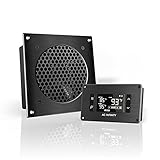
- An ultra quiet UL-certified fan system designed for cooling cabinets that requires minimal noise.
- Features an on board processor that provides a digital read-out of the cabinets temperatures.
- Programming includes thermostat control, fan speed control, and SMART energy saving mode.
- Dimensions: 6.3 x 6.3 x 1.3 in. | Airflow: 52 CFM | Noise: 18 dBA | Bearings: Dual Ball
What Compass reports about its construction approach
Data Center Knowledge reports the following figures as Compass claims, not independently verified industry benchmarks:
- More than 80%: Compass said this share of its facilities incorporates prefabricated equipment, assemblies, or precast components. The feature excerpt does not define the facility denominator.
- About 25% less on-site build time: Compass reported this comparison for its approach; the feature does not provide independent measurement details.
- Roughly 18% lower embodied carbon: Compass reported this against its own baseline methodology, not an industry-wide benchmark.
Why do power and community relationships matter?
AI capacity depends on more than equipment inside a building. Data centers need substantial, reliable power, which makes utility collaboration and grid planning part of facility design. Novak argues that operators should move from passive energy consumption toward active participation in the grid. That is her view in an executive interview, not a regulator or standards-body requirement.
Best Value
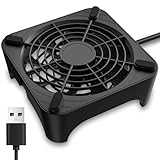
- 【Universal Compatibility】This USB cooling fan works seamlessly with Mini PC, PS5, routers, Apple TV, modems, PlayStation, receivers, Rokus, T-Mobile 5G Home Internet, Xbox Series, and other audio-video electronics. Whether cooling a gaming console, router, or streaming device, it eliminates overheating worries across your digital ecosystem.
- 【Powerful Cooling Performance】Equipped with a 120mm fan boasting 55.8 CFM airflow and 850RPM±10% speed, this USB PC fan delivers rapid cooling—dropping device temperatures by 20% in seconds. The 9-blade design ensures powerful airflow to tackle heat buildup in routers, mini PCs, and gaming consoles, preventing lag and performance drops caused by overheating.
- 【Ultra-Quiet Operation & Scratch-Proof Protection】 Designed for ultra-quiet and scratch-resistant cooling needs, this USB computer fan comes with 4 shock-absorbing pads and operates at just 18dB(A)±10% noise—whisper-quiet, quieter than library silence (30dB) and close to the sound of rustling leaves (20dB). It enables efficient device cooling without noise interference or surface scratches, letting you fully immerse in video, audio, and gaming. It’s perfect for home offices, living rooms, and gaming setups.
- 【USB-Powered & Space-Saving Setup】This USB powered fan features an integrated 530mm (20.87-inch) USB cable, connecting easily to chargers, mobile power banks, or laptops—no extra wires needed. With dimensions of 130mm×130mm×48.6mm (5.12×5.12×1.91 inches), it can be placed flat or upright, making it perfect for narrow spaces while keeping your setup tidy.
- 【Sturdy & Long-Lasting Durability】Made from premium eco-friendly ABS material, this USB fan (with a box fan-like structure) supports heavy-duty use and can withstand weights up to 11LB. With a lifespan of 40000 hours, it offers long-term cooling for your devices, ensuring stable performance and protection against overheating for years to come.
Water, land, energy, and infrastructure effects also shape how a project is received. Novak says the engineering complexity of the described cooling approach helps avoid competing with local communities for water. Marks identifies being a good neighbor as an urgent issue, while Munro says shared values are a pressing concern. These statements frame community relations as an operating responsibility; the feature does not offer a universal measure for determining whether a project meets it.
Quick Recap
What these approaches mean for operators
- For an existing facility: A hybrid air-and-liquid design offers a potential staged path, but requires site-specific engineering and operational preparation.
- For a new regional site: High-density capacity can serve demand beyond a major hub, provided grid, latency, planning, and community conditions align.
- For construction teams: Prefabricated systems can improve repeatability and reduce on-site work, while leaving site adaptation and vendor choices to resolve.
- For sustainability teams: Closed-loop descriptions and company-reported carbon figures need clear boundaries; they do not establish whole-facility performance on their own.
Product prices and availability are accurate as of the date/time indicated and are subject to change. Any price and availability information displayed on Amazon at the time of purchase will apply.

